

Venezuelan expatriates in the United States gathered to celebrate the capture of Maduro. (Video screenshot)
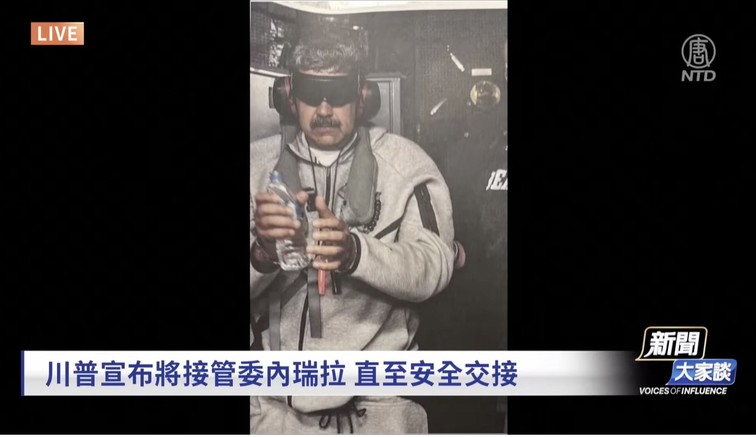
[People News] On the 3rd, U.S. President Trump ordered the launch of a raid codenamed 'Operation Absolute Resolve,' which successfully captured Venezuelan President Maduro and his wife. This operation involved 15,000 soldiers, one aircraft carrier, 11 warships, and dozens of F-35 fighter jets, and it concluded in less than three hours. The operation's speed, precision, and decisiveness shocked the world.
Some netizens in mainland China highlighted a previous statement by military expert Li Li, who had claimed on a program that the U.S. 'dared not act rashly.' Netizens mocked her, saying, 'Whoever she praises will be unlucky,' as she consistently contradicts herself with her predictions.
Li Li is a professor (colonel) at the National Defence University of the Communist Party of China and a special expert on several military programs. A month ago, she boasted on a program about Venezuela's military strength, asserting that the U.S. did not dare to take action against Maduro for a simple reason: Venezuela is not like Syria, nor is it comparable to Gaddafi or Saddam. The main reason the U.S. has refrained from using force against Venezuela is due to concerns, particularly the fear that it has a powerful backer. This is because Venezuela employs the Russian S-300 air defence missile system, and it is reported that the S-400 air defence system is already in place, just waiting to see if Trump will fall into this trap, and so on.
Li Li's comments have drawn criticism from netizens, who have labelled her as "not an expert, but rather a cultural worker." They noted, "Every time she makes a prediction, just interpret it in the opposite way, and it will turn out to be accurate." Some have even expressed support for Li's expert team to rescue Maduro, while others pointed out that this situation highlights the outdated tactical thinking of military experts. Questions have arisen about why Maduro is not panicking, with some suggesting that he simply doesn't have time to panic. It has been advised that discussions should ideally be approached from a professional standpoint; otherwise, they risk becoming a laughingstock. Furthermore, it has been suggested that Maduro might genuinely believe in his position, as he boldly claims to be in the presidential palace and not going anywhere, challenging anyone to come after him.
Li Li has a history of making public predictions that have not materialised, such as her assertion last year that Iran would eliminate Israel within half an hour during the U.S. and Israeli bombings, which ultimately proved to be incorrect.
Media reports indicate that Venezuela has procured 12 JY-27A long-range early warning radars, 18 JYL-1 3D long-range radars, and 12 JY-11B medium and low-altitude search radars from China, thereby establishing an air defence network. This indicates that Venezuela has installed a radar protection system manufactured by Russia and China; however, this system failed to provide any early warning capabilities, leading to a rapid collapse of Venezuela's air defence. Consequently, the U.S. military was able to operate as if in a no-man's land, easily capturing the country's president, Maduro.
According to Wang Zhenming, a military columnist for the Liberty Times, the radar systems produced in China have failed to function as intended, largely due to the intense electronic warfare interference executed by the U.S. military during its operations. The U.S. military's electronic warfare capabilities are unmatched worldwide, with exceptionally strong anti-radiation combat skills that can effectively suppress Venezuela's air defence network, which is not particularly surprising. The U.S. excels not only in hardware but also in software and intelligence, where it remains unrivalled.
In addition to Li Li, Du Wenlong, another military commentator and researcher from China Central Television, has remarked, 'The United States will not send ground troops forward, fearing to get bogged down in the quagmire of the Venezuelan people's war.' Shen Yi, a professor in the Department of International Politics at Fudan University's School of International Relations and Public Affairs, has also analysed multiple times that 'the United States does not dare to take military action against Venezuela,' and that Trump's 'closure of Venezuelan airspace' is merely a bluff.
However, many commentators in Taiwan hold views that starkly contrast with those of the experts nurtured by the Chinese Communist Party.
Taiwanese media figure Zhan Lingyu expressed on the 4th that while the U.S. has delivered a heavy blow to Maduro, it is Xi Jinping, the leader of China, who feels the pain; this incident has completely shattered the scepticism towards the U.S., and Taiwanese people should stop believing the falsehood that 'the U.S. does not care about Taiwan.' Currently, Xi Jinping's 'circle of friends' is being dismantled: the 'southern countries' allies that the Communist Party boasts about are now trembling one by one. Beijing is now in the most awkward position: to intervene, it lacks both the funds and the courage, as it does not dare to confront the U.S. directly; to refrain from intervening, the younger allies will see the older brother's ineffectiveness, leading to a loss of faith.
Media reports indicate that the electronic warfare and precision strike capabilities showcased by the U.S. military have led to a "devastating paralysis" of air defence and ground equipment, including systems manufactured in China, during the initial wave of attacks. The air defence systems were rendered ineffective, while ground heavy equipment, lacking the protection of air superiority, was either destroyed or abandoned without being able to engage in combat. Analysts suggest that this situation underscores the shortcomings of China's weapon systems when confronted with elite adversaries like the U.S. military in a complex electromagnetic environment and high-precision combat scenarios.
Consequently, countries that have placed undue trust in the Chinese Communist Party and invested in Chinese-made air defence systems may now find themselves regretting their choices, expressing their discontent.△





News magazine bootstrap themes!
I like this themes, fast loading and look profesional
Thank you Carlos!
You're welcome!
Please support me with give positive rating!
Yes Sure!