
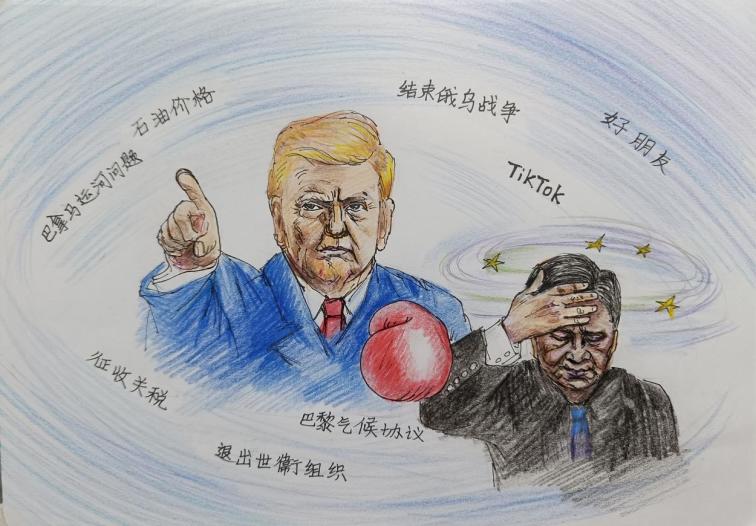
Trump's soft and hard tactics leave the CCP disoriented. (Image by Qing Yu / People News)
[People News] On January 3, 2026, the United States initiated a military operation codenamed 'Absolute Resolve,' successfully capturing Venezuelan President Maduro within just three hours. This highly efficient 'decapitation' operation represents the first successful purge of the Chinese Communist Party's (CCP) agents in Latin America since Trump returned to the White House. It marks a strategic turning point in the U.S. efforts to reshape the geopolitical landscape of Latin America, signifying the severing of the CCP's dark influence and a successful first battle in the U.S. national strategy to restore hegemony and order in the Western Hemisphere.
In contrast, Beijing's response to this event appeared rushed and panicked. The Ministry of Foreign Affairs expressed 'deep shock' and feebly demanded that the U.S. 'immediately release' Maduro. A multitude of domestic and foreign 'fifty-cent' internet commentators were left disheartened and dejected. The overseas 'fifty-cent' commentator Li Yi posted a video, slapping himself in despair: 'Caracas is 3,300 kilometres away from the U.S. capital Washington, yet they still managed to capture him alive. I feel like I am not even human anymore; I am living in this world, but I am not human!'
Ironically, this raid took place just hours after the CCP's special envoy to Latin America, Qiu Xiaoqi, visited Venezuela, serving as a stark slap in the face to Xi Jinping from Trump. The Maduro regime has long been a stronghold for the CCP's operations in Latin America, acting as a vanguard against the U.S. Its downfall not only cuts off an important tentacle of the CCP in Latin America but also reveals Xi Jinping's significant strategic failure in competing with the U.S., signalling the beginning of a systematic collapse of the CCP's global strategy.
Since August 2025, the United States has carried out extensive military deployments in the Caribbean Sea near Venezuela, launching the 'Southern Spear' military operation in November. By mid-December, Trump had classified the Venezuelan government as a 'foreign terrorist organisation' and ordered a blockade on all sanctioned oil tankers entering and leaving Venezuela. Trump has consistently asserted that U.S. forces will 'soon' initiate ground operations.
In a twist of irony, the Chinese Communist Party's internal and external propaganda, including prominent figures like Jin Canrong, Chen Xiaoping, Shen Yi, and Li Li, along with party media, have collectively claimed that the U.S. would not dare to take action. They even speculated that if Trump were to intervene, Venezuela would become the next Iraq and Afghanistan for the United States.
However, the outcome was that Trump did take action, and it was executed with remarkable effectiveness and impact! This low-cost, high-efficiency military operation has fundamentally transformed the brutal nature of traditional warfare. There was no need for extensive military expenditure or casualties, and the war's consequences did not affect ordinary citizens at all. The dictators' illusion of using civilians as cannon fodder was completely shattered, and the principle of 'letting the leaders go first' emerged as a key indicator for changing the nature of warfare.
The pressing question is, why did the Xi Jinping administration misjudge Trump and Washington?
Firstly, Xi Jinping's strategic miscalculation has revealed a critical blind spot in his understanding of the international landscape.
Under the slogans of 'East Rising and West Declining' and national rejuvenation, Xi Jinping has exhibited blind confidence, perceiving himself as the architect of the world's leading manufacturing power. After 30 years of strategic restraint, the CCP has effectively dismantled the industrial foundation of the United States, leading to a gradual decline in America's global hegemony.
Following Trump’s re-election, Xi Jinping assessed that his second term would focus more on trade compromises. Trump’s handling of the global threat from the Chinese Communist Party (CCP) has primarily involved economic disputes and diplomatic strategies, with minimal direct military action. For instance, regarding the Panama Canal issue, the United States has not engaged in any significant military operations. Meanwhile, Beijing has developed an overly optimistic view of American domestic politics, mistakenly believing that congressional disagreements and public anti-war sentiments could ultimately limit Trump’s actions. As Trump approaches the midterm elections, large-scale military actions may not be advantageous for his campaign this year. However, Beijing has underestimated Trump’s strong resolve to execute decapitation strikes.
Secondly, the decapitation incident underscores a complete failure of the CCP’s intelligence system.
The CCP’s intelligence apparatus is highly sophisticated, with the Ministry of State Security and military intelligence creating a global surveillance network through satellites, cyber espionage, overseas infiltration, and agent intelligence. However, in this case, Xi Jinping clearly underestimated the extent of American intelligence infiltration in Venezuela, while Beijing’s intelligence gathering on the U.S. military has completely faltered.
The CCP’s intelligence analysis may also be hindered by cognitive biases. Experts within the CCP have long perceived Trump as a transactional politician rather than a hawkish interventionist. Beijing typically bases its judgments about the Trump administration on conventional diplomatic and economic pressures, lacking the analytical insight and capability to grasp Trump’s unconventional methods. In other words, while Xi Jinping recognises the uncertainties surrounding Trump, he does not fully understand their underlying causes.
Conversely, Xi Jinping is increasingly at a disadvantage in the ongoing power struggles within Zhongnanhai, with military authority diminishing. It is possible that the military may selectively report intelligence, resulting in Xi’s oversight of Trump’s intentions for decapitation strikes.
Thirdly, the CCP has placed excessive trust in the Venezuelan military system.
Venezuela and Russia maintain a close relationship with the Chinese Communist Party (CCP), with much of their military equipment and systems being supported by China and Russia behind the scenes. The S-300 long-range air defence missile system, Buk-M2E medium-range missiles, and Tor-M1 short-range missiles, along with Su-30 fighter jets and various helicopters in Venezuela, are sourced from Russia. Prior to Maduro's capture, military expert Li Li from China Central Television confidently asserted that the S-300 air defence system was capable of repelling an attack from the United States.
The military support that the CCP provides to Venezuela includes the JYL-1, JY-11B, and JY-27 radar networks, communication systems, VN-16/VN-18 amphibious assault vehicles, VN-18 infantry fighting vehicles, SR-5 multiple rocket launcher systems, and C-802A anti-ship missiles, among others.
However, these military assets from China and Russia are nearly useless in Venezuela—merely ornamental. The collapse of Venezuela's economy has led to insufficient military investment, logistics and maintenance being unable to keep up, rampant corruption within the military has lowered personnel morale, and there is a complete lack of combat readiness and stagnation in military training. It is simply impossible to counter the integrated and high-tech electronic warfare capabilities of the United States. The U.S. Delta Force successfully captured Maduro, rendering Venezuela's air defence systems, radar, and intelligence systems little more than advanced scrap metal.
Lastly, there is a misjudgment in geopolitical strategic assessment.
There is no doubt that China and Russia have acted as the behind-the-scenes players and strategic supporters of the Maduro regime. As Xi Jinping continues to provoke tensions in the Taiwan Strait and the Chinese Communist Party's military power rises, alongside the Russia-Ukraine war dragging the EU into a prolonged conflict, Maduro, Xi Jinping, and Putin—two major powers and a South American ally—have created a geopolitical illusion, believing that the United States would not dare to take action. Prior to Maduro's troubles, the Chinese Communist Party's media boldly speculated that if Trump were to launch an attack on Venezuela, Beijing would retaliate against Taiwan, leaving Trump unable to manage both fronts. This fantastical strategic thinking led Xi Jinping to mistakenly believe that Trump would retreat in the face of challenges.
Just hours before Maduro's arrest, Qiu Xiaoqi, the Chinese Communist Party's envoy to Latin America, signed over 600 economic agreements with Maduro, with the two sharing laughter and conversation. As these dictators huddled together for support, they developed a false sense of security, convinced that no one would dare to challenge them. Consequently, they were completely blindsided when everything fell apart in an instant.
Perhaps a fundamental reason lies in the fact that Xi Jinping is simply too afraid to confront Trump directly. Trump's statement at the Mar-a-Lago banquet in 2018, 'I just ordered the bombing of Syria,' remains vivid in Xi Jinping's mind. In 2025, Trump used a bunker-buster missile to destroy Iran's underground nuclear facility and seized a ship on the high seas that was transporting weapon materials to Iran for the Chinese Communist Party. Xi Jinping did not dare to respond and could only swallow his frustration.
Who will be Trump's next target?
Will it be Iran, Cuba, or Colombia? Regardless of who it is, Trump's real target is the Chinese Communist Party and the Xi Jinping administration lurking in the background.
The sudden collapse of the Maduro regime highlights the modern implications of Washington's Monroe Doctrine. Trump has made it clear on multiple occasions that he plans to hold each of the 'anti-American axis' countries accountable. The nefarious 'circle of friends' that Beijing has carefully nurtured for years is now facing systematic dismantling. From Caracas to Havana and Tehran, the strategic footholds of the Chinese Communist Party in the Global South are being uprooted one by one.
Xi Jinping is finding his situation increasingly challenging. Domestically, anti-Xi factions are taking the opportunity to undermine him, leading to a gradual decline in his party and military authority. On the international front, Trump's 'America First' policy is taking precedence, strategically cutting ties with the 'old friends' that Beijing has worked hard to support. As a result of this dual pressure from both domestic and international fronts, Xi Jinping's political space is rapidly contracting.
(First published in People News) △







News magazine bootstrap themes!
I like this themes, fast loading and look profesional
Thank you Carlos!
You're welcome!
Please support me with give positive rating!
Yes Sure!