
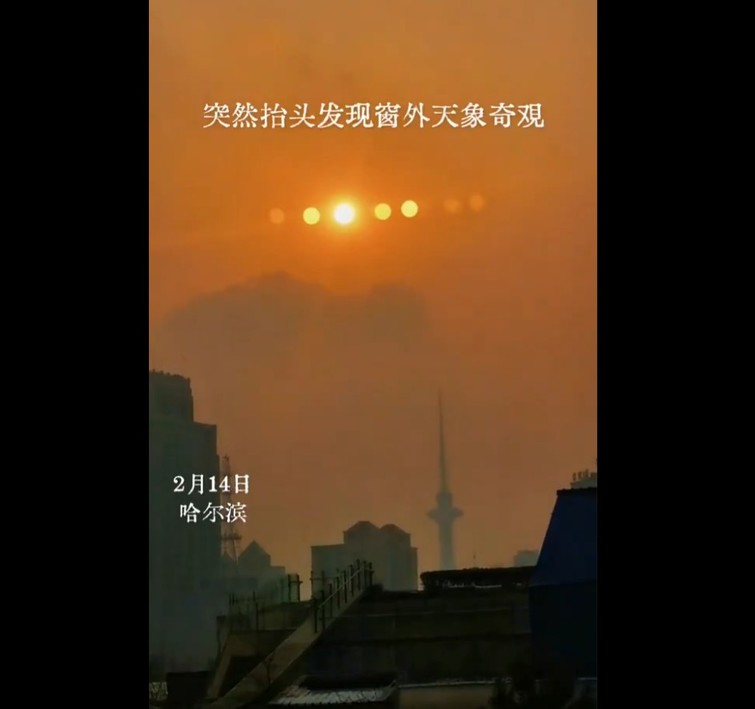
On the afternoon of February 14, a remarkable solar phenomenon was observed in the sky over Harbin. (Video screenshot)
[People News] The year 2026, the Year of the Horse, is set to be extraordinary. Before the fifth day of the first month, high concentrations of dust storms, floating dust, and severe sandstorms have been reported across half of the country. A rare phenomenon known as the 'blue sun,' caused by Mie scattering, has appeared in the skies over Beijing. While scientifically categorised as a meteorological disaster, this phenomenon is regarded as an anomaly within the traditional Chinese belief system of 'heaven and human resonance,' indicating 'heavenly signs of fortune and misfortune.'
According to reports from mainland media, starting February 20, strong cold air from western Inner Mongolia moved southward, bringing fine sand from the Gobi Desert that swept across regions including Xinjiang, Inner Mongolia, Gansu, Ningxia, Shaanxi, Shanxi, and the Beijing-Tianjin-Hebei area. On the afternoon of February 21, the air in Beijing suddenly darkened, visibility dropped to 2-4 kilometres, and PM10 concentrations reached severe to extreme pollution levels. The sun emitted a faint blue light. The Central Meteorological Administration issued yellow warnings for strong winds and sandstorms, activating a Level 4 emergency response.
February 21 marks the fifth day of the first month, an early period of the lunar new year, signifying the beginning of the year, the emergence of yang energy, and the renewal of all things. The occurrence of such a large-scale sandstorm is certainly not a good omen. The 'Book of Han: Treatise on the Five Elements' often notes that 'haze' and 'rain-soil' are associated with major military turmoil, drought, famine, and poor governance. The rise of sand and dust in the first month suggests 'shaky foundations' and 'public discontent.' Particularly, such events occurring at the start of the year in the capital are seen as a dire omen of 'the capital being covered in dust' and 'heaven's anger and people's grievances.' Historically, records of sandstorms and haze during the late Han and late Ming Dynasties, especially in the Chongzhen era, have coincided with internal strife, external threats, and the decline of dynasties.
The "Book of Jin: Treatise on Astronomy" notes, "Whenever the heavens and the earth are obscured like dust, for ten days, five days, or longer, or for a month or a time, rain does not wet the clothes, but dust is present; this is called haze. Thus, it is said that when there is haze in the heavens and the earth, the ruler and the subjects are at odds, leading to severe drought." "When the sun changes colour, armies appear; if the armies are defeated, the lords and kings will perish. If the ruler lacks virtue and the subjects disrupt the state, the sun will be red and without light. When the sun loses its colour, the country it illuminates will not prosper."
Dust storms are most common in spring, particularly from March to May. Over the past 20 years, there have been very few instances of high-concentration dust storms coinciding with the "blue sun" phenomenon before the fifth day of the first lunar month, with almost no precedents. In the early 2000s, dust storms were frequent, and Beijing recorded a high average number of dust storm days, sometimes exceeding 10 days, primarily occurring between March and April, with occasional events in July and August. In 2008, in preparation for the Olympics, the Chinese Communist Party intensified efforts to manage dust and haze in Beijing, leading to a reduction in the average number of dust storm days to about 4 per year. Initiatives such as the "Three-North" shelter forest and the dismantling of non-functional areas in the capital, along with the establishment of heavy pollution industrial zones in the Beijing-Tianjin-Hebei region, significantly alleviated extreme weather phenomena in Beijing.
In recent years, strong dust storms occurred in Beijing on March 15, 2021, and in March-April 2023, accompanied by a yellowish sky and the blue sun phenomenon. However, these events did not take place during the Spring Festival, nor before the fifth day of the first lunar month. The fifth day of the first lunar month, known as "Breaking Five" and the day to welcome the God of Wealth, is traditionally a day for seeking good fortune, making the occurrence of such extreme weather truly rare.
The year 2026 marks the Year of the Fire Horse, a time known for its intense energy and significant changes. This year's lunar new year has already been notable for a series of unusual celestial events. On February 17, the first day of the lunar new year, an annular solar eclipse occurred, primarily visible in the Antarctic region. Following this, on March 3, the fifteenth day of the lunar new year, a total lunar eclipse will be visible across Asia, Europe, and North America. Additionally, on February 28, a rare alignment of six planets—Mercury, Venus, Jupiter, Saturn, Uranus, and Neptune—will create a striking spectacle in the evening sky.
These celestial changes are believed to reflect the dynamics of human affairs, signalling the rise and fall of societies. The first month of the lunar calendar marks the start of the year, and the concentration of these unusual signs is quite rare. The occurrence of both solar and lunar eclipses, along with the planetary alignment, suggests that the heavens are signalling significant events to come on Earth, including shifts in political power, social upheaval, potential wars, natural disasters, technological conflicts, and cultural clashes.
According to traditional beliefs in the unity of heaven and humanity, a solar eclipse is seen as the celestial dog swallowing the sun, which symbolises a disruption of yang energy, a loss of virtue by the ruler, instability in royal authority, and the likelihood of chaos, war, or natural disasters. A solar eclipse occurring in the first month indicates a period of intense turbulence. Meanwhile, a total lunar eclipse suggests potential disturbances in the bureaucratic system outside the imperial authority, indicating chaos within the bureaucratic execution system, civil unrest, disasters, or epidemics. The alignment of multiple planets points to military affairs and the onset of chaotic times, suggesting a transformation in the cycle of heavenly principles.
Over the past 200 years, there have been only three occasions when both solar and lunar eclipses occurred simultaneously in the Chinese region during the first month of the lunar calendar: in 1850, 1962, and 1980. In February 1850, Emperor Daoguang passed away, and in March, Emperor Xianfeng took the throne. By November, the Taiping Heavenly Kingdom was preparing to launch its uprising. In 1962, the Central Committee of the Communist Party of China convened a meeting with 7,000 attendees, where Liu Shaoqi and others reflected on the lessons learned from the 'Great Leap Forward,' admitting that '30% was due to natural disasters and 70% was man-made.' This period saw a challenge to Mao Zedong's authority within the party, which directly led to Mao initiating the Cultural Revolution and purging Liu Shaoqi and others. In October of that year, conflicts erupted along the China-Vietnam border, and the Cuban Missile Crisis also unfolded, marking the peak of U.S.-Soviet nuclear tensions and bringing the world to the brink of nuclear disaster. This year was fraught with danger, as multiple crises both domestically and internationally converged, leading to the Red Horse and Red Sheep calamity in 1966, just four years later. In 1980, the Communist Party of China officially began implementing family planning policies, coinciding with the outbreak of the Iran-Iraq War.
As we enter 2026, we are witnessing a series of extraordinary phenomena, including solar and lunar eclipses, the alignment of multiple stars, severe sandstorms, and a blue sun. These events strongly suggest that significant occurrences are on the horizon for humanity, particularly in China, and that the political and social landscape is poised for major transformations.
Currently, the Chinese Communist Party (CCP) is experiencing significant internal turmoil, particularly following the arrest of Zhang Youxia. While Xi Jinping appears to hold all three branches of power, the situation in Zhongnanhai is in constant flux. Officials are becoming complacent, military morale is waning, and loyalty to the party is fragile. Xi Jinping's extensive purges within the military and government have created an atmosphere of insecurity, leaving many feeling like startled birds. There is widespread resentment towards Xi Jinping; although they may outwardly show submission, internally, they have condemned him countless times. Zhongnanhai has become a place of isolated rulers and chaotic ministers, approaching a critical juncture, reminiscent of the historical moment when Li Zicheng entered Beijing, similar to the day when Emperor Chongzhen hanged himself on Coal Mountain.
The CCP's economy continues to decline, marked by a sluggish real estate market, rising youth unemployment, a deflationary spiral, and widespread suffering among the populace. Local debts are soaring, and the CCP is unable to address these issues. The domestic population can no longer be exploited, prompting the CCP to extend its reach overseas, with reports indicating that 300 Chinese-speaking YouTube bloggers have been targeted by authorities for overseas capture. Public discontent is boiling over, with some resorting to desperate measures; a public account in mainland China has published a modern poem titled 'Kill That Person from Shaanxi,' reflecting a strong desire among the populace to behead Xi Jinping.
Simultaneously, the CCP is facing increasing pressure from the international community. Japan, under the leadership of Prime Minister Koizumi Sanae, is reorganising its military and revitalising its economy, posing a significant challenge to the CCP. Trump's hardline approach towards Iran and the impending disruptive strikes will completely sever the CCP's core strategic foothold in the Middle East, thereby reshaping the global strategic landscape. Even the CCP's old ally, Cuba in South America, is facing the threat of being overwhelmed by the United States.
With ominous signs in the heavens, how can ordinary people avoid risks and calamities? The best strategy is to distance oneself from the CCP by withdrawing from the party, the youth league, and other organisations. A sincere three withdrawals can ensure safety.
(People News first published) △






News magazine bootstrap themes!
I like this themes, fast loading and look profesional
Thank you Carlos!
You're welcome!
Please support me with give positive rating!
Yes Sure!