
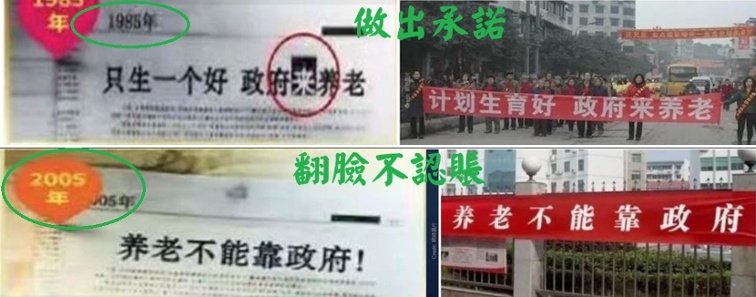
The Chinese Communist Party changes its stance faster than flipping a page. (Image from the internet)
[People News] China’s population structure is undergoing a historic turning point. According to the latest official sample survey data, the proportion of people aged 65 and above in China has, for the first time, exceeded that of those aged 0 to 14, marking the first occurrence since records began in 1949. This shift not only signifies that China has formally entered a deeply ageing society, but has also triggered widespread concern over pension pressures, family eldercare burdens, a shrinking labour force, and the future momentum of China’s economic growth. Some scholars even warn that China is falling into the dilemma of “ageing before getting rich,” with demographic issues potentially evolving into economic and national power challenges.
More Elderly Than Children
According to a report by the South China Morning Post, China’s latest official 1% national population sample survey shows that as of November 2025, among China’s population of approximately 1.4 billion, those aged 65 and above accounted for 15.87%, surpassing the 15.25% share of those aged 0 to 14 for the first time.
China’s National Bureau of Statistics stated that the data comes from a “mini-census” conducted in November 2025, covering more than 20 million people, serving as an important sample survey between two full national censuses.
For many demographers, this marks a historically symbolic turning point.
Independent demographer He Yafu pointed out that this indicates China’s traditional family-based eldercare model is facing unprecedented pressure. He noted that in terms of the pension system, the elderly population has already exceeded the number of children, meaning that the burden on social security retirement funds will continue to grow heavier; at the family level, the increase in elderly people combined with shrinking family sizes means that family caregiving capacity is rapidly declining.
In addition to the increase in elderly people, China’s working-age population is also shrinking.
Data shows that people aged 15 to 59 now account for only 61.89% of the total population, far lower than 67.33% a decade ago. Meanwhile, the average household size in China has decreased from 3.1 people ten years ago to 2.52.
He Yafu believes this is a warning signal. The increase in single-person and two-person households reflects, to some extent, intensifying trends of non-marriage, non-childbearing, and delayed marriage. This implies that China’s “demographic dividend era,” which relied on a large young labour force to drive rapid economic growth, is gradually coming to an end.
Outside View: China’s Demographic Dividend Is Officially Over
Observers generally believe that “more elderly than children” is not just a demographic shift, but a profound economic turning point.
The South China Morning Post analysis points out that China is facing not merely population decline, but a dual pressure of “rapidly increasing elderly population” and “simultaneously shrinking labour force.” In the future, China will face issues such as a declining workforce, rising social welfare costs, and heavier burdens on younger generations.
Many demographers view this as a symbol that “China’s demographic dividend has officially ended.”
Over the past decades, China has relied on its vast and low-cost labour force to rapidly become the “world’s factory,” driving exports, manufacturing, and urbanisation. However, with the reversal of population structure, there are growing concerns that China may gradually lose its low-cost labour advantage.
“Ageing Before Getting Rich” Becomes the Biggest Hidden Concern
Compared with countries like Japan and South Korea, what worries observers more about China is the possibility that it may fall into “ageing before getting rich.”
This term refers to a situation where a country enters an ageing society before reaching the level of a high-income developed economy.
Some demographic and economic scholars point out that Japan and South Korea only gradually aged after achieving higher national income levels and more mature social welfare systems. In contrast, China is currently facing slowing economic growth, prominent youth unemployment, a sluggish real estate market, and tight local government finances, making the ageing problem even more difficult.
The disparity in pension systems further exacerbates the issue.
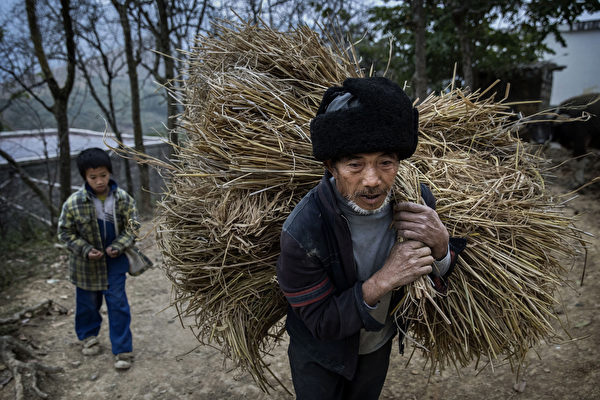
Commentary notes that although China has over 300 million retirees, there are vast differences in pension benefits among different groups: some rural elderly receive only a little over 100 yuan per month, while some retirees within the system receive several thousand yuan or more. Retired high-ranking officials can even receive various subsidies, with monthly income reaching tens of thousands of yuan.
This has led observers to question whether the “silver economy” that Beijing has actively promoted in recent years can truly become a new engine of consumption.
Can the “Silver Economy” Save China?
Facing weak consumer confidence among younger generations and continued economic sluggishness, Beijing has begun to focus on retirees aged 65 and above, hoping to develop a “silver economy” through eldercare, healthcare, tourism, and health products. Since 2025, it has strongly encouraged companies to develop products and services targeting the elderly population.
The official “Silver Economy Blue Book” estimates that China’s silver economy has an annual output value of 7 trillion yuan, accounting for 6% of GDP.
However, current affairs commentator Wang He points out that at least two major factors render China’s “silver economy” concept unrealistic. First, China is “ageing before getting rich,” unlike developed countries such as Japan, which aged after becoming wealthy. Second, China’s pension levels vary widely. Among 180 million urban and rural retirees, the average monthly pension is just over 200 yuan; 120 million urban retirees receive over 3,000 yuan per month on average; and 20 million retirees from government institutions receive over 6,000 yuan per month on average.
This shows that although more than 300 million people in China receive pensions, only about 30 to 40 million elderly people have meaningful consumption power, making it difficult to sustain the so-called silver economy.
From a Population Issue to a National Power Issue?
More importantly, some Western scholars believe that the impact of China’s ageing population may extend beyond the economy in the future.
Some analyses suggest that as the young population declines, manufacturing costs will rise, innovation capacity may be affected, and increasing spending on pensions and healthcare will further burden public finances. Even long-term military mobilisation capacity could be influenced by demographic changes.
Some commentators even describe population ageing as a potential “invisible ceiling” limiting China’s long-term rise.
From being the “world’s factory” to becoming an “ageing society,” China is undergoing a profound demographic transformation. When “there are more elderly than children” becomes reality for the first time, it is no longer just a statistical change, but a major issue affecting the economy, public finance, families, and national competitiveness.
From “The Government Will Provide Elderly Care” to “Elderly Care Cannot Rely on the Government”
In the historical evolution of China’s population policies, an important turning point lies in the shift in how responsibility for childbirth and eldercare is framed. In the 1980s and 1990s, during the early implementation of the one-child policy, the Chinese Communist Party promoted the slogan “Having one child is good, the government will take care of your old age,” which influenced family fertility decisions and structures to some extent.
However, as demographic conditions changed, the narrative gradually shifted to “elderly care cannot rely entirely on the government,” emphasising family and individual responsibility, and promoting a model where “family, community, and the market share the burden.”
For ordinary families, this shift, combined with ageing, has made the “4-2-1 family structure” increasingly common — one couple supporting one child while caring for four elderly parents. With the number of elderly exceeding that of children, the burden of eldercare continues to intensify.
Care responsibilities that were once shared among multiple children are now often concentrated on one or two, placing middle-aged individuals under dual pressure of raising children and supporting ageing parents. At the same time, disparities between urban and rural areas and between those inside and outside the system remain significant. Some rural elderly rely on subsidies of just over 100 yuan per month, further increasing the burden on families.
Under pressures from mortgages, childcare, and medical expenses, disposable income for middle-class and working families is squeezed, reducing consumption capacity. As family sizes shrink and single-person households increase, the traditional concept of “raising children for old-age security” is weakening, leaving some young people facing dual risks of supporting their parents while lacking sufficient security for themselves.
Some commentators believe this shift reflects a transition in eldercare responsibility from a “state promise” to “family responsibility.” Amid rising fiscal and demographic pressures, the risks of eldercare are increasingly being transferred to families and individuals.
As “more elderly than children” becomes reality, Chinese society is entering a new phase: demographic changes are no longer just statistical outcomes, but are directly reshaping the economic burdens and life risks of families. △







News magazine bootstrap themes!
I like this themes, fast loading and look profesional
Thank you Carlos!
You're welcome!
Please support me with give positive rating!
Yes Sure!