
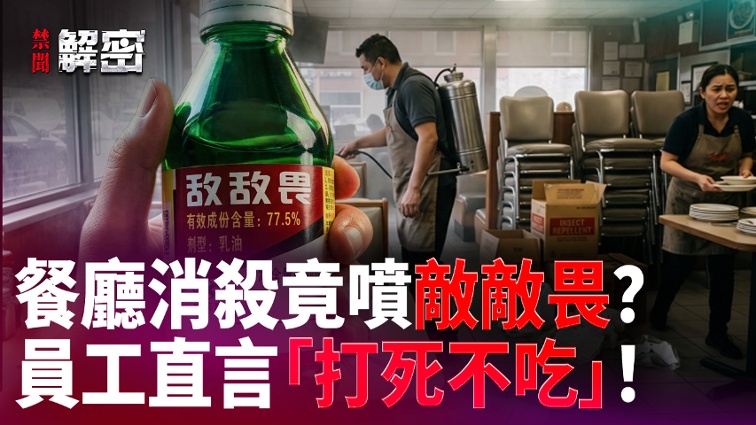
China's Food Safety Crisis: Who is Undermining Our Conscience? (Video)
[People News] Hello, dear viewers, and welcome to 'Forbidden News Exposed'. I am Sun Ning.
Imagine this: you are seated in a clean, well-decorated, and reputable chain restaurant, savoring exquisite pastries, tempting seafood, and succulent fruits. Can you fathom that just hours earlier, in the late night, the back kitchen of this restaurant had undergone a shocking incident of 'legal poisoning'?
On August 24, 2026, a hidden camera video from 'Beijing News' unveiled the darkest secrets of China's catering industry.
In Xiamen, a third-party disinfection company—Xiamen Lvlinsen Environmental Technology Co., Ltd.—was found to have engaged in late-night disinfection services for numerous popular restaurant chains, including Green Tea Restaurant and Xianqi Half-Step Tavern. Alarmingly, they used medium- to high-toxicity organophosphate pesticide—Dichlorvos—on a large scale and over an extended period for disinfection.
How did this highly toxic agricultural insecticide make its way onto diners' plates?
According to the laws of the Chinese Communist Party, disinfection in catering establishments must utilize low-toxicity, high-efficiency, and human-safe certified agents, such as Residual Killing Agent and Chlorpyrifos. Additionally, strict protective measures must be implemented to cover kitchen utensils, cutting boards, and food ingredients prior to disinfection. However, reporters from 'Beijing News' documented the industry's hidden, horror movie-like disinfection practices through months of undercover investigation.
Late at night, when these restaurants have closed and their front doors are securely locked, so-called 'professional disinfection personnel' enter the back kitchen carrying large spray bottles. They encounter stainless steel plates, cutting boards, soup pots, and even pre-cut vegetables, all completely exposed to the air without any coverings.
In their quest for efficiency and the so-called 'one-hit kill,' these disinfection workers disregard proper protocols and engage in 'blind spraying' around the areas where utensils are stored and near the shelves. In an instant, a noxious chemical mist fills the back kitchen, with a dense layer of toxic liquid covering every container that will be used for food the next morning, resembling a heavy rain of droplets.
Even more alarming is the situation in over a dozen restaurants specializing in seafood and Japanese cuisine. Due to the extreme toxicity of the disinfection solution, the live fish, shrimp, and crabs that were kept in the back kitchen sink began to float belly up shortly after the disinfection personnel completed their spraying, dying on the spot from poisoning.
Are these disinfection workers and the companies they represent unaware that they are committing a crime? They know full well, yet they continue to act against their conscience.
To avoid inspections from business and health regulatory authorities that could occur at any time, disinfection workers pour highly toxic dichlorvos solution into ordinary mineral water bottles before heading out, completely removing the labels to disguise them as regular drinking water, which they then bring into the restaurant's back kitchen for immediate use.
After the disinfection process is completed, the service documents provided by the company to catering businesses, as well as the ledgers prepared for official inspections, all list expensive and legally compliant low-toxicity pesticides such as 'Can Sha Wei', 'Da Mie', and 'Lie Xi Zhen'. This systematic fraud means that both catering brands and regulatory authorities only see 'compliance and legality' on paper.
In an undercover investigation, when reporters asked the disinfection workers why they insisted on illegally using dichlorvos, the workers revealed the industry's unspoken rules: cost and exorbitant profits. A compliant low-toxicity pesticide like 'Can Sha Wei' has a market wholesale cost of over 25 yuan, while a banned medium- to high-toxicity pesticide like dichlorvos costs only a few yuan. Given this significant price difference, disinfection companies are willing to overlook the safety of millions of diners in order to reap unscrupulous profits. Furthermore, the disinfection workers openly told reporters: 'I personally would never eat at the restaurants we have disinfected; I would never eat there even if you killed me!'
Experts from China Agricultural University have highlighted that dichlorvos is a moderately toxic organophosphate pesticide, which poses hidden and cumulative risks to human health. Its strong lipophilicity allows dichlorvos to not only enter the digestive system through residual utensils but also to be quickly absorbed through the skin and respiratory tract by kitchen staff and diners. Mild symptoms of chronic food poisoning can include dizziness, nausea, sweating, and muscle tremors. Prolonged and repeated ingestion of this toxic residue on utensils can lead to sustained inhibition of cholinesterase activity in the body, resulting in central nervous system damage, liver and kidney failure, and even a potential cancer risk.
On the night the incident was revealed, a joint investigation team from Huli District in Xiamen, along with reporters, collected samples of the liquid residue found on the ground and utensils at the implicated store. The tests returned positive results for dichlorvos, confirming the extensive toxin contamination.
The Resurgence of 'Formaldehyde Cabbage'
If the presence of dichlorvos in late-night kitchens is akin to a hidden poison arrow, then the 'formaldehyde cabbage incident' that erupted around the same time represents an 'indiscriminate attack' occurring in broad daylight, targeting the dining tables of ordinary citizens across China.
On August 22, 2026, a video released by self-media blogger 'Yulian Qige' sparked widespread panic online regarding 'formaldehyde cabbage.' The incident occurred in Tunkeng Town, Kangbao County, Zhangjiakou City, Hebei Province, a vital 'vegetable basket' in northern China. This region is known for its extensive cultivation of napa cabbage and baby cabbage, playing a significant role in supplying off-season vegetables to various provinces and major cities in the south.
However, at the outdoor site where cabbages are harvested, packed, and prepared for shipment, Yu Lianqi captured a shocking scene: illegal vegetable buyers and workers on site were remarkably skilled in their actions. They aggressively dipped each freshly pulled, water-laden cabbage into a basin filled with a noxious liquid, and then swiftly loaded them into the cargo hold of a large truck.
The transparent liquid used to 'bathe' the cabbages is a formaldehyde solution, which is highly toxic and classified as a Group 1 carcinogen by the World Health Organization, commonly referred to as formalin.
Why do these vendors take the risk of engaging in illegal activities to dip fresh vegetables in formaldehyde? The reasons behind this are more stark and brutal than one might expect.
Cabbages have a very high water content, and during long-distance interprovincial transport in the high temperatures of summer and early autumn, it often only takes a day and night of jostling in a closed cargo hold for the roots of the cabbages to rot and turn black due to bacterial growth, potentially rendering the entire truckload of vegetables unsellable. According to modern logistics standards, such vegetables must be transported using expensive refrigerated, temperature-controlled logistics vehicles. However, unscrupulous vendors opt to save on these high transportation costs by using a few dollars' worth of formaldehyde as a substitute.
Formaldehyde is a potent bactericide and preservative that can instantly coagulate proteins, effectively killing the rotting fungi at the roots of vegetables. Cabbage treated with formaldehyde can endure transport without a cold chain; even after being jostled in a hot truck for two or three days, it can still reach agricultural markets in Jiangsu, Shanghai, and Beijing with its roots appearing unnaturally snow-white and clean, while its leaves maintain their shape without wilting. Vendors take advantage of this industrial technique to create a deceptive illusion of 'freshness' in vegetables.
On the day of the undercover investigation, a batch of cabbage that had just undergone formaldehyde soaking in the 'Food Safety Demonstration Zone' of Kangbao County, Hebei, was set to be transported overnight to key agricultural markets in Suqian, Jiangsu, and subsequently distributed to the vegetable baskets of thousands of ordinary households.
Medical experts have repeatedly warned about the dangers of 'formaldehyde vegetables.' Formaldehyde is highly irritating and corrosive to the mucous membranes of the human digestive tract and respiratory system. Prolonged consumption of vegetables containing residual formaldehyde can disrupt the gastrointestinal ecosystem, leading to chronic gastritis and ulcers. Moreover, the free formaldehyde released can enter the bloodstream, posing risks to the hematopoietic system and potentially inducing childhood leukemia, nasopharyngeal cancer, and lymphoma.
The most frustrating and infuriating aspect for the Chinese public is that this is not the first occurrence of the "formaldehyde cabbage" scandal in China. In 2012, incidents were reported in Qingzhou, Shandong, and in 2015 in Dingzhou, Hebei, and Liaocheng, Shandong, involving baby cabbage and cabbage soaked in formaldehyde. Fourteen years later, the same toxic preservation methods continue to thrive in the same regions. This systemic failure to uphold safety standards has turned the kitchens of ordinary families into endpoints for chemical contamination.
From Chemical Oil to Industrial Toxins
When we take a broader view of the recent food safety landscape in China, it becomes clear that the formaldehyde cabbage and dichlorvos are merely the tip of the iceberg revealed by a vast black supply chain. The food safety incidents that have emerged in China in recent years, characterized by their extensive reach and brutal tactics, are repeatedly undermining the foundations of human civilization.
In discussing recent food safety crises, one cannot ignore the shocking "mixed edible oil incident involving tank trucks" that occurred in July 2024, which sent shockwaves both domestically and internationally.
Reporters from the Beijing News dedicated several months to tracking large liquid tank trucks. They ultimately uncovered a hidden industry secret within the bulk logistics sector: tank trucks that had just transported chemical liquids such as coal-to-oil and liquefied petroleum gas, without being cleaned or sanitized, were directly entering the facilities of major industry players like China Grain Reserves and Huifu Grain and Oil, continuing to load bulk soybean oil and cooking oil that we use daily for frying rice.
What is coal-to-oil? It is an industrial fuel that contains significant amounts of hydrocarbons, heavy metals, and internationally recognized potent carcinogens known as polycyclic aromatic hydrocarbons. Prolonged exposure to this chemical residue can result in liver and kidney necrosis, cancers of the digestive system, and even induce genetic mutations.
Along the entire profit chain, fleets save hundreds of yuan on tank cleaning fees per vehicle, drivers aim to reduce waiting times, and inspectors from large manufacturers rush shipments, all tacitly accepting these practices. Even more concerning is that traditional inspections of edible oils only check for acid value and peroxide value, completely ignoring the 'coal-to-oil' indicators. This means that even if you apply the full set of national standards for testing, this barrel of industrially contaminated oil still appears compliant on paper as 'premium soybean oil.'
During the 2026 CCP 3.15 Gala, the contract manufacturers of the well-known boneless chicken feet brands 'Shu Fu Xiang' and 'Zeng Qiao Food' were exposed. To make the originally rotten, blackened, and spoiled chicken feet look appetizingly white and tender, factory workers poured in large quantities of industrial-grade hydrogen peroxide. This highly corrosive and toxic industrial bleach is used in a workshop where sewage flows, and even the workers, wearing thick gloves, candidly state: 'How could we possibly eat this stuff?'
Simultaneously, in key production areas for vermicelli like Henan, the reality behind the health-focused sweet potato vermicelli, which claims to achieve sales of hundreds of thousands during live broadcasts and promotes itself as 'pure handmade, pure sweet potato,' is truly disturbing. Unscrupulous manufacturers are substituting sweet potato starch entirely with inexpensive cassava or corn starch. To give these non-sticky alternatives the elasticity and color of genuine sweet potato vermicelli, they recklessly add industrial gelatin, gypsum powder, and carcinogenic caramel colorants. These 'technologically enhanced vermicelli,' which contain industrial gypsum and heavy metals, eventually make their way into hot pot and spicy noodle restaurants nationwide, turning into a chronic poison for young people and children.
Even more tragically, these harmful practices have now extended to defenseless children. In July 2025, media reports revealed a large-scale lead poisoning incident at a kindergarten in Tianshui City, Gansu Province.
Investigations found that the kindergarten's principal and investors permitted chefs to buy extremely cheap industrial-grade paint pigments online, which were then mixed directly into the breakfast items, such as three-color steamed date cakes and corn rolls, prepared for the children, all in a bid to cut down on meager food costs.
Professional testing showed that the lead content in these snacks exceeded the food safety standards set by the Chinese Communist Party by an astonishing 2000 times! Lead is a cumulative heavy metal toxin that can inflict irreversible and permanent damage on the still-developing nervous systems and brains of children. In a desperate attempt to save a few yuan on food coloring, they resorted to using toxic industrial paint to 'color' the childhoods of these children, a level of insanity that has crossed the boundaries of human morality and conscience.
The underlying causes of food safety incidents.
Why is it that a country that claims to be powerful cannot even fulfill the most basic and humble need of ensuring its citizens can enjoy a safe meal?
Many attribute this failure to lax laws, light penalties, and insufficient staffing in regulatory agencies. However, these explanations merely scratch the surface.
The true root cause of the persistent and seemingly irreparable food safety issues in China lies in the systematic functioning of the CCP (Chinese Communist Party) regime, which has thoroughly destroyed the most valuable foundation of society—the humanity, morality, and conscience of the Chinese people.
When a regime views the goodwill of humanity as a threat and prioritizes party loyalty over human nature and natural justice, the outcome is a complete moral collapse within society, the extinguishing of conscience, and a total lack of reverence.
Food safety is not merely a technical or economic issue; it serves as a precise mirror reflecting the disintegration of a social system and the barrenness of human nature.
That wraps up today's discussion. If you liked our program, please give us a thumbs up, subscribe, and hit the notification bell. If you have any thoughts on the DDT (dichlorodiphenyltrichloroethane) disinfection incident, we welcome your comments in the section below. We look forward to seeing you in the next episode!
(“Forbidden News Decoded”)
△






News magazine bootstrap themes!
I like this themes, fast loading and look profesional
Thank you Carlos!
You're welcome!
Please support me with give positive rating!
Yes Sure!