
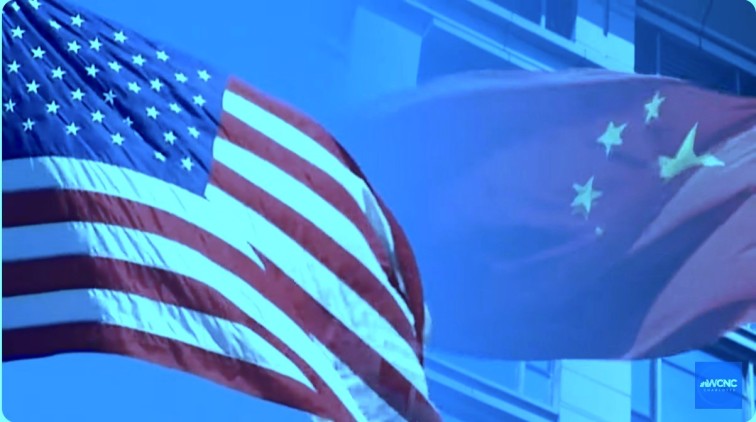
U.S.-China Confrontation. (Video screenshot)
[People News] Xi Jinping likely did not anticipate that, despite his health issues, he would undertake a challenging trip to the United States, hoping to ease external pressures. However, the diplomatic results were minimal, leaving him in an even more vulnerable geopolitical situation.
What further complicates matters for Beijing is that just days after Xi returned to Beijing, the United States quickly announced the sale of two F-16 fighter jets to Taiwan. This development revealed that prior to the Xi-Trump meeting, Beijing had repeatedly made strong statements regarding Taiwan, yet the US did not provide a direct response. The US did not alter its stance on arms sales to Taiwan to accommodate the Chinese Communist Party. It is likely that Trump, aiming to secure the best possible outcome in negotiations, intentionally avoided aligning with the CCP's narrative and refrained from discussing Taiwan. This situation can be interpreted as the US continuing its arms sales and military cooperation with Taiwan, and it also indicates that the US has not ceased fulfilling its existing arms sale commitments despite Beijing's objections.
Compounding Beijing's challenges, Europe across the Atlantic also made significant moves almost simultaneously.
On October 7, the German government, which had previously maintained a relatively moderate approach in its economic and trade relations with China, officially decided to block a Chinese state-owned enterprise's investment in acquiring Germany's largest port logistics group, under the leadership of Chancellor Friedrich Merz. This decision underscores that the Berlin authorities have fully adopted a hardline position against Beijing, prioritizing 'national security' and 'de-risking' principles.
On October 7, the European Parliament overwhelmingly approved the report titled "Strengthening and Principled EU Policy Recommendations towards China," with 454 votes in favor, 86 against, and 110 abstentions. The report not only calls for EU member states to enhance their capabilities to counter cyberattacks, foreign interference, espionage, and hybrid threats, but also explicitly urges the EU to strengthen security coordination with regional democratic partners. This includes maintaining a continuous naval presence and conducting joint exercises to enhance regional stability, while reiterating opposition to any unilateral changes to the status quo in the Taiwan Strait through force or coercion.
This series of significant events underscores a profound and unprecedented shift in the international community's approach to policies regarding China and Taiwan.
1. The Appeal of the Chinese Market Diminishes, the 'One China Threat' Fully Fails
These events reflect that Xi Jinping's personal influence and the Chinese Communist Party's regime on the international stage have significantly diminished. In the past, the CCP often leveraged the "One China Principle" alongside the "vast Chinese market" as a global threat, but this tactic has become increasingly ineffective.
The Economic Decline of China Undermines the 'Market Leverage'
As China's domestic economy experiences a downturn, foreign investment is rapidly withdrawing, and the real estate market is collapsing, this situation has not only depleted the savings of ordinary citizens but has also left local governments burdened with significant debt. The market is witnessing a surge in corporate bankruptcies and the closure of business centers, coupled with high unemployment rates, which has led to negative social phenomena among the youth, such as 'lying flat' and even 'hanging on the wall.' The so-called '1.4 billion people super-large market' has lost its former charm, and governments and businesses in Western countries have fully awakened from the 'China market illusion.' As the impact of economic coercion diminishes, Western politicians are naturally adopting an unprecedentedly tough stance towards the Chinese Communist Party (CCP).
The international community is breaking free from the constraints of the 'One China Threat'
Previously, Western nations often took a 'tacit approval, avoidance, and ambiguity' approach to the Taiwan issue due to concerns over potential economic retaliation from Beijing. However, with the normalization of U.S. arms sales to Taiwan and the EU's establishment of a transnational security coordination mechanism, it is evident that the major democratic bloc worldwide is gradually liberating itself from the contextual threats and economic leverage posed by the CCP's 'One China Principle.'
2. Why is the world beginning to achieve 'substantial breakthroughs' against the CCP's One China threat?
Historically, the CCP's most formidable diplomatic tool was 'market closure and economic sanctions.' However, as Europe and the United States actively work to de-risk supply chains and Germany blocks Chinese investments in critical ports, a consensus has emerged within Western political and economic circles: the political and security risks associated with the Chinese market now far exceed the potential commercial benefits. Consequently, we are witnessing a significant increase in political and strategic flexibility among nations regarding issues related to Taiwan.
The clear distinction between the 'One China Principle' and the 'One China Policy'
In reality, the CCP's 'One China Principle' has never been synonymous with the West's 'One China Policy.'
The Chinese Communist Party's 'One China Principle' asserts that 'Taiwan is an inseparable part of China, and the People's Republic of China is the only legitimate representative.'
In contrast, the Western 'One China Policy' merely 'acknowledges' or 'takes note of' Beijing's stance, but it does not recognize the CCP's claim of sovereignty over Taiwan.
Currently, the United States and Europe are accelerating the materialization and securitization of their 'One China Policy.' This means that, without officially announcing diplomatic relations, they are intensifying substantive security cooperation with Taiwan—such as arms sales, regular naval patrols, supply chain defense, and legislative support. This marks a complete separation of the EU from both the 'One China Principle' and the 'One China Policy.'
The collective security warning from the Russia-Ukraine war
After more than four years, the Russia-Ukraine war shows no signs of a ceasefire. The most profound lesson this conflict has imparted to the West is that 'retreat in the face of authoritarian expansion will only provoke war, not prevent it.' The EU and the US understand that allowing Beijing to engage in grey zone coercion or military adventurism regarding the Taiwan Strait would completely undermine the post-war international order. Therefore, establishing clear boundaries through pre-deployment strategies—such as arms sales, naval patrols, and legislative deterrence—has proven to be the most cost-effective strategy to avoid conflict.
3. Key Core: Taiwan's Technological Strength at the Pinnacle of Global Irreplaceability
The reason the international community no longer submits to the CCP, in addition to the West's own strategic awakening, is that a crucial pillar of hard power is Taiwan's technological industry, which occupies an irreplaceable peak position in the global economy and the wave of advanced technology.
Taiwan's semiconductor dominance and the 'Silicon Shield.'
Taiwan holds over 60% of the global semiconductor manufacturing capacity and dominates more than 90% of advanced processes below 7 nanometers. Core chips for products ranging from Apple smartphones and Microsoft servers to national defense military equipment rely on Taiwanese manufacturers like TSMC (Taiwan Semiconductor Manufacturing Company) for their production. This competitive edge, characterized by cutting-edge technology, high capital requirements, and a comprehensive ecosystem, has led to Taiwan being recognized as the 'throat' of the global economic system.
In an age where generative AI and large-scale data centers are flourishing, the computing power that drives the AI revolution—championed by leading global tech giants such as Nvidia, AMD, Meta, and Google—is predominantly supported by Taiwan's technology ecosystem. From upstream IC design and advanced wafer manufacturing to CoWoS advanced packaging, as well as midstream and downstream technologies like thermal management, power management, AI servers, and supercomputer cabinet assembly, Taiwan boasts the most complete and irreplaceable industrial supply chain in the world. Major tech companies worldwide are acutely aware that 'without the full backing of Taiwan's tech industry, the global AI revolution and the next generation of technological transformation would come to an abrupt halt.'
It is precisely Taiwan's exceptional technological capabilities that make the security of the Taiwan Strait a matter of global significance, transcending mere geopolitical concerns or support for democratic alliances. The stability of the Taiwan Strait is directly tied to the operational integrity of global technological civilization and economic lifelines. Should the Taiwan Strait descend into chaos, the global supply chain would face catastrophic disruptions, with economic repercussions far exceeding those of the Great Depression in the 1930s.
4. The Comprehensive Elevation of Taiwan's Political and Institutional Status
By leveraging its technological hard power, Taiwan's overall strategic value has revealed three unshakeable dimensions.
Technological and Economic Lifeline: As previously noted, Taiwan holds critical control over the global AI and semiconductor industries. Thus, maintaining peace in the Taiwan Strait is vital for Western nations to protect their own national security and economic stability.
Core Strategic Hub of the First Island Chain: From the standpoint of Indo-Pacific geopolitical strategy, Taiwan is situated at the geometric center of the first island chain. Should Taiwan fall under the control of the Chinese Communist Party (CCP), the CCP's navy would gain direct access to the deep Pacific Ocean, effectively strangling the energy and trade lifelines of Japan and South Korea, and forcing the US-Japan alliance to retreat its defense line to the second island chain. Consequently, preserving the status quo in the Taiwan Strait has become a collective consensus among the US, Japan, Australia, and Europe.
Institutional Benchmark of Democracy vs. Authoritarianism: Taiwan, as a highly developed and resilient democracy within the Chinese-speaking world, stands as a strong repudiation of authoritarian narratives. As global democratic nations increasingly perceive the threat of authoritarian expansion, Taiwan's significance as a democratic stronghold becomes even more pronounced.
5. Future Risks and Dynamic Balance
Despite international support for Taiwan reaching unprecedented levels, the geopolitical tug-of-war is set to become more intricate:
Considering that direct confrontation with the US and Europe or a complete blockade of Taiwan would incur substantial costs, Beijing may resort to more frequent maritime and aerial provocations, economic coercion, cyberattacks, and cognitive warfare in an effort to sow division within Taiwanese society and the international democratic coalition.
At the same time, while the US and Europe are actively 'supporting Taiwan', they will continue to uphold a defensive stance in official communications against 'unilateral changes to the status quo' to prevent geopolitical tensions from spiraling into a full-scale war.
In conclusion, the recent initiatives of U.S. arms sales and EU reports signify a new phase in the West's strategy towards China, characterized by 'reshaping the rules of the game through facts and actions.'
The diplomatic intimidation based on the 'One China Principle' that the Chinese Communist Party has traditionally relied upon is quickly losing its effectiveness. As the once-mighty Chinese market diminishes, Taiwan, leveraging its world-class technological capabilities and strategic geopolitical position, is not only avoiding marginalization in the power struggle but is also emerging as a central player in shaping the future of global security, technology, and democratic order in the 21st century.
(First published in People News)
△





News magazine bootstrap themes!
I like this themes, fast loading and look profesional
Thank you Carlos!
You're welcome!
Please support me with give positive rating!
Yes Sure!