
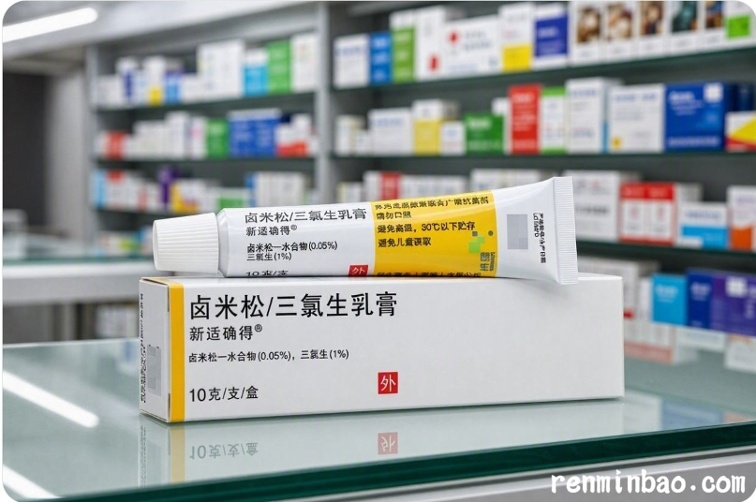
Under the manipulation of bureaucrats from the Chinese Communist Party, the price of "Luo Mi Song/Triclosan Cream" (10g/tube) has surged from 34 yuan to 800 yuan. (People's Daily/AI-generated image)
[People News] A stark contrast has recently emerged in the global pharmaceutical market: on one side, the U.S. government is aggressively lowering high drug prices through administrative negotiations and market mechanisms; on the other side, bureaucratic stagnation under China's authoritarian regime has caused the prices of basic dermatological drugs to soar more than 22 times, forcing the public to bear the costs of a failing system.
Trump Tackles High Drug Prices: A Combination of Administrative Negotiations and Market Competition
To tackle the long-standing issue of "excessively high drug prices" in the U.S., the Trump administration has recently rolled out several significant measures aimed directly at large pharmaceutical companies.
1. Most Favored Nation (MFN): The administration is demanding that pharmaceutical companies provide drug prices to the U.S. that are in line with the lowest prices in other developed countries. Currently, over 20 international pharmaceutical companies, including Pfizer, Eli Lilly, and Novartis, have reached agreements to significantly reduce the procurement costs for Medicaid (low-income medical insurance) and certain high-cost drugs (such as insulin and weight loss medications).
2. Launching a Direct Sales Platform: The establishment of the TrumpRx.gov platform aims to eliminate middlemen's commissions, allowing uninsured or specific patients to purchase drugs at discounted prices.
3. Market Competition Mechanism: By aligning patent expirations with the introduction of generic drugs, the market's supply and demand dynamics work together to effectively suppress inflated drug prices.
Chinese Communist Party Creates Barriers: Life-saving Drugs Surge from 30 Yuan to 800 Yuan
In stark contrast to the United States' attempts to 'reduce drug prices,' the Chinese market is experiencing a 'surge in drug prices' due to the inefficiency of official approvals.
Reports from The Dajiyuan and various other media outlets indicate that on September 9, news that gained significant attention revealed that the imported compound drug 'Lumi Song/Triclosan Cream' (10g/tube), used for treating inflammatory skin conditions, originally had an official reference price of only about 34 to 43 yuan. However, it has now skyrocketed to 800 yuan on e-commerce platforms, representing an increase of over 22 times.
A staff member from Ningbo Langsheng Pharmaceutical Co., Ltd. disclosed on September 8 that this drug is an original imported medication that has been out of stock since the first half of the year. The reason for this shortage is that 'the supplier of the triclosan raw material has changed,' which requires a new approval process from the Chinese Communist Party's drug regulatory authority. Unfortunately, the bureaucratic efficiency is extremely low, and the timeline for resuming imports remains uncertain.
As a result, hospitals and offline pharmacies are facing a complete shortage, leaving the public without access to necessary medications and forcing them to seek alternative drugs, even at inflated prices on the black market. Physical pharmacies have also imposed cumbersome requirements, necessitating prescriptions and identification to purchase alternative brands, significantly complicating the process of obtaining medical care.
A Benchmark for the Strengths and Weaknesses of Political Systems in China and the U.S.
These two incidents starkly illustrate the fundamental differences between the authoritarian system of China and the democratic system of the United States in addressing the 'livelihood needs of the common people.'
Under the scrutiny of public opinion, the U.S. government views 'lowering drug prices' as a significant achievement, actively pursuing benefits for citizens through institutional reforms and negotiations with pharmaceutical companies. In stark contrast, the bureaucratic system of the Chinese Communist Party (CCP) is marked by extreme arrogance and rigidity, where a simple approval for a change in raw materials can be delayed for over six months, completely disregarding the grassroots suffering of people who have 'no medicine available'.
The Trump administration worked to promote price transparency and direct sales mechanisms, aiming to eliminate intermediaries. Conversely, the CCP's system has artificially created 'administrative shortages', resulting in a supply-demand imbalance that has allowed black markets and scalpers to profit exorbitantly, effectively conducting another economic harvest from the common people.
While democratically elected Western governments are striving to reduce drug prices from hundreds of dollars, the bureaucratic system of the CCP can inflate the price of a basic drug from 30 yuan to a staggering 800 yuan. This situation not only represents a drug crisis but also serves as further evidence of the totalitarian regime's indifference to the suffering of its citizens.
△






News magazine bootstrap themes!
I like this themes, fast loading and look profesional
Thank you Carlos!
You're welcome!
Please support me with give positive rating!
Yes Sure!