
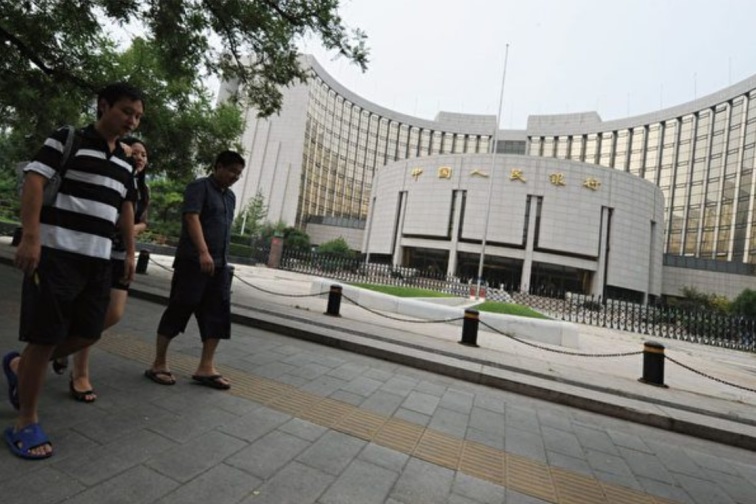
A group of citizens passes by a branch of the People's Bank of China (screenshot from X/@dujuncn)
[People News] From 2025 to 2026, China's Ministry of Finance will inject capital into large state-owned banks and financial institutions, including insurance companies, through special national bonds for two consecutive years, with a total amount nearing 900 billion yuan. In 2025, approximately 520 billion yuan will be allocated to the Bank of China, China Construction Bank, Bank of Communications, and Postal Savings Bank, with the Ministry of Finance contributing 500 billion yuan. In September 2026, an additional approximately 360 billion yuan will be provided to eight institutions, including the Industrial and Commercial Bank of China, Agricultural Bank of China, Export-Import Bank of China, Export Credit Insurance Corporation, as well as China Life, PICC, Taiping, and Reinsurance, with the Ministry of Finance contributing around 300 billion yuan, and China Tobacco and others participating in part of the subscription. The two rounds of funding total nearly 880 billion yuan, with the Ministry of Finance contributing 800 billion yuan, achieving full coverage of the six major state-owned banks and, for the first time, including insurance and policy-based financial institutions.
This is not a conventional capital replenishment; rather, it is a systematic crisis management operation in the context of a deep contraction in the real estate sector, pressure from local government debt, long-term narrowing of banks' net interest margins, and extremely weak domestic demand. The official narrative emphasizes "foresight," "preparation for rainy days," and "serving the real economy," but international observers and market logic are more inclined to view it as a stability tool to guard against systemic financial risks, covering and delaying risk exposure, restructuring balance sheets, maintaining credit issuance capacity, and stabilizing the confidence of systemically important institutions. The question remains whether this method of concentrated fiscal capital injection can genuinely resolve the structural contradictions within the financial system, or if it merely shifts or postpones the problems, or passes on the costs.
Real Estate Unsold, Debt Cycle Hard to See the Bottom
China's real estate market has been in continuous decline since its peak in 2021, and a substantial bottom has yet to be identified. Fitch Ratings has revised its forecast for new home sales in China for mid-2026, projecting a decline of 11%-13%, which is lower than previous expectations. Prices in the secondary market continue to drop in most cities, with some second- and third-tier cities experiencing significant cumulative declines. The disparity between new and second-hand housing prices, high inventory levels, and a sharp decrease in land transfer revenue are directly impacting local finances. Reports from agencies such as Reuters indicate that some analysts believe housing prices may need to fall further to reach equilibrium. However, it is overlooked that the wealth of China's middle-class residents is heavily concentrated in real estate; as housing prices decline, their wealth diminishes significantly, which in turn suppresses their willingness to consume.
While the local hidden debt of the Chinese Communist Party has been reduced through debt swaps, official data indicates that by the end of 2025, the balance of hidden debt will decrease to approximately 6.5 trillion yuan. Nevertheless, total government debt (including both statutory and hidden) has surpassed 100 trillion yuan, with the debt ratio exceeding 70%. The operational debt of local financing platforms remains substantial. Although Xi Jinping aims to completely eliminate this debt by 2028 through administrative orders, the actual debt has not vanished. Banks, as the primary creditors, are likely to become the main casualties in the local debt clearance initiative.
The net interest margin serves as a clear indicator of performance. The banking sector's net interest margin, influenced by low interest rate policies and falling loan rates, once dropped to approximately 1.4%. In the second quarter of 2026, there were signs of a slight quarter-on-quarter increase, as the decreasing cost of liabilities for some large banks appeared to stabilize the net interest margin to some extent, although the overall absolute level remains at a historical low. Low interest margins not only diminish banks' profits but also directly weaken their capacity to accumulate internal capital. The state-owned insurance companies under the Communist Party of China are experiencing pressure from prolonged low interest rates, leading to margin losses. The Ministry of Finance's capital injections over the past two years publicly acknowledge the weakening of financial institutions' self-sustaining mechanisms.
Fiscal capital injection is merely a temporary measure and not a fundamental solution.
Similar to how the Communist Party of China manages local government debt through restructuring, this approach can only postpone debt repayment rather than completely eliminate it. The immediate effect of the Ministry of Finance issuing special national bonds to inject capital into financial institutions is an increase in the core Tier 1 capital adequacy ratio, but it does not address the underlying issues causing banks' inability to generate capital. Following the capital injections into the four major banks in 2025, their Tier 1 capital adequacy ratios rose by about 0.5-1.5 percentage points each; in 2026, the anticipated increases for the Industrial and Commercial Bank of China (ICBC) and the Agricultural Bank of China (ABC) are expected to be relatively modest, although there will be an overall increase in buffers. Based on leverage calculations, the newly injected capital could theoretically unlock trillions of yuan in credit capacity. The Ministry of Finance's capital injections into policy banks and insurance companies are aimed at supporting the export sector, while state-owned insurance companies also play a role in providing emergency support for the stock market.
However, capital adequacy is merely a necessary condition, not a sufficient one. The effective allocation of credit by financial institutions hinges on credit demand. At present, domestic demand is sluggish, corporate investment sentiment is low, residents are increasingly inclined to deleverage, and precautionary savings are on the rise. Consequently, new credit has been on a downward trend in the first half of the year, making it impossible for bank credit to sustain growth. International investment banks and research institutions have consistently highlighted that China's current challenges resemble a structural dilemma marked by both a balance sheet recession and deflationary pressures, rather than a straightforward liquidity shortage. While capital injections can prevent credit contraction due to capital constraints, they struggle to resolve fundamental issues such as the downturn in the real estate sector, the accumulation of local debt, and the stagnation in total factor productivity.
The Ministry of Finance of the Communist Party of China has engaged in large-scale capital injections through special national bonds for two consecutive years, signaling that the government is providing ongoing support to the financial system. This approach helps stabilize expectations in the short term and prevents a collapse of confidence; however, it simultaneously undermines the market mechanism's ability to eliminate inefficient institutions. This has reinforced the moral hazard associated with state-owned financial institutions being 'too big to fail.' Meanwhile, the risks faced by small and medium-sized banks under the Communist Party have significantly increased, and there is a severe divergence in asset quality across regions. Such financial differentiation and imbalance pose considerable constraints on economic development.
Who will bear the cost?
The accounting treatment of special national bonds exhibits clear characteristics of maneuvering and shifting. These bonds are often excluded from the official fiscal deficit calculations or managed through mechanisms like fund budgets, which allow for a formally controllable deficit rate while effectively increasing public sector debt. The repayment of these bonds ultimately depends on future tax revenues, central government transfer payments, or monetization strategies, supported by central bank liquidity tools and indirect monetary injections—essentially, as the public puts it, printing money and flooding the market.
In the context of China's economic downturn, the increasing trend towards monetization implies that ordinary residents holding fixed-income assets such as deposits and national bonds in RMB are at risk of having their actual purchasing power diluted. With interest rates consistently low, depositors are compelled to accept low real returns, and the effectiveness of consumption stimulation is limited, as the shrinking of wealth and pessimistic expectations predominantly influence behavior.
Reports from Bloomberg and other outlets often analyze the capital replenishment of Chinese financial institutions within a broader framework of fiscal and monetary coordination, which serves both as a risk mitigation strategy and a trend towards debt monetization. However, historical experience indicates that such operations incur lower costs during periods of high economic growth; in contrast, during times of low growth and high debt, these operations can erode monetary credibility and the balance sheets of households.
Financial Stability Boundary
China's economy is grappling with prolonged low growth, low inflation, or deflationary pressures, alongside multiple risks and challenges such as the collapse of the real estate market, overwhelming local government debt, structural unemployment, and difficulties faced by young job seekers. The continuous injection of nearly one trillion yuan in capital essentially serves to buy time using fiscal resources. While this approach can postpone capital constraints and stabilize systemically important institutions, it cannot replace the necessary clearing of the real estate market, the genuine transformation of local debts, the rebuilding of domestic demand, and the repair of household balance sheets. Should effective demand continue to languish and asset quality pressures become more pronounced in the coming years, the monetization of fiscal deficits may intensify, further diluting the wealth of ordinary residents.
Japan's experience of long-term low interest rates and fiscal-monetary coordination following its balance sheet recession did not lead to a swift recovery of endogenous growth. Similarly, some emerging markets that receive bank capital injections often find themselves trapped in a vicious cycle of capital fatigue if they do not simultaneously pursue structural reforms.
While fiscal injections are a necessary short-term stabilizer, they are far from a comprehensive long-term solution. This situation underscores the reality that the Chinese Communist Party's policy toolbox is increasingly leaning towards 'fiscal bottom-line finance.' The true challenge lies in whether the continued reliance on administrative orders, political mobilization, and state-owned enterprise support can effectively advance market-oriented clearing and demand-side reforms. If these reforms are not implemented, financial 'stability maintenance' will become increasingly costly, with diminishing returns, making it difficult to address the root causes of the crisis. Consequently, measures aimed at delaying the crisis will likely serve as a precursor to the next significant crisis.
(First published by the People News)△







News magazine bootstrap themes!
I like this themes, fast loading and look profesional
Thank you Carlos!
You're welcome!
Please support me with give positive rating!
Yes Sure!