
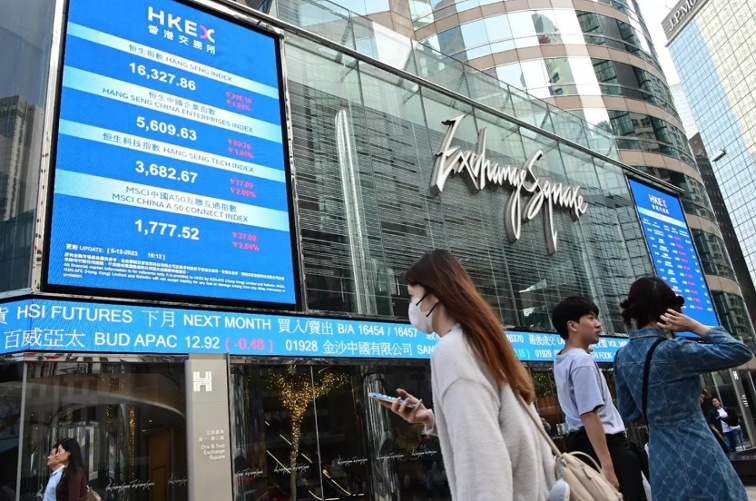
Hong Kong has transitioned from 'consuming the resources of the entire world' to 'relying on the Greater Bay Area/Mainland.' (Guo Weili / Dajiyuan)
[People News] Over the past century, 'Hong Kong' has symbolized a highly internationalized city with an independent legal system based on Anglo-American law, characterized by free capital movement and serving as a 'superconnector' between the West and China.
At present, Hong Kong is still officially recognized as the 'third-largest international financial center,' but in practice, it has fundamentally altered its operational logic. While it still appears to be a major financial hub, it has shifted from being 'the financial center of the world' to 'China's offshore financial center.'
Historically, Hong Kong 'consumed the resources of the entire world'; however, after its transformation into 'China's offshore financial center,' its economy now relies on the 'Greater Bay Area' for support, officially positioning it as a first-tier city in the mainland, akin to Shenzhen. When a city's operational logic changes from 'connecting globally' to 'integrating into the mainland,' the limitations on its potential and future trajectory become glaringly obvious.
The era of Hong Kong has come to an end.
Stephen Roach, the former chairman of Morgan Stanley Asia and a current senior fellow at Yale University, recently published an article highlighting that the economic achievements and urban resilience currently exhibited by Hong Kong represent a new 'Made in China' narrative for the city. He asserted that 'Old Hong Kong' has officially come to an end, even going so far as to replace the English name 'Hong Kong' with its Mandarin pinyin Xianggang, which has sparked considerable debate.
As reported by Radio France Internationale (RFI) and relayed by the Liberty Times, Roach's commentary titled 'Yes, the Hong Kong of Old is Over' explores various reasons why he believes 'Old Hong Kong' has concluded, despite the fact that Hong Kong has reclaimed its status as the leader in the global initial public offering (IPO) market.
Roach remarked that after closely observing the 2019 anti-extradition movement (also known as the anti-send-back movement), it is clear that Hong Kong, under the comprehensive governance of Beijing, will be fundamentally different, even if it regains its position at the top of the global IPO market by 2025.
He intentionally referred to Hong Kong post-1997 as 'Xianggang' using Mandarin pinyin, which conveys a stark reality: the old Hong Kong, once a 'buffer zone' and 'freedom stronghold' between the West and China, has come to an end. In its place is a 'Chinese-style ordinary city (Xianggang)' that is deeply integrated into the governance system of the Chinese Communist Party, centered around the Greater Bay Area, and aligned with the central government's overarching strategy.
Roach believes that the rule of law has historically been one of Hong Kong's key institutional advantages. However, since the implementation of the 'Hong Kong National Security Law' in 2020, which was enacted by Beijing without going through Hong Kong's legislative body, the national security framework of China has been fully integrated into Hong Kong's legal system, significantly undermining the rule of law in the region.
He noted that in 2024, the Hong Kong Legislative Council swiftly passed legislation for Article 23 of the Basic Law, which further broadened the scope of the 'Hong Kong National Security Law', restricted public discourse, and resulted in more arrests. Some political figures who are already serving sentences now face harsher penalties due to new charges. Independent bookstores are closing down one after another, and press freedom has nearly vanished. Additionally, six overseas non-permanent judges of the Hong Kong Court of Final Appeal have resigned, raising serious concerns about the judicial independence of Hong Kong's highest court.
The economic model of Made in China
The 'new Hong Kong story of Made in China' referenced by Roach does not suggest an immediate collapse of Hong Kong's economy; instead, it indicates a fundamental shift in its economic driving forces and operational logic.
Historically, Old Hong Kong depended on Western capital from the US, Europe, and Japan, international foreign banks, the Asian headquarters of multinational corporations, and the advantages provided by Western legal systems and information freedom.
In contrast, New Hong Kong relies on Chinese enterprises—both state-owned and private sector giants—listing in Hong Kong, southbound capital (Chinese 'internal waters') bolstering the liquidity of Hong Kong stocks, and the integration into the regional economic framework of the Guangdong-Hong Kong-Macao Greater Bay Area.
This new model can still yield GDP growth and urban resilience; however, its capital sources, risk structure, and rules of engagement are now entirely dictated by Beijing.
Roach noted that the recent rebound in Hong Kong's stock market is primarily driven by mainland Chinese companies such as Contemporary Amperex Technology Co., Limited (CATL), Luxshare Precision, Z.ai, the autonomous driving firm Momenta, and Montage Technology listing in Hong Kong. Rather than characterizing Hong Kong as a thriving international IPO market, it is more accurate to view it as a crucial platform for financing Chinese enterprises.
From 'Western Bridgehead' to 'Inland City' Tragedy
Roach, a former senior executive at Morgan Stanley who has long held a positive outlook on the economies of Asia and China, has elicited strong reactions with his commentary because he embodies the profound lament of Western establishment financial capital regarding Hong Kong's transformation into Xianggang.
Hong Kong's distinctiveness in the past stemmed from its status as 'part of China, yet different from other Chinese cities,' which encapsulates the essence of 'one country, two systems.'
As 'Xianggang' increasingly aligns with mainland cities in terms of politics, law, information control, and geopolitical positioning, Western capital will inevitably view it as 'another Shenzhen or Shanghai.' The loss of its uniqueness has led to an irreversible decline in Hong Kong's attractiveness to top international capital.
Roach noted that Hong Kong's economic performance has become closely tied to China's economy. With China's growth rate slowing to 4.3% in the second quarter of this year, falling short of the official target, it is understandably challenging for Hong Kong to thrive independently. Nevertheless, the Hong Kong government is optimistic that China's central planning can offer new hope for its economy and plans to introduce the first five-year development plan for Hong Kong soon. It is indeed too early to claim that Hong Kong can once again showcase its resilience.
'Hong Kong' can never return.
Roach's follow-up article appears to recognize why Hong Kong continues to function, but in truth, it delivers a stark qualitative judgment: Hong Kong is not dead; it has simply been 'remolded' into a different form.
Since Hong Kong transitioned to Xianggang, it continues to be a vibrant and thriving metropolis filled with skyscrapers on a macro level. However, on a micro level, its fundamental essence, institutional advantages, and international standing have undergone a complete transformation.
The name "Hong Kong" is slowly receding, while "Xianggang" has officially taken its place; this reflects the decision made by the Chinese Communist Party.
△







News magazine bootstrap themes!
I like this themes, fast loading and look profesional
Thank you Carlos!
You're welcome!
Please support me with give positive rating!
Yes Sure!