

Leaders in the tech industry have warned that reducing the risk of human extinction caused by artificial intelligence should be a global priority on par with other large-scale societal risks.
[People News] Chen Yixin, the Minister of State Security of the CCP, has indicated that the primary risk posed by artificial intelligence to the CCP is its effect on the 'political security environment.' This marks the first time that the CCP's top intelligence agency has publicly and systematically discussed the risks associated with artificial intelligence and how it threatens the Communist Party's grip on power. The CCP perceives artificial intelligence as a significant threat to regime security, contrasting sharply with the Western focus on the dangers of AI to human safety.
Insights from CCP Intelligence Executives
As reported by Voice of America, Chen Yixin published a signed article in 'CCP Cybersecurity' on Sunday (September 13), asserting that artificial intelligence is infiltrating human society at an unprecedented speed, breadth, and depth. The CCP must 'seize the opportunity while also recognizing the risks and maintaining a firm bottom line.'
In his article, Chen Yixin identified six major risks that artificial intelligence could pose within the CCP's national security framework, with political security being the foremost concern.
He cautioned that 'hostile forces and those with ulterior motives' might exploit generative artificial intelligence technology to 'fabricate political rumors, disseminate harmful information, and incite divisive sentiments... thereby threatening our political security, institutional security, and ideological security.'
Following political security, the other five risks identified by Chen Yixin include cyber offense and defense, intelligence theft and leakage, technological development, social governance, and military struggle.
Perspectives from Western AI Executives
In contrast to the official position of the Chinese Communist Party, Western artificial intelligence experts and executives widely emphasize the safety concerns of AI for humanity itself. Dario Amodei, co-founder of the American AI company Anthropic, Sam Altman, CEO of OpenAI, and others have issued warnings that as AI systems grow more powerful, they could become dangerous or difficult to control, regardless of who is using them. The concern has shifted from 'who will use it against us' to 'what will happen if the technology itself evolves faster than our ability to manage it.'
Addressing this issue reveals a clear gap between China and the West.
Not only do the narratives surrounding the threats of AI differ, but there is also a significant disparity in how the Chinese Communist Party and the West propose to tackle AI risks. According to Chen Yixin, Beijing's approach is to enhance national surveillance and control systems, without mentioning any pause or slowdown in AI development. In contrast, the safety recommendations from Western AI executives focus on conducting alignment research and temporarily halting capability development. This indicates that the Chinese Communist Party perceives AI threats as geopolitical and security challenges that require prevention, while the West views them as technical and governance issues that must be resolved before further advancement.
Future areas of focus.
Notably, in Chen Yixin's article, he specifically highlighted Anthropic's 'Mythos' (Claude Mythos) and OpenAI's 'Cyber' (GPT-5.5-Cyber) large models, asserting that their technology significantly improves the efficiency of network vulnerability detection and malware development, as well as the level of weaponization, 'posing serious risks to our country's critical information infrastructure.'
Last weekend, Anthropic's CEO, Amodei, published a lengthy piece discussing how the Chinese Communist Party's (CCP) advancements in artificial intelligence could pose a serious threat to the United States and the world. He advocates for Washington to implement strict measures against Chinese companies to limit the sale of powerful AI chips to the CCP, aiming to bolster the United States' competitive edge.
Amodei's comments prompted a response from the CCP, with the state-run Global Times stating on Sunday that his assertion of 'containing the CCP' is a 'completely unrealistic delusion.' CCP Foreign Ministry spokesperson Guo Jiaqin remarked on Tuesday that they have taken note of recent statements from American industry figures, emphasizing that the CCP 'places great importance on the various inherent and derivative risks associated with artificial intelligence and is committed to establishing a robust security baseline.'
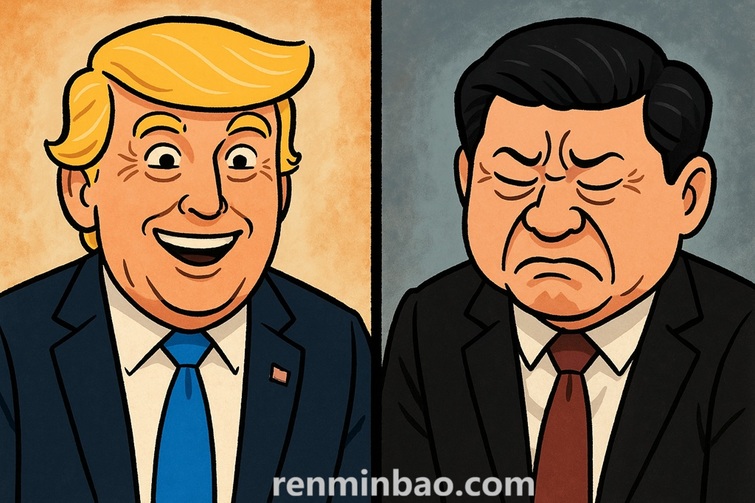
As U.S. President Donald Trump prepares to meet with CCP leader Xi Jinping in Washington on September 24, the competition in technology and the management of AI may emerge as contentious topics during their discussions. Analysts suggest that both parties regard the CCP's technological capabilities as critical to national security and global competitiveness, thereby limiting the potential for compromise in the near term.△




News magazine bootstrap themes!
I like this themes, fast loading and look profesional
Thank you Carlos!
You're welcome!
Please support me with give positive rating!
Yes Sure!