
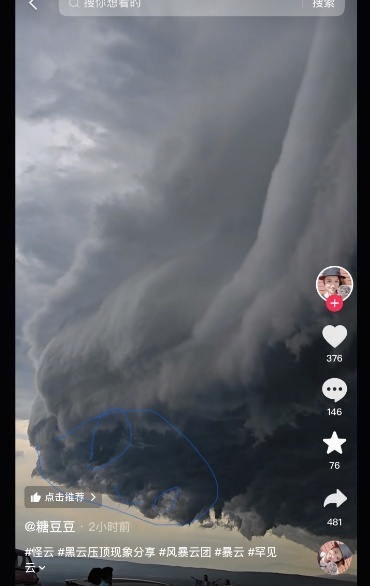
Hebei Sky (video screenshot)
[People News] "One disaster has not yet settled, and another has arisen. What sins have we committed!" This year's 12th typhoon, "Hongxia," made landfall in Huidong County, Huizhou City, Guangdong Province, around 3:50 AM on July 26. At the time of landfall, the maximum wind speed near the center reached level 14 (45 meters/second). Local residents described the wind as howling like a ghost, while the rain was whipped into a curtain by the wind, shooting towards the ground like a high-pressure water gun, resulting in zero visibility. "Can we even survive this?"
Reports indicate that "Hongxia" is the strongest typhoon to make landfall on the mainland this year, with local cumulative rainfall in northern and eastern Guangdong reaching as high as 400 to 500 millimeters. In response, Guangdong has activated a level II emergency response for wind, with over 715,000 people relocated. Flights, high-speed trains, subways, and ferries in some cities have all been suspended. The entire city of Dongguan in Guangdong has implemented a "four stoppages" policy: classes suspended, work halted, transportation stopped, and businesses closed.
The typhoon is expected to continue moving inland, bringing sustained strong winds and heavy rain to Jiangxi, Hunan, Hubei, and other areas. On the 27th, some regions in Fujian, Jiangxi, Hunan, and Sichuan recorded cumulative rainfall of 250 to 400 millimeters. The prolonged presence of "Hongxia," along with the significant cumulative rainfall, has made it challenging to accurately assess secondary disasters such as mountain floods, landslides, and urban waterlogging in the affected areas.
The aftermath of "Bawui" on the mainland is still being felt, and the Chinese Communist Party has yet to disclose the casualties and economic losses. The arrival of "Hongxia" undoubtedly exacerbates the already dire disaster situation on the mainland.
In fact, this July, in addition to the 'Bawi' storm transforming many cities from the south to the northeast into lakes and seas, and the flood discharges from artificial reservoirs turning city streets into rivers, natural disasters in the People's Republic of China have been relentless. According to incomplete statistics:
Starting on July 4, the strong tropical storm Meishake and its residual circulation caused flooding across Guangxi. Several reservoirs collapsed, overflowed, and discharged water without warning, ultimately triggering disasters such as mudslides and landslides. The Chinese Communist Party (CCP) reported 39 deaths and 9 missing persons; on July 7, a massive explosion occurred at the Wanfang Technology Industrial Park in Xingtai, Hebei, resulting in a large black mushroom cloud; on July 9, a fire broke out at the Fujian Quanzhou Jinjing Huiteng Footwear Company, leading to 28 fatalities; in the early hours of July 15, an explosion followed a fire at a fireworks factory in Lingchuan Town, Putian City, Fujian; on July 21, a magnitude 5 earthquake struck Yunnan; in some areas of the northwest, surface temperatures exceeded 50 degrees Celsius; on July 17, a large-scale landslide occurred in Pengshui County, Chongqing, causing multiple residential buildings to collapse, and by July 24, the CCP officially reported the death toll had risen to 14; on July 26 at around 14:30, a forest fire broke out near Yuping Mountain in Hongya County, Meishan City, Sichuan...
These disasters can be characterized as simultaneous landslides and earthquakes, as well as fire and water disasters, leading to the complete destruction of the five elements. The public is questioning the casualty figures and economic losses, which are believed to be significantly higher than those reported by the authorities, with some disasters still not officially acknowledged. Many netizens assert that the CCP is reluctant to reveal the truth, as many of these disasters are man-made, which only serves to validate the illegitimacy of the CCP regime, or indicate that the CCP is indifferent to the lives of the people.
July 2026 is not the only month marked by frequent disasters; the author’s investigation reveals that for nearly two decades, every July has been a month prone to calamities, giving rise to a unique phenomenon in the Chinese Communist Party (CCP) known as the 'July Disaster,' which some refer to as the curse of July.
For example, in July 2007, the Tuojiang Bridge in Fenghuang, Hunan, collapsed, resulting in 64 fatalities; in July 2011, a train in Wenzhou fell off a bridge, leading to 240 casualties; in July 2012, a severe rainstorm in Beijing caused 79 deaths; in July 2015, a fire at a nursing home in Lushan, Henan, claimed 39 lives; in July 2021, floods in Henan and a water leakage incident in Zhuhai resulted in a total of 412 deaths; and in July 2023, Typhoon Doksuri caused significant casualties. The floods in July 2024 are expected to result in hundreds of deaths and disappearances nationwide.
Why does July in the CCP's China see one disaster after another? The 'curse of disasters' can be traced back to July 1999.
In July 1999, major rivers in the mainland and southern regions experienced severe flooding, with the CCP reporting at least hundreds of deaths and 60 million people affected. A large number of houses collapsed, and farmland was destroyed, leading to the term 'Jiangze (flooded people)' among the public. There were 13,000 geological disasters such as landslides and mudslides across the country, resulting in 864 deaths.
Since then, disasters have continued to occur every July in the mainland.
There is an ancient saying in China: 'Disasters are the punishment of heaven; anomalies are the might of heaven, caused by the ruler's lack of virtue.' Traditionally, it is believed that natural disasters and divine punishment are brought about by the ruler's moral failings, and if the emperor does not issue a self-criticism edict, a true calamity will befall the land.
In July 1999, what significant event occurred in China that resulted in years of divine retribution? The only notable incident during that month, both within the Chinese Communist Party (CCP) and on a global scale, was the extensive persecution of over a hundred million Falun Gong practitioners by then-General Secretary Jiang Zemin, who exploited the CCP's organizational structure to carry out this campaign.
Many Falun Gong practitioners are elderly individuals or patients seeking physical and mental well-being. They aim to enhance their moral character based on the principles of Truth, Compassion, and Forbearance, and they do not engage in political activities.
From its introduction in mainland China in 1992 until 1999, more than a hundred million people practiced Falun Gong. The CCP feared that this could undermine its support base, prompting Jiang Zemin to initiate a severe crackdown using the party's apparatus. For the past 27 years, various forms of torture have persisted, including beatings, sleep deprivation, injections of neurotoxic substances, electric shocks, forced feeding, killings, sexual assaults, animal attacks, and economic sanctions. High-ranking officials within the CCP have even participated in organ harvesting for profit, while military and research institutions have conducted live biochemical experiments on Falun Gong practitioners. Furthermore, 361 practitioners who refused to reveal their identities were thrown into the boiling steel furnaces at Shougang...
It is important to note that the CCP's persecution is not confined to Falun Gong practitioners; it has extended its oppressive policies to any Chinese individuals it seeks to target. After experiencing the benefits of organ harvesting and extortion, the CCP disregards the personal actions of Chinese citizens. As long as an individual is labeled by the CCP, it can act without restraint. This has been a lesson learned by the CCP over a century of various movements. Party officials, driven by atheistic ideology, are capable of committing any form of atrocity.
The most tragic aspect is that those who assist the Chinese Communist Party (CCP) and take part in the persecution do not believe they will be affected. Why does the CCP's malevolence impact the common people?
One reason is that the CCP's brutality has garnered silent or submissive support from the populace. Individuals such as Chaoyang Aunty, Xicheng Grandpa, Shanghai Aunty, Wulin Aunty, Old Yang's group workers, Guangzhou neighbors, grid workers, and internet trolls are directly involved in monitoring and listening to Falun Gong practitioners or anyone the CCP wishes to surveil. Additionally, some tech company employees, journalists, and members of the Chinese People's Political Consultative Conference (CPPCC) who assist in internet and mobile phone surveillance were originally part of the civilian population. Along with 7.2 million civil servants, they contribute to the CCP's brutality. This means that the CCP's ruling power has permeated civil society, turning the populace into scapegoats for the CCP's misdeeds, a so-called 'people's tactic.' Furthermore, the CCP has over a hundred million party members, all of whom pledged to dedicate their lives to the CCP upon joining. Thus, when it comes time to hold the CCP accountable for its crimes, these civilians and their families—who have been brainwashed, deceived, or coerced by the CCP—become the victims who pay the price for the CCP's actions.
What sins have the Chinese people committed that have led them to endure various natural and man-made disasters for 27 years? Perhaps the answer lies here.
Thus, the question arises: "Is there still a way to live?" Heaven embodies the virtue of preserving life. In reality, natural disasters and human-made tragedies act as a wake-up call. It is essential for the populace to liberate themselves from the Chinese Communist Party (CCP) and to nullify their pledges of dedicating their lives to it. This is significant because such pledges are fundamentally theistic in nature, while the CCP encourages individuals to forsake the nurturing essence of heaven and earth, leading to self-destruction. Therefore, the 'three withdrawals' are a prerequisite for 'allowing life.' In a society like that of the CCP, where natural disasters and human-made calamities are rampant, and survival itself is a miracle, it is crucial to choose the 'three withdrawals' and not bear the blame for the CCP's wrongdoings.
(First published in People News) △






News magazine bootstrap themes!
I like this themes, fast loading and look profesional
Thank you Carlos!
You're welcome!
Please support me with give positive rating!
Yes Sure!