
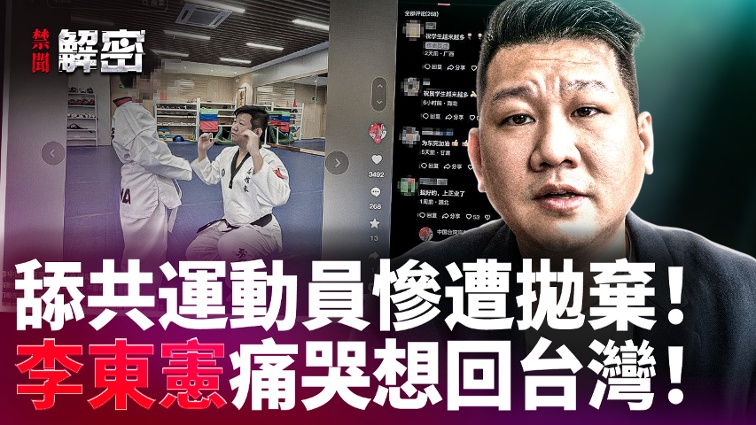
United Front Golden Boy Abandoned! Li Dongxian Cries and Wants to Return to Taiwan (Video)
[People News] Hello, dear viewers, welcome to "Forbidden News Unveiled." I am Sun Ning.
At the end of August 2026, a screenshot of a Douyin chat that circulated on overseas social media sparked a heated discussion in public opinion across the Taiwan Strait.
The individual in the screenshot expressed feelings of despair and helplessness, even hinting at a plea to fate. He disclosed that the taekwondo gym he invested in on the Chinese mainland has completely gone out of business, leaving him with a staggering debt of up to one million yuan. To make matters worse, his health has severely declined; he has spent six months in the hospital, facing a life-and-death situation due to a stroke and aphasia, and has reached the dire point of being unable to withdraw 1,000 yuan from his bank card. At the end of the conversation, he expressed his deep disappointment, stating that he wanted to return to Taiwan.
If this were merely an ordinary Taiwanese businessman who faced failure abroad, it might have drawn a sympathetic sigh. However, when netizens recognized the name of the person in this conversation, the entire Taiwanese online community erupted, not with sympathy, but with outrage.
This individual is Li Dongxian.
Indeed, he is the same Li Dongxian who, at the 2023 South Korea Asia-Pacific Masters Games, raised the five-star flag and publicly declared that "Taiwan is a place without human rights, a dictatorship," and later joined the Chinese Communist Party with great fanfare, vowing to shed the last drop of blood for "national reunification."
Just three years have passed, and the bold declarations from that time still resonate in the online realm. How did this once-lauded 'Taiwanese youth model' of the United Front, celebrated by the Chinese Communist Party's official media, transform into a 'discarded child of the times' who can't even afford a meal and is barred from returning to Taiwan to reunite with family?
Today, let us dispel the confusion and trace the timeline to discuss Li Dongxian's shattered dreams.
From Stroke to Debt
At the end of August 2026, Taiwanese YouTuber 'Jiujiang' unexpectedly released a highly shocking exposé video. In this video, Jiujiang unveiled several unpublished screenshots of conversations from Douyin, featuring none other than Li Dongxian, who has been living in Shenzhen, China, and has publicly declared his 'naturalization in China.'
According to the details shown in Jiujiang's video, Li Dongxian revealed in private messages to friends that his taekwondo business empire, which he had painstakingly built in mainland China, has completely collapsed over the past year. The taekwondo studios he opened in Shenzhen, Xiamen, and other locations, whether through joint ventures or sole proprietorships, have all shut down due to an inability to attract students, facing overwhelming rent and personnel pressures.
If it were merely a business failure, that would be one thing, as the business world is indeed competitive. However, even more devastating is that Li Dongxian disclosed in private messages that this business failure has left him with a staggering debt of over one million yuan. In mainland China, once someone incurs such debt and is unable to repay it, they are blacklisted by the court as a 'dishonest person subject to enforcement,' commonly referred to as a 'deadbeat.' This status prevents them from taking high-speed trains or flights, and even their personal bank accounts can be frozen.
The revelations do not end here; Jiǔ Jiàng later revealed even more alarming information— Li Dongxian's health has taken a turn for the worse.
According to a private message, Li Dongxian suffered a stroke in Shenzhen due to business failures, overwhelming debts, and prolonged anxiety from high-pressure work. He spent six months in the hospital, enduring severe paralysis and aphasia, to the extent that he could barely speak. In mainland China, without the safety net of Taiwan's health insurance, the costs of private hospitals and non-local medical expenses consumed his remaining assets like a bottomless pit.
In the chat logs, Li Dongxian expressed his despair, writing: "What breaks me the most is not my physical condition... I used to dedicate myself to cross-strait exchanges, enduring countless criticisms, believing I was doing the right thing. Now, as I face illness, I see the cold indifference and those who take advantage of my misfortune. I bear the medical expenses alone, and there’s not even anyone who cares. Sometimes I wonder if this is some kind of retribution... I find it quite ironic; my heart has completely turned cold."
At the end of the conversation, this once patriotic youth, who had vocally criticized Taiwan's media for being "dictatorial and lacking human rights," humbly told his friend: "I want to return to Taiwan." "My dad is still in Taiwan; I’ll apply for family reunification first. No matter what, I can go back and figure out the rest later. Otherwise, being alone in mainland China, with no money and no one to care for me, I really can’t hold on any longer."
His friend replied: "When are you leaving? Just let me know, and I’ll see you off."
Li Dongxian responded: "There’s really no need for a send-off. To be honest, I’m reaching out to you today with great difficulty; could you lend me some money to help me get by?"
The friend asked How much?
If it's convenient, could you lend me two W for now? I'm currently facing medical expenses, re-examination fees, and rent. My account is really running low at the moment. I promise to pay you back as soon as the remittance from home arrives. Thank you so much.
This video by Jiu Jiang has sparked a wave of discussions online across the Taiwan Strait, akin to a deep-water bomb. Taiwanese netizens sarcastically labeled it as 'instant karma' and remarked, 'In the end, we still miss health insurance.' Meanwhile, mainland Chinese netizens were shocked, unable to believe that the 'patriotic hero' heavily promoted by the Communist Party had ended up in such a dismal situation.
From Tainan Youth to 'United Front Rising Star'
To grasp Li Dongxian's despair today, we need to rewind time and examine how he gradually embarked on this irreversible path.
Li Dongxian was born into an ordinary family in Tainan, Taiwan. He began studying Taekwondo at a young age, but his competitive level did not qualify him for the elite Olympic national team. After struggling for many years on the fringes of Taiwan's sports scene, he realized he had neither fame nor resources, and could only work as an assistant coach at local dojos, earning a meager salary.
The turning point came around 2012. At that time, cross-strait relations were warming, and civil exchanges were frequent. Li Dongxian began to accompany some civil organizations to mainland China for sports exchange activities. For a young man who had long felt unrecognized in Taiwan, the vast market in mainland China, the high-standard receptions, and the natural enthusiasm for 'Taiwan compatriots' were a tremendous shock.
During this period, he became acquainted with the political discourse of the Chinese Communist Party. He soon realized that by simply incorporating phrases like 'cross-strait family' and 'recognizing ancestors and returning to the roots' into his speech, the resources, subsidies, and respect he could gain in mainland China far surpassed what he could achieve through hard work in competitions in Taiwan.
Over time, Li Dongxian's rhetoric intensified. What began as a call for 'exchange' evolved into a complete rejection of Taiwanese society. His family and friends in Tainan gradually distanced themselves from him, which only drew him closer to the mainland. He began to reside in cities like Xiamen and Shenzhen, opening taekwondo studios in an effort to turn his identity as a 'Taiwan coach' into a commercial advantage.
However, it was the Asia-Pacific Masters Games held in Jeollabuk-do, South Korea, on May 14, 2023, that catapulted him to fame.
In the men's taekwondo competition, Li Dongxian won a bronze medal. When he took the stage to receive his award, he wore a taekwondo uniform marked with 'TPE' for Chinese Taipei, but he unfurled and raised the five-star red flag. This act caused a significant uproar across the strait at the time.
In the face of a tidal wave of criticism from Taiwanese public opinion, Li Dongxian portrayed himself as a 'tragic hero'. In an exclusive interview with mainland media, he made several statements that now seem quite ironic. He boldly declared:
'There is no freedom of speech on Taiwan Island! If I am persecuted by the Taiwanese government for raising the five-star flag, that only proves Taiwan's hypocrisy and dictatorship!'
'I have a powerful motherland with 1.4 billion compatriots behind me; what do I have to fear?'
Taiwan is a place devoid of human rights, and it’s better not to stay here!
At this point, Li Dongxian reached the pinnacle of his life. He was hailed as a 'true man' by netizens from mainland China, and a flurry of business collaborations and speaking invitations followed. By the end of 2023, he made the boldest decision of his life—publicly announcing his membership in the Communist Party of China. He pledged in front of the camera to dedicate his life to the 'unification cause' of his homeland.
At that moment, he believed he had found the strongest support and had unlocked the secrets to wealth and fame. However, he was unaware that all of fate's gifts had already been assigned a price in the shadows.
Bait and Dividends
After joining the Communist Party and making a high-profile declaration, Li Dongxian indeed reaped a wave of tangible 'united front dividends.'
The united front departments across China viewed him as a model for 'cross-strait youth exchange.' He was invited to speak at major universities, sharing his experiences of how he 'overcame numerous obstacles to embrace the motherland.' Local government agencies also provided him with significant policy support, helping him expand his taekwondo business in first-tier cities like Shenzhen.
During his most successful period, Li Dongxian's martial arts school was overflowing with students, as many parents sent their children to learn, attracted by his reputation as a 'patriotic Taiwanese youth' and 'officially recognized by the media.' He traveled in a car, was accompanied by officials at social events, and was vibrant on social media, occasionally making sarcastic remarks about Taiwan's political situation.
However, what he failed to notice at that time was that the applause surrounding him had a very specific expiration date.
As we move into 2024, the fervor surrounding the flag-raising in South Korea is beginning to wane. In this age of information overload, netizens have started to view the patriotic outcry from a Taiwanese individual as commonplace, losing its initial appeal. Li Dongxian soon realized that the 'patriotic traffic' that once attracted hundreds of thousands of views with just a simple video was now in sharp decline, and due to his engagement with sensitive political issues, he frequently faced restrictions imposed by platform algorithms.
With the decline in online traffic, the recruitment efforts for his dojo also faced a tough environment due to the broader economic situation. In recent years, mainland China has been undergoing economic adjustments, leading families to tighten their budgets and downgrade their spending, with extracurricular activities like Taekwondo being the first non-essential expenses to be cut by parents. Li Dongxian found himself overwhelmed by the fixed monthly costs of rent and personnel, which reached tens of thousands of RMB.
At this critical juncture, he decided to take a decisive step. To demonstrate his utmost loyalty to the system and in hopes of securing more direct subsidies or rent reductions from the local government, he applied for a Chinese identity card.
However, he never anticipated that this move would not serve as his lifeline but instead act as a catalyst for the complete erosion of his status.
When news of his receipt of a Chinese identity card in the mainland reached Taiwan in January 2025, the Taiwanese government officially revoked his Taiwanese household registration and identity card in accordance with the law, and annulled his Republic of China passport.
At the moment his Taiwanese identity became entirely invalid, the mainland officials who had previously treated him with great respect suddenly exhibited a subtle shift in their demeanor.
The promised subsidies have begun to be delayed by various administrative procedures, and officials who were once readily available are now making excuses about meetings. Even the application for rent reduction for the martial arts gym has been stuck at the grassroots level. In the political context of cross-strait unification, the value of a Taiwanese individual is often based on their 'Taiwan identity.' When Li Dongxian lost his Taiwanese household registration, his 'Taiwan content' dropped to zero. For officials of the Chinese Communist Party, he was no longer the 'valuable Taiwanese compatriot' suitable for propaganda against Taiwan; instead, he became an ordinary 'mainland entrepreneur' who had completed his mission and no longer required budget support. Given the financial constraints faced by local governments, who would be willing to cover the business losses of a once-popular internet celebrity?
In this dire commercial situation, Li Dongxian also faced significant challenges online.
To salvage his precarious revenue, Li Dongxian tried to follow the example of other pro-China internet celebrities by engaging in 'live streaming sales' through short videos or by ramping up his political rhetoric to attract attention. However, he soon realized that this avenue was also blocked.
China's internet regulations are extremely stringent, and any discussions involving sensitive cross-strait political issues are closely monitored by platform algorithms. Li Dongxian's overly radical comments not only failed to generate traffic but also repeatedly violated the 'content red line' set by social media platforms, leading to restrictions on his account and even temporary bans. Without traffic, live streaming sales became unsustainable; without special official support, he was mercilessly swept away in the fierce competition of the e-commerce landscape.
This situation perfectly reflects the harsh reality highlighted by Jiu Jiang in the first part of the exposé: martial arts schools shutting down, accumulating debts, and strokes leading to paralysis. A person in a foreign land, stripped of all political glamour, is left with nothing but an overwhelming sense of desolation.
The Home That Cannot Be Returned To
In moments of deep despair, people instinctively yearn to return home. Li Dongxian shared with a friend in a private message his wish to return to Taiwan for medical treatment and to reunite with family. After all, Taiwan boasts a world-class and affordable healthcare system, his elderly father, and a familiar living environment.
However, he overlooked the fact that this path had been irrevocably destroyed by his own actions over a year ago.
On January 23, 2025, the Mainland Affairs Council and the Ministry of the Interior of the Republic of China issued a startling announcement that sent shockwaves across the Taiwan Strait. It was confirmed that Li Dongxian had registered his household in mainland China and obtained a Chinese identity card, thereby officially violating Article 9, Paragraph 1 of the Cross-Strait Relations Act, which prohibits “people from Taiwan from registering their household or obtaining a passport in mainland China.” Consequently, the Taiwanese government decided to legally cancel Li Dongxian's Taiwanese household registration and identity card, as well as revoke his Republic of China passport.
This means that from that day forward, legally speaking, Li Dongxian is no longer considered a “national of the Republic of China.” He has lost his eligibility for Taiwan's healthcare system and the right to purchase a plane ticket to return to Taiwan at any time. He has become a complete “citizen of the People's Republic of China.”
In late August 2026, as revelations from Jiujiang created a significant uproar and news emerged that Li Dongxian planned to return to Taiwan for family reunification, Liang Wenjie, spokesperson for Taiwan's Mainland Affairs Council, addressed the situation during a press conference on September 3, citing the most stringent legal provisions.
Liang Wenjie explicitly stated that Li Dongxian currently holds the status of a mainland resident. Under existing laws, mainland residents seeking to apply for 'family reunion residence' in Taiwan must have a 'spouse' residing in Taiwan. However, Li Dongxian only has his parents in Taiwan, and this familial relationship does not satisfy the requirements for family-based residency. Consequently, unless he remarries a Taiwanese citizen, he will never be able to return to Taiwan to settle as a Taiwanese national, nor can he expect to regain access to Taiwan's health insurance benefits. The only option available to him is to apply for a short-term 'family visit' as a mainland resident, which is subject to a very strict review process.
In addition to the Mainland Affairs Council, the Straits Exchange Foundation also issued a statement the following day, asserting: 'The primary service target of the Straits Exchange Foundation is 'Taiwan compatriots.' For an individual who has voluntarily renounced their Taiwanese identity and has even publicly insulted Taiwan, the public authorities in Taiwan have no obligation and no legal basis to open the country's doors to him.'
This situation exemplifies the harsh reality of a 'double emptiness.'
A Cautionary Tale
Li Dongxian's story is not just an absurd drama; it serves as a significant cautionary tale.
In recent years, individuals like Li Dongxian in Taiwan, who seek to amass wealth by selling political positions and leveraging 'patriotic traffic', are not isolated cases. For instance, Liu Leyan, who openly admitted online to 'selling herself to pay off debts', and stunt actress Chen Zhuyin, who controversially declared her resignation from health insurance only to quietly return to Taiwan to register for candidacy, share strikingly similar narratives. Initially, they garnered significant amounts of RMB and applause through provocative statements, but later found themselves quickly marginalized amid the harsh realities of China's competitive market and economic adjustments.
The deep-water bomb dropped by Jiujiang not only shattered the facade that Li Dongxian was desperately trying to uphold, but also stripped away the last remnants of decency in this political transaction.
This situation reveals a fundamental truth: the state and the system will never bear the costs of individual speculative actions. When you choose to fully objectify yourself and become a pawn in political propaganda, you must be ready to be discarded as soon as this propaganda ends and new political pawns emerge.
In 2026, on the streets of Shenzhen, Li Dongxian may still be fervently denying his downfall in front of media cameras, striving to maintain his last vestige of dignity. However, the leaked chat records, along with the cold rejection letter from Taiwanese authorities regarding his entry, have already provided the most authentic commentary on this chapter of his history.
He once believed he was at the forefront of the times, supported by a powerful ally; only to ultimately discover that he was merely a speck of dust blown away in the grand political narrative between the two sides of the Taiwan Strait.
As midnight dreams resurface, one might wonder if this former taekwondo champion, gazing at the half of his body that remains immobile and the Chinese identity card that no longer grants him the freedom to return home, regrets having raised that red flag too high during the summer of 2023, while underestimating the length of the road back home.
That concludes today’s segment. If you enjoyed our program, please give us a like, subscribe, and activate the notification bell. If you have thoughts on Li Dongxian's regrets about wanting to return to Taiwan, we welcome you to share your comments in the comment section. We’ll see you in the next episode!
(“Forbidden News Decoded”)
△





News magazine bootstrap themes!
I like this themes, fast loading and look profesional
Thank you Carlos!
You're welcome!
Please support me with give positive rating!
Yes Sure!