
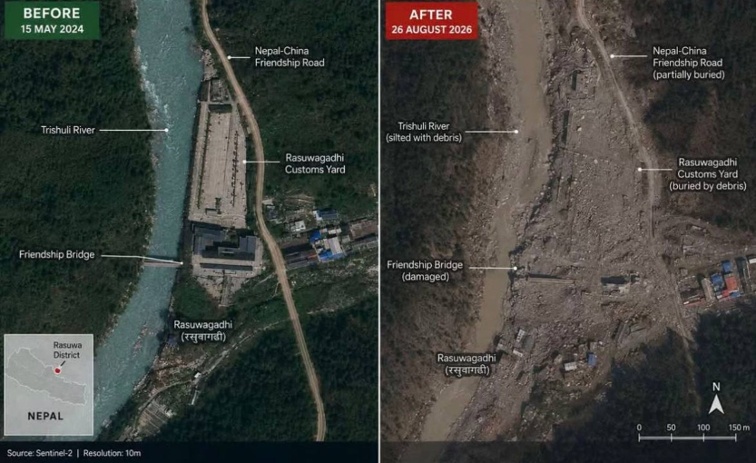
Villages along the Nepal–Tibet border were devastated by severe mountain floods, with the entire Gyirong port flattened. (Screenshot from X platform)
[People News] On Friday (August 28), the flash flood disaster along the Nepal–Tibet border entered its third day. Nepal announced that the death toll had reached 626, with 2,426 people still missing. The United States Geological Survey (USGS) stated that this disaster is the deadliest Nepal has experienced since the 2015 earthquake, triggered by a glacier collapse that unleashed massive flows of ice, snow, and debris.
Gyirong Port Flattened
On August 26, a tsunami-like mudslide suddenly erupted in the mountainous region along the Nepal–Tibet border. Torrents of floodwater roared down from the high mountains through valleys, carrying enormous energy that destroyed numerous buildings, crushing them into rubble almost instantly. Many homes in border villages vanished, resulting in heavy casualties.
Located in Gyirong Town, Gyirong County, Shigatse City in Tibet, Gyirong Port is the largest and most important national land border crossing connecting China’s Tibet Autonomous Region with Nepal and serving South Asia.
Numerous online videos show that at Gyirong Port, the Friendship Bridge, the Chinese customs gate building, and large multi-story parking structures and customs residential areas built along the valley riverbank were overwhelmed. Hundreds of people were seen running desperately to evacuate, but they and the buildings were swept away and obliterated in an instant by the massive flood.
After the mudslide subsided, aerial images revealed that all buildings in the customs area had disappeared, completely flattened.
Heavy Casualties; Nepal Actively Conducting Rescue Operations
According to the latest data released by Nepal’s National Disaster Risk Reduction and Management Authority, as of 10:00 a.m. local time on the 29th, the death toll from the flash floods in northern Nepal had risen to 626, with 2,426 people missing. Even as new flood threats remain, rescue workers continue searching through mud and debris. Some victims were even swept downstream as far as India.
Alongside the updated figures, Nepal’s disaster authorities added 933 hydropower project workers to the list of missing persons. The list also includes mountaineers and pilgrims heading to Mount Kailash in Tibet.
Hospitals in Nepal’s capital are filled with anxious family members desperately searching for missing loved ones. Walls are covered with photos and names of the missing.
Aerial images also show that the torrents of ice, snow, and debris have formed massive lakes, one of which now directly threatens rescue workers searching for survivors.
Nepalese police have urged all rescue personnel to “immediately move to safe locations,” stating that reports have been received of “another dam breach on the Tibetan side.”
In India, authorities reported that seven bodies had been recovered from rivers originating in Nepal, believed to be victims of the floods.
In Tibet, China, authorities had suspended rescue operations yesterday in the hardest-hit Gyirong area due to fears of further flooding, later stating that the threat had subsided.
Strict Monitoring of Disaster Reporting for Stability Maintenance
According to a Xinhua report early on the 29th, seven people have died and 554 remain missing in Tibet.
Because most areas are inaccessible to foreign journalists, outside information is currently largely limited to official Chinese sources.
It is well known that Chinese authorities maintain strict control over disaster reporting. While natural disasters are objective physical events, issues such as the efficiency of rescue efforts, distribution of supplies, and the quality of disaster-prevention infrastructure (such as whether “shoddy construction” exists) can easily evolve into broader questioning of local or even central authorities.
Analysts note that in the early stages of major emergencies, local and central CCP authorities immediately activate a highly unified system of information review and release to ensure that “statistical data and official narratives remain consistent.”
Secondly, official media reporting frameworks tend to emphasize the “speed and efficiency of rescue operations” and the “prompt instructions and concern of leadership.” This reflects the CCP’s characteristic approach of “turning tragedies into positive narratives.”
Thirdly, strict restrictions are imposed on independent media and on-the-ground information. In disaster zones, citizen journalists or unauthorized independent reporting often face stringent censorship or traffic suppression, limiting the public’s access to first-hand information and leaving them primarily reliant on official statements or unified releases. This is intended to prevent unverified images or data from triggering public panic or evolving into distrust or protest against the system.
Observers point out that the CCP’s information management during major disasters is a systemic outcome of its centralized political structure, media control apparatus, and “stability above all” logic. Its core objective is to maintain stability and ensure that the state retains sole authority over the narrative in times of major crisis. △








News magazine bootstrap themes!
I like this themes, fast loading and look profesional
Thank you Carlos!
You're welcome!
Please support me with give positive rating!
Yes Sure!