

Dark clouds loom over Beijing’s Tiananmen Square. (Feng Li/Getty Images)
[People News] The main article in the 20th issue of the CPC's party journal "Qiushi," published on October 16, is authored by CPC leader Xi Jinping. This article is based on a speech he delivered at the Central Commission for Discipline Inspection (CCDI) plenary session in January this year. The central theme revolves around advancing the "comprehensive and strict governance of the Party," with a strong emphasis on the need to "more resolutely and forcefully implement the major decisions and deployments of the Party Central Committee." Xi asserts that this is a "fundamental requirement for maintaining the authority of the Party Central Committee and centralised, unified leadership." This indicates that the implementation of the Party's decisions and policies is currently facing challenges within the CPC.
It is significant that the article references the "major decisions and deployments of the Party Central Committee" four times. While Xi has occasionally mentioned these major decisions in previous years, since he ascended to the peak of power at the 19th CPC National Congress, such statements have often appeared more as a formality, given that Xi himself embodies the "Party Central Committee."
However, following reports of Xi suffering a stroke in July 2024, the concepts of "Party Central Committee" and "centralised, unified leadership" have begun to be associated once again, with Xi gradually being recognised as a member of the "Party Central Committee." Although he regained some power in January this year due to the downfall of Zhang Youxia, signs of his power being diminished have quickly re-emerged. The overall tone of Xi's recent article continues to highlight the "central" position, while his own status appears to be weakening.
So, who is orchestrating the diminishment of Xi's position and the shifts in power within the CPC?
The answer can be found in the latest issue of "Qiushi". This edition features not only Xi Jinping's article but also a commentary from the editorial team that further explains how to implement the "major decision-making arrangements of the Party Central Committee". It concludes by mentioning that the upcoming Fifth Plenary Session of the 20th Central Committee will make arrangements concerning this matter.
Additionally, three other articles address topics from Xi's speeches. One of these is by Wang Xipeng, a researcher at the Chinese Academy of Discipline Inspection and Supervision, titled "Improving the Mechanism for Implementing Major Decision-Making Arrangements of the Party Central Committee". This article includes a statement that responds to the previously raised question. In the second paragraph, it states: "The decision-making and coordination institution of the Party Central Committee plays a role in top-level design, overall coordination, comprehensive advancement, and supervision of implementation in major work."
When was the central decision-making and coordination institution established? It will be established by the end of June 2025. On June 30 of last year, the Political Bureau of the Central Committee of the Communist Party of China convened a meeting, presided over by Xi Jinping. The meeting did not address the pressing economic issues that are currently of greatest concern to the public; instead, it focused on a political matter: the establishment of the central decision-making and coordination institution of the Party Central Committee, along with the formulation and issuance of the "Work Regulations of the Decision-Making and Coordination Institution of the Party Central Committee". Reports at that time indicated that the establishment of this institution "is an important institutional arrangement to enhance the centralised and unified leadership of the Party Central Committee over major work and to promote the implementation of significant tasks."
Establishing this institution outside the Political Bureau is quite unusual. It not only indicates that Xi Jinping's position is weakening but also suggests that certain individuals, likely the elders of the Communist Party of China (CPC), are entering this power structure and can exert control over the political landscape with legitimate authority. After all, they have long since retired, and without proper titles, their influence is diminished. With such an institution in place, they can participate in Political Bureau meetings, engage in decision-making, and achieve what they refer to as 'the centralised and unified leadership of the Party Central Committee.'
According to Wang Xipeng's article, since the establishment of the Central Decision-Making Coordination Institution over a year ago, it has played four key roles in significant matters: first, top-level design; second, overall coordination; third, comprehensive advancement; and fourth, supervision and implementation.
What qualifies as significant work? The foremost issue is how to manage the power transition without inciting turmoil within the Party or society, particularly given Xi's deteriorating health.
The so-called 'top-level design' likely aims to diminish the emphasis on the 'one supreme leader' status and revert to a 'collective leadership mechanism.' Following Xi's stroke, the frequency with which the CPC's official media has emphasised 'the centralised and unified leadership of the Party Central Committee' has increased significantly, and Xi himself has referenced this concept multiple times. Furthermore, articles in official media have transitioned from stating 'Xi Jinping at the helm' to 'the Central Committee at the helm.'
Once the design is finalised, it is essential to 'coordinate and advance overall efforts,' as well as 'supervise and implement.' This involves how senior CPC officials articulate their positions, how official media report on these matters, and how information is communicated down the hierarchy, among other aspects. This process requires a methodical approach to advance and implement, identify issues, and make timely corrections.
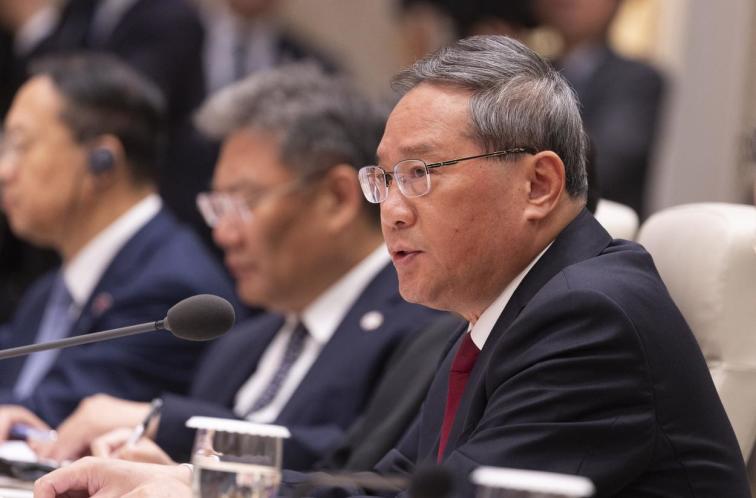
In recent months, the unusual statements from senior officials of the Communist Party of China, Xi Jinping's absence of congratulatory messages at major meetings, his inability to make 'decisions and deployments' independently, his insistence on adhering to the directives of the 'Party Central Committee', and the recent instance of Li Qiang publicly delivering a video speech on Xi's behalf at the opening ceremony of the China-North Korea Yalu River Bridge—complete with the same image specifications as Xi—are all indicative of the workings of a central decision-making and coordination institution.
This institution is undoubtedly akin to the Central Advisory Commission of the 1980s and is not intended to be a permanent body, but rather a transitional one. At that time, members of the Central Advisory Commission were allowed to attend plenary sessions of the Central Committee, and the deputy director could participate in plenary meetings of the Political Bureau. When necessary, members of the Standing Committee of the Central Advisory Commission could also attend Political Bureau meetings.
From the author's perspective, Wang Xipeng's article has made it clear to the outside world that Xi's power has been diminished while Li Qiang's position has been bolstered, a development that reflects the operations of the central decision-making and coordination institution of the Communist Party of China. The leaders of this institution are preparing for the imminent changes at the highest levels, and the forthcoming Fifth Plenary Session is expected to provide clarity on these developments.
(First published by People News) △







News magazine bootstrap themes!
I like this themes, fast loading and look profesional
Thank you Carlos!
You're welcome!
Please support me with give positive rating!
Yes Sure!