
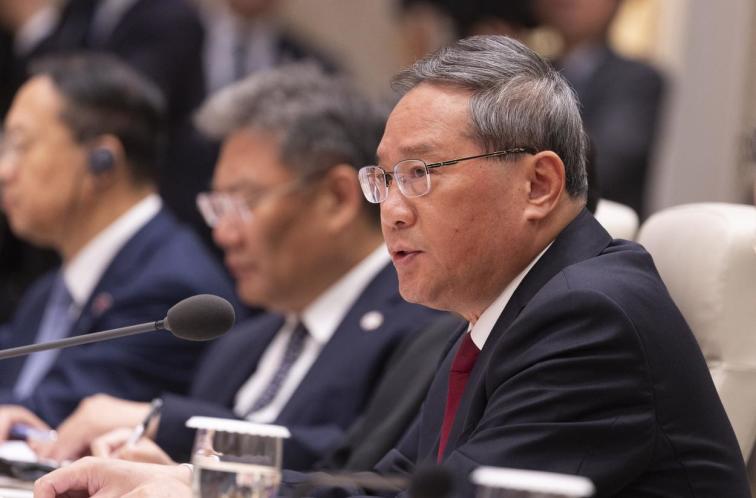
The image shows Chinese Premier Li Qiang. (Jeon Heon-kyun - Pool/Getty Images)
[People News] As the Chinese Communist Party prepares for its Fifth Plenary Session, rumours have circulated online regarding Xi Jinping's potential resignation as General Secretary of the Communist Party and President of the State. These rumours, along with various signs observed over the past few months, suggest that Premier Li Qiang is the likely successor.
On October 15, state media reported that Li Qiang delivered a video speech during the opening ceremony of the new Yalu River Bridge connecting China and North Korea. The North Korean counterpart who also delivered a video speech was Premier Pak Tae Song. This news is quite unusual.
In the author's view, over the past few years, such video speeches or congratulatory messages have typically been reserved for the Communist Party leader, Xi Jinping, and such prominence has belonged only to him.
For instance, on July 3, 2024, Xi Jinping participated via video link in the opening ceremony of the China-Europe cross-Caspian express service alongside Kazakhstan President Tokayev at the presidential palace in Astana.
On June 30 of the same year, when the Shenzhen-Zhongshan cross-river passage was inaugurated, Xi Jinping sent a congratulatory message. On June 12, Xi delivered a video speech at the opening ceremony celebrating the 60th anniversary of the United Nations Conference on Trade and Development.
On November 8, 2023, Xi Jinping delivered a video speech at the opening ceremony of the World Internet Conference in Wuzhen. On September 15 of the same year, the China-Europe Railway International Cooperation Forum was held in Lianyungang, Jiangsu. Although Xi did not attend, Ding Xuexiang, a member of the Standing Committee of the Political Bureau of the CPC Central Committee and Vice Premier of the State Council, read Xi's congratulatory message at the event.
On December 3, 2021, Xi delivered a speech at the opening ceremony when the China-Laos Railway commenced operations.
On October 23, 2018, the opening ceremony of the Hong Kong-Zhuhai-Macao Bridge took place in Zhuhai City, Guangdong Province. Xi Jinping attended the ceremony, announced the official opening of the bridge, and toured it.
Regarding Li Qiang, since he assumed the role of Premier, he has only been able to physically attend meetings and deliver speeches; there have been no video speeches reported in the news of his public activities (at least the author has not found any). Thus, this video speech by Li Qiang is not only unusual but also appears to send an important signal ahead of time.
Furthermore, the opening of the new Yalu River Bridge between China and North Korea is undoubtedly a significant event for North Korea. In a country where a single leader holds absolute power, such occasions typically belong solely to Kim Jong-un. However, Kim Jong-un was notably cooperative this time, allowing the North Korean Premier to deliver a corresponding speech while the Chinese Communist Party (CCP) arranged for Li Qiang to deliver a video speech in place of Xi Jinping.
This suggests that the CCP has informed North Korea in advance about internal developments, specifically that there will be changes in the CCP leadership at the upcoming Fifth Plenary Session in a few days, with Li Qiang playing a crucial role. For Kim Jong-un, who has long been aware of Xi Jinping's health issues, collaborating with the CCP in this manner is advantageous.
It is particularly noteworthy that in the news reported by the CCP's official media, while the word count and broadcast duration adhered to specifications, the dimensions and image size of Li Qiang's accompanying photo appear to match the standards of similar video speeches by Xi Jinping.
According to the new regulations on news reporting about Chinese Communist Party (CCP) leaders established in 2020, core leaders (General Secretary) are typically depicted in close-ups and extreme close-ups to create a visual focus. In contrast, other members of the Standing Committee are generally filmed in a more 'loose' manner, using medium shots or images that include their surroundings, with shot sizes clearly indicating their ranks.
A review of news from Xinhua News Agency and CCTV shows that Li Qiang is presented with close-ups and extreme close-ups, similar to the shots of Xi Jinping in comparable situations. This trend has only recently emerged; previously, images of Li Qiang delivering speeches at meetings were captured in a relatively 'looser' style.
The unusual video speech that replaces Xi Jinping, along with the atypical image specifications, raises a significant question: is it not quite clear that Li Qiang is poised to succeed Xi?
Furthermore, during his speech, Li Qiang echoed Xi Jinping's words to reassure Kim Jong-un, stating that 'regardless of how the international situation evolves, the Chinese Communist Party and government’s steadfast commitment to valuing the traditional friendship between China and North Korea will remain unchanged. Our unwavering support for General Secretary Kim Jong-un in leading the socialist cause in North Korea will not waver, nor will our firm determination to protect the common interests and favourable strategic environment for both China and North Korea change.'
When comparing this with news from 2025 regarding Li Qiang's meetings with Kim Jong-un and the North Korean Prime Minister, it becomes evident that such explicit support for Kim Jong-un was absent at that time. At this juncture, is Li Qiang's role as the 'crown prince' not clearly apparent?
The author has previously analysed and indicated that Li Qiang's role as a 'successor' has been apparent for some time. From August 24 to 26, Li Qiang conducted research in Heilongjiang and Jilin provinces. During this research, in addition to the usual emphasis on implementing Xi Jinping's directives regarding the 'three rural issues' and ensuring national food security, he also stressed that food security is a 'major national issue.' He stated that 'the rice bowl of the Chinese people must always be firmly held in our own hands,' and highlighted the need to 'continuously enhance agricultural comprehensive production capacity to ensure a stable and safe supply of important agricultural products such as food,' adding that 'the way to increase food production lies in technology,' among other points.
However, in Li Qiang's research over the past few years, his investigations into food production areas and concerns about food output have been quite limited; it is Xi who has genuinely made statements on this matter. Naturally, Li Qiang's low profile is a result of Xi Jinping's high visibility, as he oversees everything, including food security.
Immediately after completing his research, Li Qiang swiftly travelled to the disaster area affected by mudslides in Jilong Town, Jilong County, Tibet, on August 27. This is quite unusual, as in the past, when disasters occurred, the most Xi and Li would do is issue directives and then visit the site long after the disaster had passed for a photo opportunity. Often, they would not even take that opportunity. Li Qiang's absence was likely due to concerns about overshadowing Xi. The death of his predecessor, Li Keqiang, serves as a cautionary example.
Now, Li Qiang can visit the disaster area without hesitation, which likely indicates that he no longer fears overshadowing Xi, thus potentially avoiding Xi's resentment.
On the morning of July 28 this year, the anniversary of the Tangshan earthquake, Li Qiang, acting on behalf of Xi Jinping, visited Tangshan City to lay a wreath and offer condolences. Traditionally, Xi would have attended such an event himself.
Various indicators suggest that since the Communist Party's meetings in June, which reiterated the importance of 'centralised and unified leadership,' Xi's presence in media coverage remains prominent. However, there are many signs that indicate his military and party authority are being curtailed. It is likely that due to Xi's health issues, the Communist Party has redistributed power ahead of the Fifth Plenary Session, with Li Qiang, who has Xi's endorsement, positioned as the successor. This helps explain why several of Li Qiang's associates have ascended to power and why he has displayed various unusual behaviours.
As Li Qiang approaches the peak of his power, what strategies will he employ to address the challenges left by Xi? Particularly, how will he manage the ongoing repercussions of the 'June Fourth' crackdown on students and the suppression of Falun Gong, and how far can he advance under such burdens?
(First published by the People News) △






News magazine bootstrap themes!
I like this themes, fast loading and look profesional
Thank you Carlos!
You're welcome!
Please support me with give positive rating!
Yes Sure!