
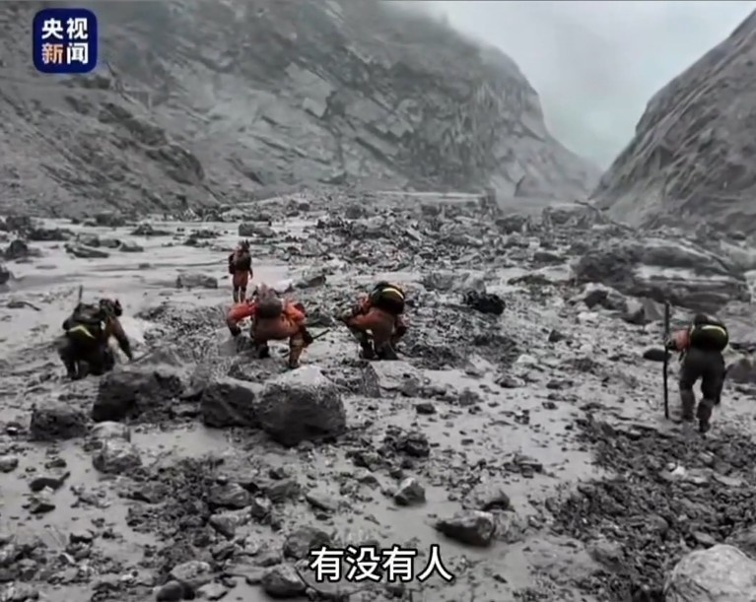
CCTV footage shows rescue personnel in the Jilong disaster area shouting loudly into the flat ground,' Is anyone there?' This is not due to a lack of spirit on their part, but rather a reflection of the director's 'too low' IQ. (Video screenshot)
[People News] On August 26, a sudden flood and landslide struck Jilong Town in Tibet, affecting the Jilong Port that borders Nepal. This disaster, occurring simultaneously on both sides of the border, provides a rare opportunity for the international community to observe the stark differences in how Nepal's democratic government and the CCP's authoritarian regime handle rescue operations and news reporting.
In Nepal, the death toll stands at 1,287, with 5,000 individuals reported missing.
As per the latest official statistics released by the Nepal National Disaster Risk Reduction and Management Authority (NDRRMA) on September 4, 2026, the large-scale landslides, mudslides, and flash floods in the border region with China (including areas like Rasuwa County) have resulted in the following casualties: 1,287 bodies have been recovered, while 5,083 people remain unaccounted for, including hundreds of foreign tourists and pilgrims. Over 5,000 individuals have sustained injuries.
Currently, Nepal's military and police, along with rescue teams, are actively conducting search and rescue operations in the affected areas, which include Rasuwa, Nuwakot, Chitwan, and others. However, the search and confirmation efforts are facing significant challenges due to some mountain roads being blocked and the geological conditions being highly unstable.
The death toll reported by the CCP is alarmingly low and completely untrustworthy.
On the Chinese side of the border, the official death toll in Tibet is reported to be just 21, with an additional 541 individuals missing, including 261 foreign nationals.
This data sharply contrasts with the videos circulating online, the level of destruction at the border customs facility (Jilong Port), and the casualty figures of thousands reported by neighboring Nepal, which has led to significant skepticism from the public and online communities regarding the authenticity of official data and the censorship of information.
The Chinese Communist Party (CCP) is fully aware that the internet is flooded with terrifying images of mudslides crashing through the Jilong customs and engulfing crowds. However, according to the CCP's propaganda logic, these are truths that must remain hidden, as the death toll serves as a 'political weapon' crucial to the 'survival of the Party and government.'
Consequently, the public observes that the death toll and number of rescues reported by the Nepalese government are increasing daily. In contrast, the CCP's reported casualty figures have remained stuck at 16 for several days, only recently creeping up to 21 before halting again.
The public is skeptical of the official figures; Tibetan human rights organizations have raised serious concerns about the low death toll released by Chinese authorities. Some netizens have sarcastically remarked, 'Don't worry, according to the Party's usual practice, the death toll will never exceed 35.'
In stark contrast to the slow and ineffective rescue operations, the CCP has acted quickly and effectively to suppress dissent. By the end of August, the Tibet police announced that they had 'punished' 10 individuals for sharing on-site footage, branding these videos taken by netizens with their mobile phones as 'false information.'
Netizens recognize that the authorities are attempting to 'kill the chicken to scare the monkey,' creating a climate of fear to prevent others with on-site videos from disclosing the truth. It is clear that suppressing the truth is the CCP's top priority in governance.
Using 'Two Dishes and One Soup' to Divert Attention
Simultaneously, official reports have entirely shifted the news focus to positive themes such as 'the party committee and government responding swiftly, rescue teams working diligently to save lives, and the affected population being adequately resettled,' while employing a strategy of high ambiguity and low-key treatment regarding actual casualty statistics.
For instance, official media outlets (including the 'Tibet Daily' and others) have extensively covered disaster rescue efforts, showcasing numerous cooks in the logistics area holding steaming iron pots filled with 'tomato scrambled eggs' and 'stir-fried pork.' Cooks have been seen cheerfully stating on camera: 'Providing hot meals to the front line ensures that the frontline officers and rescue personnel can eat their fill and enjoy a hot meal.' This portrayal leads viewers to feel as if they are watching a culinary program in a daze.
Observing the rescue officers leisurely walking along the flat riverbank, occasionally calling out in unison 'Is anyone there?', and the graceful actions of rescue team members as they touch stones and check women's backpacks, combined with the warm 'two dishes and one soup,' creates the impression that the official organization has dispatched thousands of people to Jilong Town as if to host a group travel show.
Given that the official death toll has been fixed at '21,' under the scrutiny of state media, rescue personnel 'cannot' uncover the bodies of the deceased each day, nor have they located any survivors or missing persons. So, what exactly are the thousands of rescue personnel and heavy machinery doing in the disaster area daily? Are they merely waiting to enjoy three hot 'two dishes and one soup' meals each day?
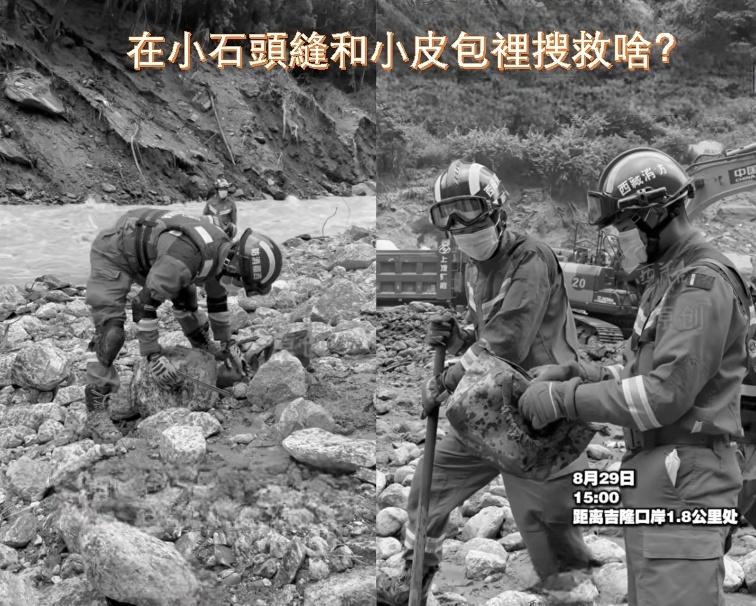
From the perspective of the Chinese Communist Party (CCP), corpses symbolize casualties and are viewed as sensitive and strictly controlled 'political liabilities.' In contrast, personal belongings such as identity cards, wallets, family letters, and mud-stained photos are seen as symbols of 'tenderness and value.' Consequently, state media can extensively report on 'rescue teams meticulously digging through mud to recover and properly safeguard the belongings of victims and the missing,' even showcasing close-ups of 'carefully cleaning the mud and sand off the photos.' This emphasis on 'caring for relics' serves to obscure 'the concealment of the truth regarding life and death.'
Funerals are being celebrated, and this is currently taking place in Jilong Town!
The CCP is attempting to repackage a profound tragedy as a 'heartfelt anthem of disaster.' However, in the context of many people being missing and families devastated, this farcical portrayal of tragedy as a 'collective camping and picnic' is deeply ironic and demonstrates a lack of fundamental respect for life.
One netizen expressed outrage, stating: 'This is the disaster relief site in Jilong, and the CCP's party militia is now showcasing their culinary skills. How many bodies remain unburied? This is truly inhumane. In comparison to the rescue efforts of soldiers in neighboring Nepal, the CCP is utterly repulsive.'
This reflects the propaganda tactic of 'shifting the focus.'
From the Wenchuan earthquake, Zhengzhou floods, and Zhuozhou water disaster in previous years, to the current mudslides in Jilonggou, Tibet, and the floods in Fujian, the reporting logic of the Chinese Communist Party's (CCP) official media, which can be described as 'holding a funeral as a celebration,' has remained unchanged: they transform natural disasters and man-made calamities into moving stories that promote the 'great, glorious, and correct' narrative, while turning accountability into gratitude gatherings. By capturing the struggles of rescue teams and the abundance of logistical support in a compelling way, the CCP aims to make the public forget to question 'how many people actually died,' 'why the early warning system failed,' and 'why the infrastructure collapsed so quickly.'
The propaganda machinery of the official media, 'holding a funeral as a celebration,' has been operating at peak efficiency for a long time!
Shifting Responsibility to the United States
The CCP's official media are also skilled at attributing man-made disasters—such as failures in early warning systems, sudden reservoir discharges, and unoperated sluice gates—entirely to 'once-in-a-century extreme weather.' They even openly shift the blame to the United States, allowing the 'little pinks' to promote the idea of 'American imperialist weather weapons.' As long as these events are classified as acts of God, no officials are held accountable.
Several official media outlets, including Observer Network, Hongxing News, Sina News, and Global Times, among other peripheral mainstream media, have coincidentally depicted the United States as the 'scapegoat.' These outlets assert that in January 2025, the Trump administration terminated the 'Hindu Kush-Himalaya SERVIR project,' which was originally designed to monitor landslides in Nepal and high-altitude glacial lakes, but was forced to shut down after the U.S. withdrew its funding.
The Chinese Communist Party's official media has repeatedly highlighted that following the disaster, the United States initially announced only $500,000 in emergency aid, which former U.S. officials criticized as 'pitiful.' This is contrasted with the millions of dollars in relief supplies, rescue teams, and DNA identification experts that China provided to Nepal.
This situation exemplifies a typical narrative in the CCP's propaganda: 'externally attacking the U.S. for its negligence while internally showcasing the responsibilities of a great power,' which serves to obscure the reality of grassroots disaster victims suffering, going missing, and being silenced.
In reaction, Chinese netizens expressed their frustration, stating: 'The Chinese Communist Party believes that all disasters in China are caused by the United States, while all achievements in China are due to the Communist Party...'
A netizen from Guangdong sarcastically remarked, 'So the responsibility lies with the U.S.!'
For the CCP regime, the loss of life is merely cold statistical data (or even data that is erased), but 'the process of disaster relief' serves as an excellent platform to showcase the regime's legitimacy and positive energy. This 'celebration of misfortune,' where the suffering of disaster victims is treated as a red carpet and significant disasters are turned into a display of political achievements, represents the most cruel secondary harm to the victims.
In reality, by comparing the different approaches taken by Nepal and the CCP regarding rescue efforts and truth reporting, netizens can clearly see that Nepal's transparency reflects the basic response norms of a modern government, while the CCP's concealment of casualty data and 'celebration of misfortune' is solely aimed at 'maintaining the regime's image and stability.' Once you recognize this, can you still trust the deceptive narratives of the CCP's official media?
(People News first published)
△




News magazine bootstrap themes!
I like this themes, fast loading and look profesional
Thank you Carlos!
You're welcome!
Please support me with give positive rating!
Yes Sure!