

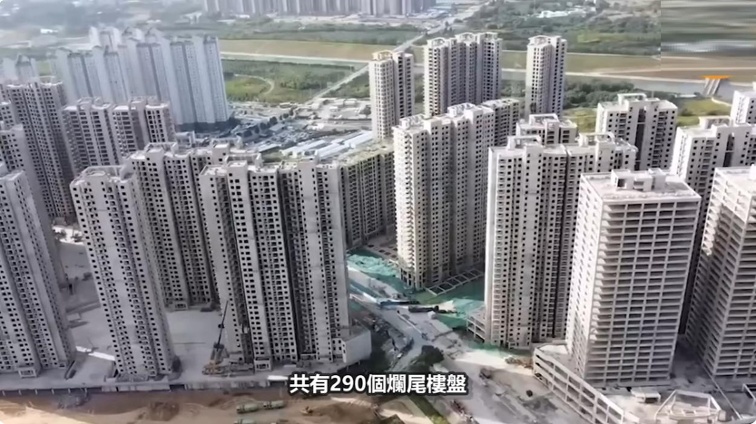
In China, nearly every real estate sales office faces a starkly quiet scene each day. (People News/AI-generated image)
[People News] Recently, relevant departments of the Communist Party of China rushed to release the 'Opinions on Reforming and Improving Real Estate Credit Management to Promote the Acceleration of Building a New Model for Real Estate Development' ahead of the 'Golden September and Silver October' period. The key point of this document, which states that 'the maximum term for personal housing loans will be extended from 30 years to 40 years,' has garnered significant attention.
Following the release of the document, a senior economist promptly provided an analysis and interpretation in state media. He stressed that the focus of the document is on 'new loans,' rather than 'existing loans.' But is this truly the case? Let's first examine this concept of 'new loans.' He suggests that it primarily targets individuals in their 20s to 30s, with the government 'hoping that this group can enter the market.' However, the expert was unclear about whether this demographic actually possesses the economic capacity to secure loans for home purchases.
Initially, he categorizes this group of young people as those who are 'just starting work,' meaning they are currently employed. However, he acknowledges that they are still in a phase of 'income growth' and that their 'income may be stabilizing,' which indicates a less than comfortable financial situation, while they also 'have limited savings.' This suggests that even those who are employed may not have the financial means to take out loans for home purchases, let alone the majority who experience 'unemployment immediately after graduation.'
Recently, the Chinese Communist Party announced that the youth unemployment rate for July this year has reached 17.9%, marking the highest level for the same period in nearly three years and setting a new record since September of last year. However, this somewhat troubling figure is likely a polished version of the 'registered unemployment rate.' To be counted in these statistics, individuals must have contributed to the five social insurances and one housing fund (only the 'five insurances' include unemployment insurance, while the 'three insurances' do not) and must have actively applied for unemployment benefits from the government to be considered 'registered.' It is highly unlikely that these individuals come from 'flexible employment,' nor are they the young students coerced by universities into falsifying 'tripartite agreements' only to face 'graduation and unemployment.' Their original employers are likely to be various levels of government or state-owned enterprises.
The express delivery and takeout markets in mainland China are already saturated, and in many areas, young people can even be seen scavenging for garbage or begging. Even those who are relatively fortunate and can rely on their parents find it unrealistic to continue draining the six wallets at home to buy a house. Nevertheless, the experts maintain that today's youth can inherit multiple 'houses left by the elderly,' and due to their 'abundance of choices,' they may be less inclined to take out loans for home purchases. In summary, the reasons young people are not buying homes are either that their families own multiple properties or that 'I am happy living here today, but if I am not happy tomorrow, I will move to another city.' It is certainly not because they are unemployed, lack income, or cannot afford to buy due to insufficient funds.
This raises the question: if it is clear that young people are unwilling to take out loans to buy homes, why is the government still focusing on the new policy of 'extending mortgages to 40 years'? Does this approach suggest that bureaucrats are simply 'acting on impulse'? One expert is making a concerted effort to mislead and shape public opinion, trying to obscure the reality that many young people are unemployed, yet he fails to realize that he is lifting a stone only to drop it on the feet of his master, the Communist Party of China.
While the expert's flattery may have missed the mark, it does not imply that the government's introduction of new regulations is without careful consideration. The expert's self-contradiction does not mean he did not put in significant effort to cover up and polish the narrative for his superiors. In fact, his outright dismissal of 'stock' is akin to saying 'there's no silver here'.
'Stock' refers to those individuals who already have mortgages with banks. Concerning the repayment issues faced by this group, a domestic online media outlet published an article in January of this year that revealed an important insight: 'Banks are more afraid of the house being auctioned than you are.' The article noted, 'With housing prices currently declining, many cities have seen prices drop by over 20% compared to a few years ago,' and added that 'foreclosed properties typically sell at a 30% discount.' This means that a house valued at 1 million would 'ultimately sell for at most 500,000. If there is still 800,000 owed on the loan, the bank would incur a loss of 300,000. Therefore, the bank would prefer to hold off, either waiting for housing prices to rebound or hoping to negotiate with you.'
In reality, if houses can be auctioned off, the pressure on banks would be significantly reduced. The greatest concern is being left with properties that cannot be sold. It is easy to imagine that when dealing with borrowers who are unable to meet their monthly payments, banks will likely first advise them to withdraw, using more favorable pricing arguments to encourage them to attempt to sell their homes independently. This approach means that even if the proceeds from the sale do not fully cover the outstanding loans, the remaining debt can still be serviced. Banks will never incur a loss.
However, with the imminent collapse of the mainland real estate market, successfully selling a house is far from straightforward. More homeowners, who possess properties that have lost value, will likely surrender them directly to the banks for foreclosure. As banks approach their limits, the Chinese Communist Party is left with no choice but to implement drastic measures.
An article that has been taken down, titled 'The 40-Year Mortgage is Here: Can Ordinary People Really Bear It from Graduation to Retirement?' presented a calculation: 'For a loan of 1 million yuan, at an annual interest rate of 3%, the monthly payment for a 30-year term is approximately 4,216 yuan, while for a 40-year term it is about 3,581 yuan, resulting in a monthly saving of 634 yuan.'
If such figures can be used to persuade borrowers, banks would find it much easier to recommend withdrawal. However, the significant drawback is that 'the longer the loan term, the more total interest is paid to the bank,' and 'while the monthly payment for a 40-year term is reduced by over 600 yuan compared to a 30-year term, the total interest paid will ultimately exceed 200,000 yuan.'
When a borrower has 800,000 remaining on their loan, and the house is auctioned for 500,000, the bank incurs a loss of 300,000. If the property fails to sell, the bank faces a total loss. On the other hand, if the borrower can continue to make payments by extending the loan term and utilizing the remaining time, the bank not only avoids losses but can also earn significantly more.
Consequently, some online media have begun to stir the pot—"Stopping payments is not the end; the real danger lies in choosing to lie flat and avoid facing the issue," "The first step is to proactively negotiate with the bank; don’t wait for them to approach you," "You can... apply for an extension of the repayment period," and so forth.
Just as the online media wrapped up their dramatic performance, experts stepped in to play the role of the naysayer. The experts, using a mix of persuasion and caution, stated: "In principle, existing loans... can be extended," but "the key is that the bank must agree to the extension... because they need to evaluate your reasons for requesting it and the likelihood of future repayments," "An extension of 40 years cannot exceed the age of 70, and this combined assessment can be quite challenging." Doesn’t this seem like wanting to benefit while also trying to be accommodating? You end up paying more interest, and you still need to get the bank's approval first?
Recently, there has been much discussion among people within the walls about Xu Jiayin's massive debts, which he refuses to repay, while ordinary citizens are relentlessly pursued for their small debts to banks. An online media outlet published an article titled 'Evergrande Real Estate Initiates Bankruptcy Liquidation, Xu Jiayin Drags Down 20 Banks,' which reported that 'as of the first half of 2023, China Evergrande's total liabilities stand at approximately 2.39 trillion yuan,' with 'loans accounting for about 624.77 billion yuan, or 25%, which consists of loans from banks, trusts, and other financial institutions.' Although the 'bankruptcy liquidation process' has begun, banks remain uncertain about 'how much of the money lent out can be recovered, when it can be recovered, and through what means it can be recovered.'
How many Xu Jiayin figures exist within the Communist Party of China? How much have the hidden elites and powerful figures behind them embezzled? The question of whether banks are out of money or why they are incurring losses can be compared to the current situations of other central and state-owned enterprises, as well as government departments and public institutions. Under the Communist Party's blatant plundering and harvesting model, both state-owned and private capital have long been appropriated by this interest group.
Currently, the extension of the repayment period for ordinary people's housing loans is merely a performance where the sickle will not spare the leeks, and the harvesting of leeks must continue. The Communist Party will never 'put down the butcher's knife' without first emptying the property, or even the bodies, of the Chinese people.
(First published in People News) △







News magazine bootstrap themes!
I like this themes, fast loading and look profesional
Thank you Carlos!
You're welcome!
Please support me with give positive rating!
Yes Sure!