
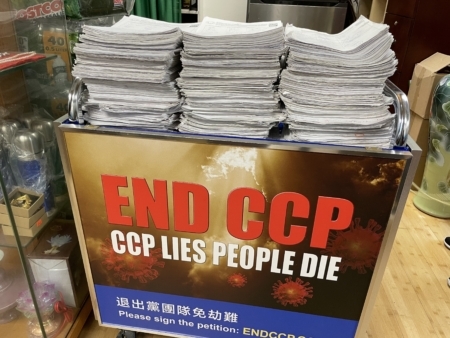
Signed petitions for the ‘End CCP’ initiative, filling up a small cart. (Provided by the Tuidang Center)
[People News] For the past fifty years, a unique set of rules for engaging with the Chinese Communist Party (CCP) has been entrenched in American diplomatic circles: sensitive issues should be discussed privately; avoid publicly embarrassing Beijing; allow CCP leaders to 'save face'; trust the assurances they provide in private; and most importantly, major issues are best resolved behind closed doors.
In the annals of modern American diplomacy, few principles have been so firmly believed yet so resistant to factual scrutiny.
The concept of 'backroom diplomacy' should have been consigned to history long ago.
When China joined the World Trade Organization, it made solemn commitments to adhere to the rules and open its markets; it promised not to militarize the South China Sea; it assured a high degree of autonomy for Hong Kong; and on matters such as human rights, intellectual property, cyber conduct, and international regulations, Beijing has made countless promises.
What has been the outcome?
Time and again, Beijing has first secured the benefits, only to later breach its commitments, evade responsibilities, or simply reinterpret its promises. Time and again, Washington receives new private assurances from Beijing; yet, time and again, what Beijing extracts are new tangible gains.
So why has this diplomatic superstition endured to this day?
Because it has sustained a large interest group—a professional 'China broker' class. Their status and value hinge on an assumption that can never be disproven: as long as we engage in one more secret conversation with Beijing, the CCP will become a bit more accommodating.
Wall Street seeks access to the Chinese market; Silicon Valley is interested in Chinese consumers and supply chains; K Street lobbying firms are after clients; universities are looking for Chinese funding, students, and pathways into China; think tanks desire projects, consultants, and various 'distinguished researchers.' Some former officials and out-of-favour politicians have also suddenly realized that Beijing can provide them with something that Washington no longer offers—visibility.
Consequently, a rather absurd situation has arisen in U.S.-China relations: a group of Americans continuously warns their fellow citizens to avoid offending the Chinese Communist Party.
In reality, as long as there are enough influential Americans willing to advocate for Beijing, the Chinese Communist Party doesn't even need to lobby Washington directly. This network of interests has also led to the emergence of a group of Chinese issue experts who tend to blame the U.S. first. In their view, any aggressive actions by the Communist Party can almost always be traced back to America's own mistakes.
Is China militarizing the South China Sea? It's due to U.S. pressure. Is Beijing threatening Taiwan with military force? Washington hasn't provided enough 'security.' Is the People's Liberation Army expanding rapidly? The Pentagon has sparked an arms race. Did the Communist Party violate agreements? Perhaps it's because Americans 'don't understand Chinese history.'
In short, Beijing always has its grievances, while Washington always bears the responsibility. This self-deceptive diplomatic tradition can actually be traced back to the very beginning of the 'ice-breaking' in U.S.-China relations.
Nixon and Kissinger did achieve a significant strategic breakthrough in their time, but they also established a highly personalized and secretive diplomatic approach towards China. In this framework, Beijing exercises an unusual degree of control over the negotiation environment, language interpretation, and even the flow of information.
The significant negotiations held with Mao Zedong and Zhou Enlai in the past often depended on highly trusted translators from the Chinese Communist Party (CCP) leadership, such as Mao's personal translators Tang Wensheng and Wang Hairong, rather than fully utilizing the United States' own professional diplomatic translators as per standard diplomatic practices.
CCP senior translators have never been just language workers. They are political cadres who have undergone strict political training, have a profound understanding of the workings of party and state power, and directly serve the highest leadership of the CCP.
In a major diplomatic negotiation, if one party has overwhelming control over language interpretation, the consequences are clear: tone can be adjusted, concepts can be redefined, meanings can be obscured, and ambiguities can be exploited.
These ambiguities later caused significant issues for the United States for decades.
What does 'China' truly mean? What commitments did the United States make to Beijing regarding the Taiwan issue? What defines 'sovereignty'? What is merely a position claimed unilaterally by the Chinese side? What are the actual commitments that the United States accepted in several key joint communiqués and various summits?
These seemingly minor distinctions ultimately evolved into diplomatic disputes that have lasted for generations.
Thus, no American president should make decisions on major national interests behind closed doors with the General Secretary of the CCP in an information environment controlled by the CCP, without competent American translators, record-keepers, and professional advisors present, nor should there be an accurate and complete institutional record left behind.
The fate of the nation must never be left to the personal feelings of any American president, specifically, the belief that he has established some form of 'special relationship' with the CCP leader sitting across the table.
Creating such illusions is a hallmark of the leaders of the Chinese Communist Party (CCP). They carefully orchestrate every meeting, complete with red carpets, honor guards, and state banquets, all enhanced by a few meticulously chosen, pretentiously profound Chinese idioms. The professional bureaucrats of the Communist Party morph into 'philosopher kings' filled with 5,000 years of Chinese wisdom, captivating foreign dignitaries. In contrast, ordinary Chinese citizens often find themselves confused, unable to comprehend why foreigners are so easily misled.
Much of the so-called 'Chinese wisdom' presented to foreign audiences consists of common sayings that are well-known to the Chinese. This scenario is reminiscent of the political satire film 'Being There,' where gardener Chance casually discusses flowers, trees, and the seasons, while a group of self-proclaimed intellectual elites mistakenly interprets his simple words as profound insights into economics, politics, and the rise and fall of civilizations.
The CCP has transformed this absurd performance, akin to that of 'gardener Chance,' into a sophisticated form of geopolitical art.
Jiang Zemin had a particular fondness for displaying his knowledge in front of foreigners. One of his most notable performances was his incessant recitation of Lincoln's Gettysburg Address—an act by the General Secretary of a Leninist dictatorship, who relied on one of history's greatest democratic declarations to showcase his own civility and intellect, all while fundamentally opposing the principles of 'government of the people, by the people, for the people.'
Xi Jinping harbors an almost uncontrollable desire for foreign leaders to perceive him as a profound thinker and a great figure knowledgeable about history. However, within China, he is frequently mocked as a pompous yet incoherent 'Winnie the Pooh', notorious for his gaffes and embarrassing blunders.
The real question is: which is more absurd, the performances of Jiang Zemin and Xi Jinping, or the Western audiences who are genuinely moved by such displays?
The Western fascination with the so-called 'face' of the Chinese is also a manifestation of naivety.
For decades, Americans have been cautioned against publicly criticizing Beijing, as 'Chinese culture places a high value on face', and such criticism could humiliate Chinese leaders.
This idea is often presented as a deep understanding of Chinese culture. In truth, it reflects a condescending paternalism.
Chinese people are not an unusual pre-modern nation that requires careful attention to their 'face' from Western civilized individuals. More importantly, the ruling elite in Beijing are not emotionally fragile Confucian sages steeped in ancient traditions. They are officials of a Marxist-Leninist party, equipped with nuclear weapons, intelligence agencies, propaganda machinery, and the largest military force in the world.
In reality, using 'Chinese culture' to explain the actions of the Chinese Communist Party completely distorts the historical narrative.
Marxism-Leninism has never been part of China's cultural heritage; instead, it is a radical ideology that was imported from the West and imposed on the Chinese people through the Leninist party-state apparatus. Its political terminology is derived from figures such as Marx, Lenin, Stalin, and Mao Zedong, and is rooted in the fierce conflict between capitalism and communism, as well as concepts like democratic centralism, the united front, ideological discipline, and the party's absolute leadership.
The misconception of Leninism as 'Chinese culture' represents one of the most persistent and arrogant misunderstandings in the West.
Backroom diplomacy has another serious consequence: it instills fear and anxiety among America's allies.
Whenever a U.S. president and the General Secretary of the Communist Party of China vanish behind closed doors, countries like Taiwan, Japan, South Korea, the Philippines, Australia, and other American partners instinctively wonder: What are they discussing? Will Washington compromise our interests?
Even if the U.S. ultimately makes no concessions, the very act of secrecy fosters suspicion. The resulting doubts and unease among U.S. allies constitute a strategic victory for Beijing.
This is not to suggest that the U.S. should refrain from dialogue with China. It is essential for these two nuclear powers to maintain communication. Some diplomatic negotiations do require confidentiality. However, secrecy should be a diplomatic tool, not a guiding principle.
The core principle of U.S. diplomacy should be the opposite: if something can be made public, it should be; if it can be documented, it should be; if it can be verified, it should be.
Significant agreements must be formalized in writing; professional translators from the U.S. should be present; allies must be consulted; important commitments made by the Communist Party of China should be publicly documented whenever feasible; and any violations should be publicly disclosed.
Regarding the assurances made by Beijing in private, they hold no value until they are converted into observable and verifiable actions.
Crucially, Washington needs to abandon a longstanding bad habit: it should stop being so afraid of embarrassing the Chinese Communist Party (CCP). At times, making the CCP uncomfortable is not only necessary but essential.
A dictatorship that allocates astronomical resources to suppress information, imprison dissenters, distort history, and maintain a massive propaganda apparatus has already revealed to us what it fears the most. It fears the truth. It fears transparency. Most importantly, it fears the truth being exposed to the public.
Sunshine can accomplish what yet another lavish state banquet in Beijing can never achieve. It can increase the cost of lying, provide reassurance to America's allies, and eliminate Beijing's ability to tell different stories to different audiences.
For more than fifty years, many in the U.S. diplomatic community have clung to a peculiar assumption: that if the door is closed, with no reporters, no public, and no allies observing, the CCP will suddenly become more rational, pragmatic, and trustworthy.
History has shown the exact opposite to be true. In private settings, Beijing can flatter, intimidate, incite, distort, make solemn promises, and issue arbitrary commitments. It is only in the light of day that it must be held accountable for its words and actions.
The CCP has seldom yielded to whispers in closed rooms. What can genuinely compel it to back down is to bring the truth to light, to place diplomacy under scrutiny, to expose deception, to impose costs on betrayal, and to raise the stakes of open confrontation to an unbearable level.
When it comes to confronting the Chinese Communist Party, secretive whispers in backrooms will not bring about change; only the truth revealed in the open can compel it to alter its course. To date, history has not demonstrated otherwise.
(Source: Author X Account)
△





News magazine bootstrap themes!
I like this themes, fast loading and look profesional
Thank you Carlos!
You're welcome!
Please support me with give positive rating!
Yes Sure!