
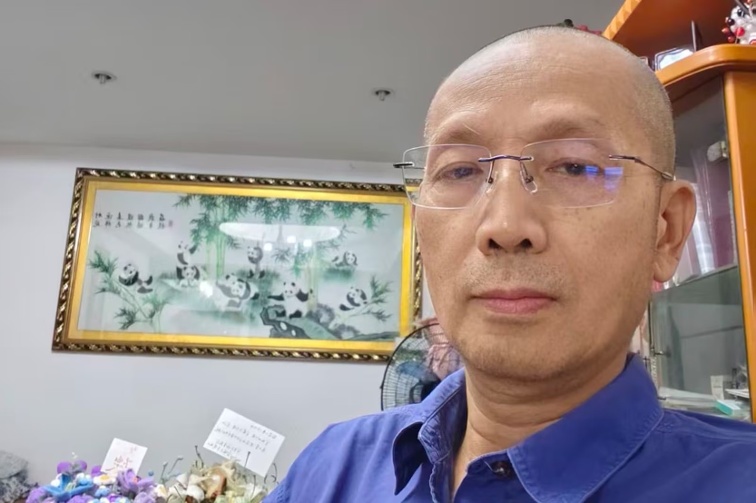
In April of this year, Cao Sanqiang was diagnosed with late-stage prostate cancer and is appealing to the authorities to issue him a passport on humanitarian grounds, which would allow him to join his family in the U.S. (Provided by Cao Sanqiang)
[People News] Pastor Cao Sanqiang, who served a seven-year prison sentence, has faced restrictions on his ability to leave the country for two and a half years due to the Chinese Communist authorities. In a recent interview with Radio Free Asia (RFA), he mentioned that he has applied for a passport several times since his release, but has been unable to obtain one because he is on a border control list. He hopes that the authorities will consider his situation and grant him a passport to reunite with his family in the U.S.
As reported by Radio Free Asia, Cao Sanqiang explained that he sought treatment at Xiangya Hospital of Central South University in April due to severe pain in his right foot, which was initially diagnosed as inflammation. After taking anti-inflammatory medication for over ten days without improvement, he underwent MRI and biopsy tests that confirmed he has late-stage prostate cancer. Since then, he has received chemotherapy and radiation therapy, which have led to significant weight loss and the need for a wheelchair for longer distances. His treatment is currently paused as he waits for his body to recover for a follow-up examination.
He shared with reporters, "At my age, my body cannot handle this, and it has caused significant side effects. I have lost weight suddenly, and I can no longer walk; I need to use a wheelchair for longer distances."
Repeated Denials of Passport Applications
Cao Sanqiang currently lacks medical insurance and lives with his 90-year-old mother, relying primarily on her pension and support from church members to cover living and medical expenses. His wife and son had returned from the U.S. to Changsha for ten days in May to be with him, but they left afterwards due to work obligations.
He stated, "If I stay in the hospital, it costs about 3,000 yuan a day, so after a month, I spent nearly 100,000 yuan. This is a significant burden for me."
Cao Sanqiang received theological education in the United States and holds permanent residency there. In March 2017, he returned to Yunnan, China, from Wa State in Myanmar, entering through an informal channel. He was subsequently sentenced to seven years in prison by the authorities for 'organizing others to illegally cross the border.' In 2019, the United Nations Working Group on Arbitrary Detention concluded that his detention was arbitrary and linked to his Christian faith.
On March 4, 2024, Cao Sanqiang was released from prison after completing his sentence. Since then, he has made multiple trips to the exit and entry administration department in Changsha to apply for a passport. When the staff entered his name into the system, it immediately displayed 'prohibited from leaving the country,' without providing any explanation for the border control or its duration.
He recounted, "I specifically asked him, 'If you are prohibiting me from leaving, how long will it last?' He said he didn't know. So, it became a matter of me needing to try again, right? To test that system and see how long it will hold me back."
Cao Sanqiang also submitted a handwritten application to the Changsha Public Security Bureau, explaining that he is suffering from cancer and faces a constant threat of death, requesting permission to travel to the United States. Local public security officials informed him that his application would be escalated through the proper channels. He later wrote to the Minister of Public Security to plead his case, but has not yet received a response.
Our station attempted to contact the exit and entry administration department of the Changsha Public Security Bureau, but no one answered the phone.
Reporting for going out, three individuals followed.
Cao Sanqiang stated that after his release, he is still required to report in advance when traveling to other cities. The relevant authorities will arrange for three individuals to accompany him to the same city, find another hotel near his residence, and meet him for dinner every two days to ensure he remains in the area.
He mentioned, "Whenever I go to a new place, they always send someone to follow me. Over the past two years, I have traveled to many locations because I want to visit some brothers and sisters, and there are always people shadowing me."
He has previously told the personnel following him that if they allowed him to leave, the three of them could engage in other work, thus saving related expenses.
The reasons for and duration of the border control remain unclear.
When asked if the border control is related to his prior sentencing, Cao Sanqiang indicated that the relevant departments have never provided an explanation. When inquiries are made, staff often respond with, "You know in your heart."
He expressed, "Why can't I leave? I find it very confusing. There are simply too many people under border control in China, as numerous as the hairs on a cow. They don’t provide reasons. If you ask, 'Why can't I go out?' the typical response is 'You know in your heart,' and that’s how they reply."
His wife, two sons, and grandson are all American citizens. His grandson was born in July 2025 and has never met his grandfather.
Reflecting on his illness and distant relatives, he said, "This cancer can spread at any moment, which could pose a life-threatening risk. However, I truly hope to be with my family. If I can meet them, we refer to it as meeting God; if I can quietly leave this world in the presence of my family, that would also be a very beautiful thing."
Cao Sanqiang is calling for intervention from the U.S. government and the international community. He noted that Jin Mingri, a pastor from the Beijing Zion Church, was released in July and has since reunited with his family in the United States. Prior to Jin Mingri's release, U.S. President Trump had brought up his case with Xi Jinping, the leader of the Chinese Communist Party. Cao hopes that the U.S. government will also advocate for his name with the Chinese authorities, pushing for the lifting of border controls and the issuance of a passport for him.
In August, the China Aid Association, based in Texas, initiated a petition titled 'Bring Pastor Cao Home.' The association's founder, Fu Xiqiu, recently spoke to the Taiwan Church News, stating that Cao Sanqiang has completed his prison sentence and is now fighting late-stage cancer, which has turned the situation into a humanitarian crisis. He urged the Chinese government to remove the exit restrictions, allowing Cao Sanqiang to return to the U.S. to receive care from his family. △








News magazine bootstrap themes!
I like this themes, fast loading and look profesional
Thank you Carlos!
You're welcome!
Please support me with give positive rating!
Yes Sure!