
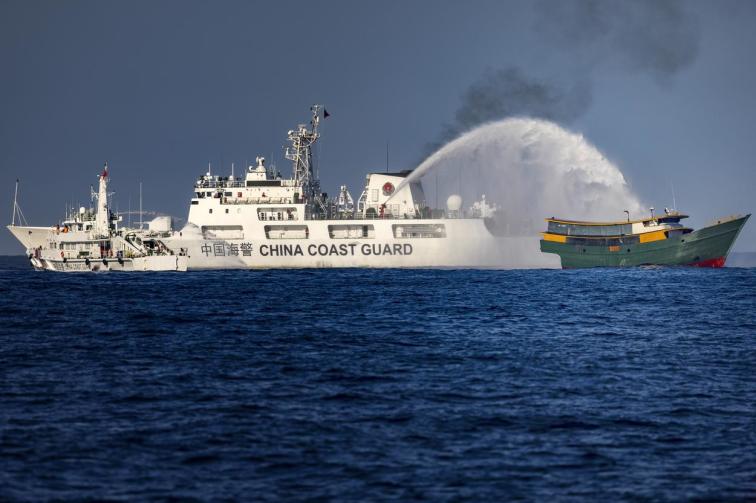
On March 5, 2024, a collision occurred in international waters between a Philippine supply ship and a China Coast Guard vessel. The windshield of the Philippine ship was shattered by a high-pressure water cannon fired by the China Coast Guard, resulting in minor injuries to four Filipinos. (Photo by Ezra Acayan/Getty Images)
[People News] Recently, Jing Quan, the Chinese ambassador to the Philippines known for his 'Wolf Warrior' diplomacy, has sparked controversy with his unrestrained comments. On October 19, Philippine Foreign Secretary Maria Theresa Lazaro summoned Jing Quan to express 'serious concern and strong opposition' regarding his recent statements, informing him that his remarks made to the media last week were 'provocative and unacceptable.' Furthermore, a Philippine senator has formally proposed to designate Jing Quan as an unwelcome person.
Calls for Jing Quan to Leave
This diplomatic dispute arose after Philippine Defence Secretary Gilberto Teodoro Jr. referred to China as a regional 'troublemaker.'
In response, Ambassador Jing Quan stated in a media interview: 'If we wanted to use force, we could easily win. But we won't; we will not choose to resort to violence; we love peace.'
These comments immediately stirred significant reactions in Philippine politics. President Ferdinand Marcos Jr. remarked that this statement sounded 'very much like a threat' to him.
The Philippine Department of Foreign Affairs indicated that Jing Quan's remarks were 'almost a blatant threat of military action,' which were provocative and unacceptable. The Philippines reserves the right to take further diplomatic actions if necessary.
Foreign Secretary Lazaro emphasised that such statements do not contribute positively to the already sensitive bilateral relations and undermine the joint efforts of both nations to foster mutual understanding and cooperation, stressing that sensitive issues 'are best addressed through established diplomatic channels and bilateral mechanisms.'
The statement emphasised that as a democratic nation, the Philippines cherishes freedom of speech and mainstream opinions, and will not tolerate foreign diplomats attempting to threaten those exercising these rights.
Jing Quan responded by asserting that he "disagrees" with the accusation that he threatened military action against the Philippines, while countering that Manila has engaged in "negative actions" concerning the Taiwan issue.
The office of Philippine Senator Erwin Tulfo has formally submitted a resolution requesting that Jing Quan be declared a "persona non grata." Tulfo remarked that instead of waiting for the Philippine Senate to officially declare him "persona non grata," Jing might consider leaving voluntarily.
Tulfo also brushed off the intimidation from the Chinese Embassy in the Philippines, which warned against allowing anti-China politicians to enter China. He stated, "This is not an issue. Personally, I have no plans to visit China, Hong Kong, or Macau at this time."
He stressed that as an elected member of Congress, remaining silent in the face of controversy would undermine the role of being a representative of the people, asserting, "We speak out because we have that right."
Is the Chinese Communist Party concerned that its wolf warrior diplomacy could lead to war?
In reality, when the Chinese Communist authorities pursue "wolf warrior diplomacy," it is not that they are "completely unafraid of war," but rather that their internal political logic and strategic calculations lead them to believe that this diplomatic style "will not genuinely provoke a large-scale war."
In other words, the Beijing authorities view wolf warrior diplomacy as a tool for 'extreme pressure and psychological intimidation,' aiming to maximise strategic interests and internal political legitimacy while avoiding a full-scale conflict.
The Chinese Communist Party (CCP) is highly skilled in utilising 'grey zone strategies' and 'extreme pressure' in its diplomatic efforts.
Wolf warrior diplomats often adopt a confrontational tone and issue threats (such as 'it would be easy to win if we decided to use force'), essentially engaging in 'brinkmanship.' Beijing assumes that Western nations and neighboring countries (like the Philippines and Japan) prioritise regional stability and fear being drawn into conflict; thus, the more aggressive their rhetoric and the higher their stance, the more likely the opposing side may make concessions at the negotiating table or back down on issues such as the South China Sea and the Taiwan Strait.
While wolf warrior diplomats are extremely assertive in their diplomatic language, the CCP typically exercises precise control over the principle of 'not firing the first shot' in actual military actions. For instance, during confrontations in the South China Sea with the Philippines, they employ coast guard vessels, water cannons, and ramming tactics—non-military methods. This strategy of 'extremely tough rhetoric while actions hover on the brink of war' is intended to avoid directly triggering the U.S.-Philippines Mutual Defence Treaty.
'Internal propaganda' is significantly more important than 'foreign relations.'
Under the Chinese Communist Party's (CCP) system, diplomacy is not merely about managing international relations; it also serves as a tool for maintaining the legitimacy of internal governance. Diplomatic postures act as a 'shot in the arm' that can alleviate domestic tensions, particularly in the context of China's economic slowdown, rising youth unemployment, and low social morale. The government is in urgent need of a tough diplomatic stance to cultivate a sense of national pride in 'the rise of a great power,' 'the gathering of nations,' or 'looking at the West from an equal standpoint.' The more 'wolf warrior' the diplomats appear, the better they can cater to domestic nationalist sentiments and divert public attention from the challenges faced at home.
For CCP diplomats, making 'incorrect statements or appearing too weak' on the international stage is considered a grave political error within the system (they risk being labelled as traitors or weaklings). In contrast, even if 'speaking too harshly' leads to diplomatic disputes, it is regarded internally as 'having a firm political stance and being willing to fight.' For individual diplomats, it is preferable to err externally than to show weakness internally.
Disregarding the Weakness of Neighbouring Countries
Beijing possesses a deeply rooted 'great power mentality' towards its smaller neighbouring countries (such as those in Southeast Asia). Former Foreign Minister Yang Jiechi has publicly asserted: 'China is a great power, and other countries are small countries; this is a fact.'
In Beijing's view, smaller neighbouring countries like the Philippines have limited military capabilities and could never 'actively declare war on China.' As long as the U.S. military does not directly intervene, the CCP believes it holds absolute military superiority, leading to a condescending tone and even open threats, under the assumption that smaller nations ultimately have no choice but to accept their position.
Wolf Warrior Diplomacy Has Significant Backlash.
While the Chinese Communist Party (CCP) believes that wolf warrior diplomacy will not directly lead to war, this 'bullying' diplomatic approach has resulted in significant strategic backlash, leaving the CCP in a more isolated situation.
Initially, wolf warrior diplomacy aimed to intimidate the Philippines, but the opposite occurred—rather than being deterred, the Philippines has accelerated the opening of additional military bases to the U.S. and strengthened security cooperation with Japan and Australia.
The confrontational statements from wolf warrior ambassadors have rendered Xi Jinping's 2013 diplomatic principle of 'amity, sincerity, mutual benefit, and inclusiveness' irrelevant overnight. This has also led the Western world and neighbouring countries to recognise the authoritarian nature of the CCP, thereby hastening efforts for economic 'de-risking' and technological blockades.
The CCP does not genuinely seek to instigate war through wolf warrior diplomacy; instead, it hopes to 'deter opponents with a tough posture' while simultaneously fostering domestic nationalism to maintain stability.
However, this 'over-calculated' extreme diplomacy, while meeting internal political demands in the short term, has ultimately alienated neighbouring countries in the long run, placing China in an increasingly isolated and passive position on the international stage.
(First published by People News) △







News magazine bootstrap themes!
I like this themes, fast loading and look profesional
Thank you Carlos!
You're welcome!
Please support me with give positive rating!
Yes Sure!