
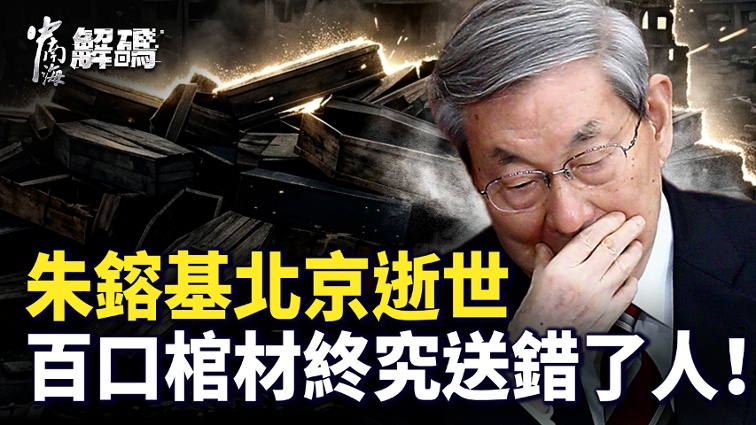
Zhu Rongji has passed away in Beijing. In the end, the coffin was mistakenly sent to the wrong person!
[People News]
One
Zhu Rongji has passed away at the age of ninety-eight on August 12, 2026, in Beijing. The obituary presented the usual array of titles that anyone could easily recite—'a long-tested loyal communist warrior, an outstanding proletarian revolutionary and politician.' However, it is curious that the public's reaction to this obituary and the same individual was markedly different from that of any previous high-ranking official of the Chinese Communist Party (CCP).
When Jiang Zemin died, the internet was filled with the 'Jiang Xuan' meme. Upon Li Peng's death, half of the comments were cursing the June Fourth Incident, while the other half were mocking. In contrast, reactions to Zhu Rongji were sharply divided: one faction viewed him as the only person in the CCP still deserving of the title 'capable minister,' while the other coldly pointed out—who exactly did he save?
This polarization is itself worthy of reflection. It highlights a question that looms over Zhu Rongji: why would someone who was aware of the regime's evil contribute to its continued existence?
Two
To address this question, we must first examine his origins.
Zhu Rongji, born in 1928 in Changsha, Hunan, lost his parents at a young age. His educational years coincided with the last golden era of modern education in China. He attended Guangyi Middle School, a prestigious private institution founded by revolutionary pioneer Yu Zhi Mo in 1905. At that time, a saying in Changsha went: 'To learn is to gain.' He completed his high school education at Chuyi School, established by Chen Runlin, where he specialized in mechanical studies. He then progressed to National Eight High School and Provincial First High School, ultimately gaining admission to the Electrical Engineering Department at Tsinghua University. This sequence of schools represents a complete lineage of 'new-style education' from the Republic of China, encompassing English, mathematics, practical skills, and a scientific spirit, all underpinned by moral standards that had not yet been entirely distorted by politics. An interesting detail from the archives notes that during evening self-study sessions, while others argued over the direction of the tung oil lamp, Zhu quietly memorized English in a corner. He would then stand up and light the wick on both sides, effectively resolving the dispute among his peers.
This lineage is associated with a group that is fading away. In the first half of the twentieth century, a systematic cultivation of a generation of Chinese elites trained in Western modern thought and religious humanities took place, spanning from church schools to local new-style institutions. Almost all the leading figures in various fields during the Republic of China emerged from this cohort. They shared a common ethos: treating people with respect, valuing dignity, recognizing right from wrong, and believing in science. After 1949, this group faced systematic purges, marginalization, and elimination from the political landscape in China. Decades later, when reflecting on the political arena of the Chinese Communist Party, it becomes evident that this generation has nearly vanished, with Zhu Rongji being one of the very few survivors.
This background is the foundation for his frequent "exposure of humanity" within the Chinese Communist Party (CCP) environment, and it is also the aspect that has made him a target for constant attacks. In a system built on a philosophy of struggle, where the suppression of humanity is the norm, a person who retains a humanistic education grounded in good deeds is inevitably seen as an outsider. His competence, integrity, and concern for the people's basic needs are virtues in a normal society, but within the CCP, they have become accusations of "bourgeois tendencies" and "right-leaning weakness." Ironically, the very qualities that have led to his criticism from his peers are the ones that still make him human.
Three
The tax-sharing reform shifted financial authority from local governments back to the central government, reversing the trend of fiscal collapse characterized by a "weak central, strong local" dynamic. At that time, the central government was so financially strained that it had to "borrow money" from local authorities, and without reform, even paying salaries would have become problematic. State-owned enterprises adopted a strategy of "focusing on the large and letting go of the small," leading to millions of workers in Northeast China being laid off, with devastating consequences; an entire generation of industrial workers was crushed by the wheels of progress, without even receiving an apology. However, from a systemic perspective, this reform effectively plugged a black hole that was consuming national finances. By forcefully engaging with the WTO, China’s economy was forcibly integrated into the global division of labor system, and the growth dividends of the subsequent twenty years largely originated from this integration.
These events combined had a dual effect, which is key to understanding Zhu Rongji:
On one hand, they extended the life of the CCP—at least for twenty years. Without these reforms, the regime that faced both internal and external crises, financial exhaustion, and ideological bankruptcy at the end of the 1990s might not have survived.
On the other hand, this is a perspective that critics often overlook—Zhu Rongji simultaneously prevented the Chinese Communist Party (CCP) from reverting to isolationism and the outdated path of a planned economy. A China that has integrated into the global trade system, relies on tax revenue instead of planning, and has developed a private economy with market prices, faces prohibitively high costs in attempting to close its doors again and return to the old order of 'preparing for war and famine.' In this sense, Zhu Rongji has not only extended the life of this regime but has also placed it in shackles.
Thus, the question is not whether 'he saved the CCP'—he did. The real question is why he saved it, and whether the reasoning behind this decision reflects the kind of loyalty we typically assume.
Four
There are two prevailing narratives regarding this matter.
The official narrative: He is portrayed as a loyal communist warrior, devoted to the party's cause. This version can be dismissed outright, as even members of the CCP do not believe it.
The narrative popular among the opposition: Ultimately, he is still upholding the CCP's rule, so regardless of his capabilities, he is merely serving the interests of the regime. While this version may seem satisfying, it does not withstand critical examination. It presupposes the existence of individuals within the CCP who genuinely wish to maintain this regime.
What I want to emphasize is that there are none. Today, there is not a single person in the upper ranks of the CCP who sincerely desires to uphold the abstract notion of 'CCP rule.'
Five
This point is the crux of the entire discussion; it must be articulated clearly and accurately—there is a common misjudgment that needs to be addressed first.
An organization can be unified by two fundamentally different elements: belief and interest. While many people tend to view belief as fragile and interest as solid, the reality is quite the opposite.
True faith operates as a positive feedback mechanism: it is inclusive, can be shared without diminishing its value, and the more individuals who believe, the stronger the faith becomes, which in turn draws in even more believers. Your belief in God does not hinder my belief or his; rather, when we believe together, each person's faith is reinforced. Once this kind of unity is established, it is remarkably resilient—it is founded on something that can be shared infinitely and grows stronger the more it is distributed. Historically, orders that have been genuinely united by faith have often endured for thousands of years.
The belief in communism stands out as a fatal exception, as it bases its cohesion on material wealth. The nature of material wealth is fundamentally opposed to belief: it is exclusive and cannot be shared—if you consume a piece of bread, it is no longer available to me; if a property is yours, it is no longer mine. Communism promises to transform this exclusive entity into something non-exclusive, shared by all. However, once it is declared that wealth belongs to everyone and not to those who create it, the motivation and mechanisms for wealth creation are dismantled—resulting in wealth not being 'shared,' but rather destroyed. While it seeks to make material wealth shareable, it ultimately undermines the very production of that wealth, leading to widespread scarcity. When scarcity emerges, the belief, which initially relied on material promises, collapses at its core. The demise of the communist belief is not due to the inherent fragility of belief itself, but because it has built its foundation on something unsteady—embedded within that foundation is a self-destructive fuse from the outset. (It is worth noting that you can share an empty position that no one can occupy, but you can never share a pile of wealth that disperses with just a division. The former serves as the foundation of legitimate order, while the latter becomes a breeding ground for all forms of usurpation.)
The generation that once believed in communism has either been eliminated by their own during various movements or has witnessed their faith crumble alongside the scarcity of material resources. The individuals currently in power are no longer true believers. They are acutely aware of the party's malevolence, and many harbor a profound hatred for it — they understand the system's flaws better than any dissidents, as they have directly contributed to its decay.
What remains after faith has died? What remains is a deception that uses communism as a front while actually concentrating wealth. Any deception is destined to lead to bankruptcy — and this regime is no different. The only reason those in control continue to uphold it is that this deception still proves profitable for them. Thus, their unity is entirely distinct from the stability of genuine belief: true belief strengthens as it divides and is renewable; whereas interests are an exclusive, diminishing enterprise, and stability is merely temporary and conditional. Its collapse only requires the fulfillment of one of two conditions —
First, conflicts may arise between entrenched interests and emerging power holders over the pursuit of benefits: when the old guard's holdings clash with what the new elites seek, and the distribution is unequal, this 'community of interests' will fracture from within.
Second, the overall mechanism for wealth generation may be fundamentally undermined: when this entity has been stripped of all its resources, and there are no more benefits to extract, maintaining it will no longer be advantageous.
By that time, they will not hesitate for a moment and will release their grip on the ship's railing. Therefore, it is crucial not to confuse today's stability with the stability of a nation grounded in faith—these are fundamentally different. It simply hasn't activated those two switches yet.
Once this layer is understood, the accusation that 'he is maintaining the rule of the Communist Party of China' collapses on its own. For anyone on stage today, maintaining the Communist Party's rule is not the objective; it is merely a means to safeguard their own interests. While the distinction may appear subtle, it is the essence of the matter.
Six
So, what about Zhu Rongji?
He must be more aware than anyone of the Communist Party's malevolence. Coming from a rightist background—labelled a rightist in 1957, expelled from the Party, and sent down for twenty years—he has been personally crushed by this system and has witnessed it crush millions, leaving no room for naive illusions. Additionally, considering his background—he inherently possesses a rich cultural foundation from the new-style education of the Republic of China—he perceives this dehumanizing system with greater clarity and harbors deeper resentment. It is rumored that he has an exceptionally high IQ, allegedly as high as 160; while such figures are unverifiable, they should be taken with caution; nonetheless, based on his words and actions, it is evident that he has a clear understanding of issues.
However, the concept of 'seeing through' must be understood in two distinct layers and should not be conflated.
The first layer involves recognizing the evil of the Communist Party and the life-and-death circumstances at hand. On this level, given his background, experiences, and lifelong words and actions, it can almost be definitively concluded that he sees things very clearly. He understands the nature of this regime and is aware that it is currently teetering on the edge of a cliff.
The second layer involves understanding the deep-seated deadlock of this system—recognizing that it is fundamentally a scam built on exclusive wealth, which is destined to collapse. Regardless of how many capitalist elements are introduced, they merely postpone the inevitable and cannot resolve its intrinsic contradictions. At this level, it is challenging to determine whether he truly comprehends the situation. His actions seem to embed capitalist elements into the communist framework: tax distribution, market mechanisms, and joining the World Trade Organization. These initiatives have partially repaired the wealth generation mechanism, significantly delaying the second 'collapse trigger' mentioned earlier, thereby prolonging the system's existence. However, he has neither eliminated nor can he eliminate the core contradiction—the scam remains unchanged, and not a single detonator of the exclusive masquerading as communal has been dismantled. Is he fully aware that he is merely 'buying time,' or does he genuinely believe he is laying a sustainable foundation for this system? This remains uncertain. He might see through everything, or he might, at this profound level, be just like many technocrats, ultimately separated by a layer.
One aspect, however, is inflexible and does not rely on his understanding—if his actions cannot sustain the Chinese Communist Party (CCP), he will never achieve the position of Premier. The selection logic of this system is evident: it only assigns the highest positions to those whose actions objectively strengthen it. A person who sincerely wishes to dismantle it cannot reach that level; those who do reach that level must have made significant contributions to its continuity through their actions. The position itself acts as a filter, excluding anyone unwilling to extend its life.
Zhu Rongji found himself in a challenging position: he was someone deeply scarred by the system, who understood it thoroughly and harbored a profound hatred for it, yet he stood in a role that required him to sustain that very system in order to maintain his position. He had no beliefs to compromise and no illusions to protect. What he faced was a stark historical choice—though he might not fully grasp all the implications of this choice.
Seven
When this choice was laid before him, it likely presented two paths—
The first path: laissez-faire. This would mean allowing the financially crumbling and ideologically stagnant Chinese Communist Party (CCP) to retreat to its familiar old ways—self-isolation, planning, control, and movements. On this path, the CCP might quickly lose its economic foundation due to its refusal to reform, leading to disintegration and collapse within a few years or a decade. However, the cost would be that before and during its collapse, the populace would have to endure significant hardships alongside it—economic stagnation, material shortages, and potential unrest and violence. The regime's demise is never solely its own.
The second path: reform. This would involve implementing a tax-sharing system, reforming state-owned enterprises, and joining the World Trade Organization (WTO) to pull this struggling regime back from the edge—essentially, it would mean repairing its nearly stalled wealth production machine, allowing exclusive goods to be produced again, thus delaying the 'collapse switch.' The cost of this path would be extending its life by twenty years, permitting it to continue its rule, perpetuate its wrongdoings, and tighten its grip on power. However, the benefit would be a significant improvement in the living standards of hundreds of millions during these two decades, a generation transitioning from extreme poverty to basic sustenance and even moderate prosperity, and a society that, while not free, at least does not revert to total control.
This is not a choice between 'loyalty and betrayal.' Rather, it is a choice between 'allowing the regime to die quickly, with the people buried alongside it' and 'allowing the regime to die slowly, with the people living first.' This decision reflects a heavy consideration made by someone who recognizes the regime's evil, in a reality where the survival of the regime and the livelihood of the people are inextricably linked and cannot be separated.
He opted for the second choice. What is crucial is to understand what this choice has accomplished and what it has failed to achieve: it has postponed the reckoning, but it has not eliminated it. The core contradiction remains intact; it has simply been nourished and suppressed by capitalism for two decades. Thus, one could argue this is an achievement, or one could argue it is a failure, but it is certainly not 'loyalty.' Loyalty implies obedience without choice; what he has done is a conscious decision between two evils—although he may not fully grasp it himself, this decision has only bought time, not a solution.
Eight
With this understanding, the well-known detail from the podium truly holds significance.
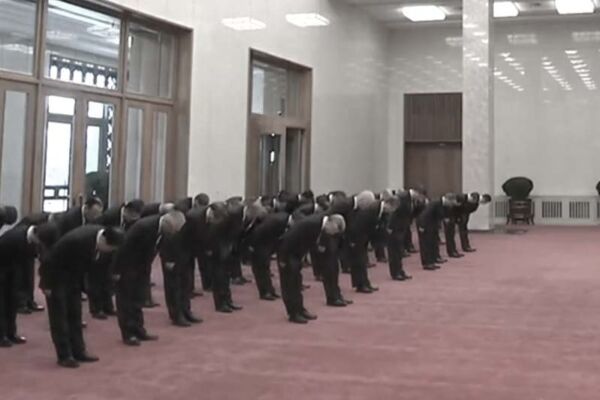
During that event where everyone stood and applauded, the applause synchronized like a machine; Zhu Rongji was the only one who did not applaud for Xi Jinping (Xí Jìnpíng). Many interpret this as the defiance of an elder, the pride of old age. While these interpretations are valid, they do not capture the full picture.
What truly instills him with confidence is the significant role he has played in sustaining this regime. It is precisely because he has extended its life that he feels entitled not to applaud. When someone who has contributed nothing to the regime refrains from applauding, it is seen as dissent and will be punished; however, when someone who has prolonged the regime's existence for twenty years does not applaud, it is a creditor exercising their rights. He is not merely staging an act of rebellion; he is reminding the person on stage: part of the foundation beneath the chair you are sitting on today was laid by me—and I look down on you.
This confidence is a unique flower that has blossomed within a self-serving structure. He has reached the apex of the logic of interests, and from that height, with a demeanor that only he is entitled to, he casts a scornful vote against the entire logic. The source of this disdain may stem from the remnants of pride he retains, reminiscent of individuals from the Republic of China era.
Nine
At this point, I have said what needed to be said, but a few additional remarks are necessary to prevent this piece from devolving into mere wishful thinking.
Firstly, the claim that 'he harbors hatred for the Communist Party' is a reasonable inference based on his experiences and his later demeanor, rather than a verifiable fact. The human heart is concealed, especially behind the walls of Zhongnanhai. What we can confirm are his actions and their objective consequences; as for his true thoughts, any definitive statement would exceed what the evidence can support. A more cautious assertion would be: his actions align closely with those of a 'clear-headed self-interested individual and a serious deliberator,' while being entirely inconsistent with that of a 'devout believer.'
Secondly, referring to the blood and tears of laid-off workers as the 'cost of weighing' is a chilling statement. The destinies of tens of millions have been compressed into the concept of 'systematic benefits,' which is inherently cruel—though this cruelty may have been unavoidable given the constraints of the time. Any defense of Zhu Rongji that glosses over this aspect is fundamentally dishonest. While he saved the regime and improved the lives of hundreds of millions, the tens of millions who were trampled by history are equally real, and their suffering should not be dismissed with the phrase 'the cost of history.'
Thirdly, there is an alternative interpretation worth considering: perhaps he neither harbored such hatred nor calculated so meticulously, but was simply a technocrat, focused on his political agenda, treating the economy as a purely technical problem to solve, detached from issues of loyalty or betrayal. Historical figures are rarely as clearly defined as the commentary often suggests.
Ten
However, even with these reservations, the core judgment remains valid and is more significant than Zhu Rongji alone—
Do not assume that the Chinese Communist Party can sustain itself today because it still has loyal ministers within.
In fact, it is precisely because there are no true loyal ministers left that it can still hold on at this moment—but caution is needed here, as this 'maintenance' should not be mistaken for the kind of stability found in a nation of faith. Genuine faith strengthens as it divides; it represents a renewable stability, whereas this group relies on an exclusive, diminishing arrangement, a stability that persists only while there is still flesh on the corpse. The hatred they harbor does not manifest in action, not because this structure is unassailable, but simply because the first casualty of any upheaval would be themselves.
Thus, the stability of this regime is limited in time. As previously mentioned, there are two critical switches: when the old guard and the new elite clash over the spoils, or when this corpse has been stripped of all its benefits—once the interests no longer add up, this group of sailors will let go in an instant. What Zhu Rongji accomplished back then was simply to add twenty years' worth of oil to this machine, nudging the switches a bit further back; he neither removed nor could he remove the switches.
This reflects the true predicament of the regime: it does not stand on faith—faith has long since perished amid material scarcity. Instead, it relies on a group of individuals who look down on one another but are temporarily bound by mutual interests, welded together by their selfishness. It holds together because there is still something to gain; once that is gone, the welds will inevitably break.
Zhu Rongji stands out as the most capable and the most storied among this group. He embodies the fading light of a generation—those Chinese elites who received benevolent and humanistic training and still regarded people as human; in the political landscape of the Chinese Communist Party, he is nearly the last of his kind. With twenty years of life extension, he earned the confidence to refrain from applauding during that moment on the podium. Once he departs, that light will extinguish as well. The vacant position that should represent 'legitimacy' remains unfilled—it has never been occupied by a loyal servant of communism, nor will it be in the future. Next to it, gripping the armrests tightly, will always be a group of individuals who have calculated that if they abandon ship, they will drown, and thus they desperately patch up a sinking, leaky boat.
Zhu Rongji may only surpass them in that while he repaired the ship, he also took the opportunity to mend the people aboard; after completing his work, he still bore a gaze that looked down on the captain.
——That's it. However, at that point, this is already the maximum limit.
△






News magazine bootstrap themes!
I like this themes, fast loading and look profesional
Thank you Carlos!
You're welcome!
Please support me with give positive rating!
Yes Sure!