
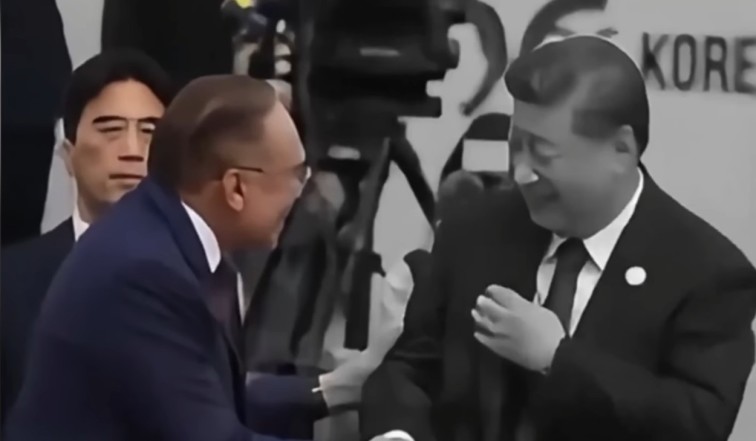
On October 31, during the APEC meeting in South Korea, Malaysian Prime Minister Anwar approached Xi Jinping, who was seated, to greet him. Xi, unable to understand a word, awkwardly smiled while looking around for a translator. (Video screenshot)
[People News] The 33rd informal meeting of the Asia-Pacific Economic Cooperation (APEC) leaders is scheduled to take place in Shenzhen from Wednesday to Thursday (18th to 19th). U.S. President Trump is set to hold a trilateral meeting with Chinese Communist Party leader Xi Jinping and Russian President Putin before concluding his visit to China.
Radio Free Asia reported that the Chinese Ministry of Foreign Affairs announced on Monday (16th) that Xi Jinping will meet with Putin and Trump in Shenzhen on the 19th, although specific topics and detailed schedules have not been disclosed.
During a regular press conference on the 16th, Chinese Ministry of Foreign Affairs spokesperson Mao Ning addressed reporters' questions, stating that this will mark the first face-to-face meeting in history between the leaders of China, Russia, and the United States. The discussions will centre on maintaining world peace and promoting strategic stability in relations among major powers, which is considered groundbreaking.
A representative from Shenzhen Airport informed reporters this week that temporary airspace restrictions will be enforced within a radius of three to four hundred kilometres around Shenzhen to ensure the flight safety of the attending leaders. They stated, "The area within a radius of three to four hundred kilometres is under temporary control, primarily to ensure airspace safety. Leaders from the United States and Russia will be attending, and this is a form of military control. No aircraft may enter the restricted area without prior approval, which is similar to military exercises."
Residents have reported that schools have announced a four-day holiday.
The main venue for this informal leaders' meeting is the Shenzhen International Exchange Centre located in the Xiangmi Lake area of Futian District, with the nearby Wuzhou Xiangmi Lake Hotel serving as the conference's supporting hotel. As the meeting date approaches, Shenzhen has been ramping up security and traffic management measures.
Ms Xue, a resident of Nanshan in Shenzhen, informed reporters that both schools attended by her two children have notified parents about a four-day holiday. The community grid staff also advised residents to limit their outings: "The schools of our two children have already informed parents about a four-day holiday. The community grid staff advised residents to minimise going out during this period to avoid causing traffic congestion."
Officials from Guangdong and Shenzhen announced at a media briefing held at the conference's news centre last Saturday (14th) that all preparations for the meeting are complete. The core venues, including the Shenzhen International Exchange Centre, Shenzhen Bay Cultural Plaza, Qianhai International Conference Centre, and bilateral meeting locations, have finalised the optimisation of their functional layouts and enhanced comprehensive drills for various segments.
The U.S. intends to discuss nuclear disarmament and the Iran issue.
White House officials indicated last week that Trump plans to address nuclear weapons reduction during the trilateral talks with Xi Jinping and Putin, with the Iran issue also on the agenda. However, the complete agenda and format of the trilateral discussions had not yet been finalised at that time, and the U.S. does not anticipate reaching an immediate agreement during this meeting.
According to sources close to the diplomatic community in China, during the Shenzhen meeting, the U.S. aims to discuss topics beyond tariffs, semiconductor exports, and investments, including the Iran issue, nuclear weapons reduction, and preventing nuclear proliferation. This source stated: "The topics the U.S. wishes to discuss not only involve economic and trade relations but also extend to regional conflicts and international security. However, China will not accept Trump's military suggestions, as the Chinese Communist Party has observed that the side without nuclear weapons is at a significant disadvantage in the Ukraine war."
In an interview, Song Guocheng, a senior researcher at the International Relations Research Centre of National Chengchi University in Taiwan, remarked that the Chinese Communist Party (CCP) is unlikely to accept any arrangements that would limit its nuclear weapons development. However, it may outwardly project a cooperative stance in diplomatic contexts. He stated, 'The Chinese side certainly cannot accept this, but on the surface, it will appear to comply, because the CCP's strategy for nuclear weapons development is to pursue independent growth and conduct it in secrecy. Nevertheless, in international forums, it will still demonstrate alignment with the mainstream trend of global nuclear disarmament, which fits its diplomatic image and propaganda strategy.'
He highlighted that the CCP's past efforts to build nuclear weapon launch bases and increase the number of nuclear warheads have been carried out in secrecy, lacking transparency, and have not been communicated through military dialogues or other internationally recognised methods regarding its nuclear weapons development status.
The Iran War and Beijing's Strategic Considerations
Concerning the possibility that Trump might request Xi Jinping's assistance in addressing issues related to Iran and the Strait of Hormuz, Song Guocheng assessed that Beijing would not actively cooperate, as the ongoing conflict serves to restrain the United States.
He explained, 'The continuation of the Iran war is beneficial for China, as it can keep the United States bogged down in the Middle East, preventing it from diverting its focus to strategic preparations in the Indo-Pacific region. This approach is similar to how it manages its nuclear weapons.'
Song Guocheng noted that while the Strait of Hormuz is crucial for China's energy imports, Beijing can still secure oil through alternative channels, so it may not feel an urgent need to push for a resolution. He also expressed scepticism about Beijing's capacity to mediate the Iran-U.S. conflict, anticipating that China will continue to emphasise diplomatic positions such as communication and dialogue, and oppose unilateralism, in order to cultivate an international image that supports peace.
This marks China's third hosting of the APEC Leaders' Informal Meeting, following Shanghai in 2001 and Beijing in 2014, and it is the first such meeting in 12 years.
The news centre for the conference was officially opened on the 11th at Hall 2 of the Shenzhen Convention and Exhibition Centre (Futian). According to the Xinhua News Agency, this centre will offer conference information, broadcast television public signals, and news release services to nearly 5,000 journalists from both domestic and international media.
△





News magazine bootstrap themes!
I like this themes, fast loading and look profesional
Thank you Carlos!
You're welcome!
Please support me with give positive rating!
Yes Sure!