
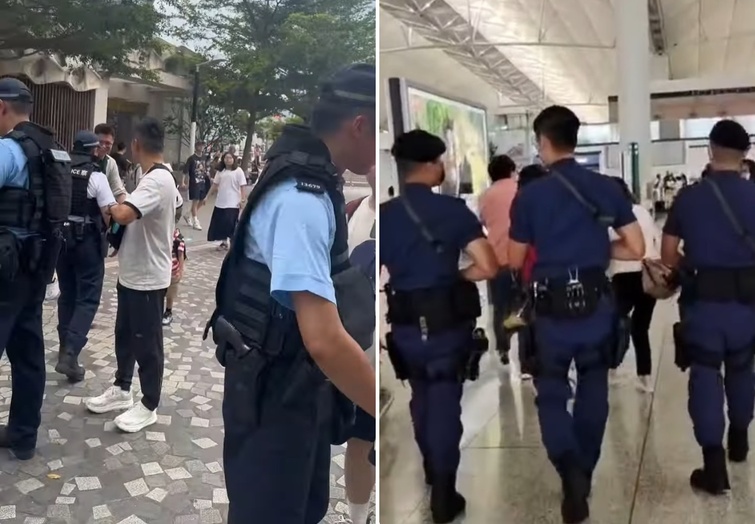
The newly revised national security law in Hong Kong allows police to demand that citizens hand over passwords for their electronic devices. (Video screenshot)
[People News] The Hong Kong police have activated AI facial recognition technology, which has sparked concerns among human rights organisations regarding potential political surveillance. These groups fear that, following the enactment of the Hong Kong National Security Law, the authorities may leverage this system to intensify tracking of political dissenters.
AI Surveillance Integrated into Shopping Malls, Data Retention Period Extended to 180 Days
According to The Dajiyuan, the Hong Kong police have introduced the 'SmartView' system, which connects closed-circuit television (CCTV) footage from government departments and public institutions to the police network. Since late last year, over ten thousand surveillance cameras have been gradually installed across Hong Kong.
On November 16, the Hong Kong police further activated AI facial recognition capabilities. Chief Superintendent Chow Man-king stated that this technology can be utilised to search for suspects and high-risk missing persons during specific investigations, and it also includes license plate recognition functionality.
When questioned about the system's ability to identify individuals wearing masks, Chow Man-king refrained from disclosing technical details, citing concerns that individuals with malicious intent could exploit this information to evade detection.
One of the concerns surrounding the system is the length of time personal data is retained. In its latest newsletter on “Artificial Intelligence and Individual Rights,” the New York-based human rights organisation Human Rights Foundation (HRF) stated that ordinary CCTV footage is retained for a maximum of 31 days. However, photographs generated through AI facial recognition, along with associated data such as the location, date and time of capture, and facial characteristics, are retained for as long as 180 days—nearly six times longer than ordinary footage.
Police have stated that facial recognition technology will not be used to continuously analyse footage from all cameras around the clock. However, when necessary, designated cameras can be activated to conduct 24-hour facial recognition. This means that, in specific investigations, police can use footage from different locations to search for a targeted individual.
The scope of surveillance is also expanding into privately owned commercial premises. According to a report by RTHK, at least four shopping malls—Olympian City, Tuen Mun Town Plaza, Kwai Chung Plaza and The Belcher's (Villa by the Park)—have agreed to connect their CCTV systems to the police network. Under the law, shopping malls equipped with CCTV surveillance systems are required to display notices informing the public that video surveillance is in operation.
However, the Department of Justice previously proposed that shopping malls should be allowed to decide voluntarily whether to disclose that their CCTV footage is connected to the police system, rather than being required to display notices. This means that even when members of the public know that cameras are installed in a shopping mall, they may not be aware that the footage is also connected to the police surveillance network.
Human Rights Group: AI Surveillance Could Intensify Political Tracking
The Human Rights Foundation (HRF) has warned that combining AI facial recognition with an extensive surveillance camera network could make it easier for authorities to identify and track political dissidents. In the past, police had to manually review large volumes of footage. With AI, they can now search for specific individuals, significantly reducing the cost and effort involved in tracking them.
In its official documentation, Hong Kong Police have already listed safeguarding national security as one of the purposes of the “SmartView” surveillance system, alongside crowd management at major public events.
HRF is concerned that, following the implementation of the Hong Kong National Security Law and the Safeguarding National Security Ordinance, surveillance technology could be used to monitor political activities beyond the scope of criminal investigations. Although there is currently no evidence that police have used the new system to systematically track dissidents, there remains a lack of sufficient transparency regarding the scope of data use, access permissions and external oversight mechanisms.
Smart Lampposts Sparked Controversy During the 2019 Anti-Extradition Protests
Controversy over surveillance equipment on Hong Kong's streets dates back to the 2019 anti-extradition protests. On August 24 that year, during a protest march in Kwun Tong, demonstrators dismantled several smart lampposts installed by the government, suspecting that the devices were equipped with facial recognition technology and linked to the Chinese Communist Party's “Skynet” surveillance project.
One component, a Bluetooth positioning device bearing the model number SPLD01, attracted particular attention after the supplier TickTack Technology's website briefly indicated that the product was associated with Shanghai Sansi's street lighting control system. This fuelled suspicions of a technological connection between the two. At the time, the Hong Kong government denied that the smart lampposts had facial recognition capabilities, while the supplier also denied having any ownership or subsidiary relationship with Shanghai Sansi.
Shanghai Sansi is one of the contractors involved in the Chinese Communist Party's Skynet project. It has undertaken numerous projects involving smart lampposts and display screens in public security surveillance centres across mainland China.
More significantly, Bloomberg reported in October 2019, citing several sources, that Hong Kong police had acquired facial recognition software from Australian company iOmniscient as early as 2016, and that dozens of police officers had received training in its use. The system could scan CCTV footage and compare faces and vehicle licence plates against police databases, enabling officers to identify specific individuals within crowds. At the time, it could not be confirmed whether the police had used the technology during the anti-extradition protests.
Surveillance Network Continues to Expand, Resembling Mainland China's Model
Following the 2019 anti-extradition movement, Hong Kong police officially launched the “SmartView” programme in 2024, beginning the installation of additional cameras in public spaces and integrating footage from other government departments. With the subsequent introduction of AI facial recognition, the system's capabilities have evolved beyond simply recording images in public places to automatically searching for specific individuals.
In mainland China, the “Skynet” and “Sharp Eyes” projects use extensive networks of cameras, AI recognition technology and public security databases to establish cross-regional surveillance systems. Research by the Brookings Institution has pointed out that the Chinese Communist Party also integrates data from various sources, including government-owned and privately owned cameras, further expanding the reach of its surveillance network.
Hong Kong police plan to increase the number of surveillance cameras to approximately 60,000 by 2028, with a further 6,500 cameras to be installed in the Northern Metropolis development area thereafter. From the controversy surrounding smart lampposts on the streets in 2019 to the connection of shopping mall CCTV footage to police systems today, Hong Kong's public surveillance network has continued to expand and become increasingly sophisticated.
Hong Kong police have not confirmed whether they have directly adopted the entire technological platform used by mainland China's Skynet system. Nevertheless, practices such as interconnected surveillance cameras, cross-agency integration of video footage and AI facial recognition already display similar characteristics. △





News magazine bootstrap themes!
I like this themes, fast loading and look profesional
Thank you Carlos!
You're welcome!
Please support me with give positive rating!
Yes Sure!