
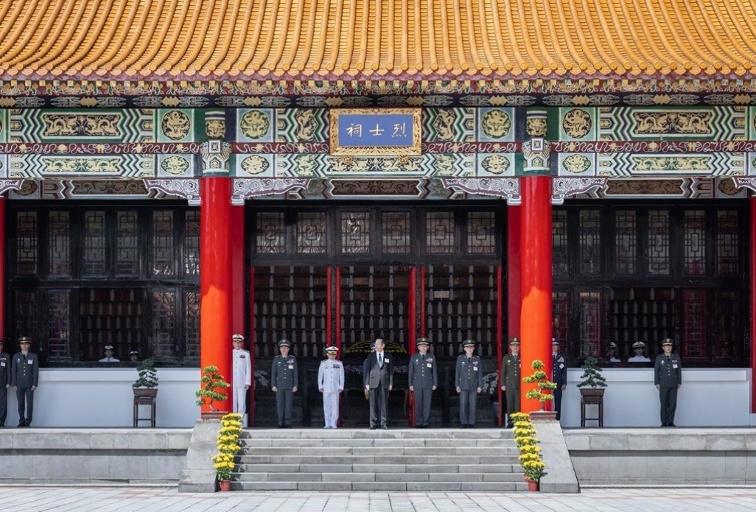
Taipei's Zhonglie Shrine. (Presidential Office of the Republic of China)
[People News] Taiwan's military education previously focused on preventing traditional tactics such as 'honey traps, monetary inducements, conversational manipulation by strangers, or blackmail threats.' However, the CCP has diversified its methods for collecting intelligence on Taiwan's military. They not only employ new technologies but also exploit human vulnerabilities, creating entirely new traps. Many active and retired military personnel are caught off guard, unaware that the heartfelt posts on Facebook praising former commanders are actually traps set by the CCP! The aim is to entice individuals to reminisce about the past and 'recognise relatives' in the comments, inadvertently disclosing sensitive military connections that should remain confidential.
As reported by the Liberty Times, Taiwan's security agencies recently intercepted a Facebook fan page named 'Dreaming Back to Huaxia,' which frequently shared touching stories about current and retired Taiwanese military leaders. This attracted a significant number of military personnel who commented and identified themselves, even revealing their unit numbers and who they served with. Security agencies have cautioned that this could be a new intelligence-gathering tactic by the CCP targeting military networks. Investigations revealed that all the administrators of this fan page are located in Hong Kong, and the operations are closely linked to the overseas content farm known as the 'Borderless Group.'
Nostalgic military fan pages serve as traps.
The security unit found that when 'Dreaming Back to Huaxia' was launched in 2023, it was originally a simplified Chinese account called 'Crow Lord's Emergency Workplace', which underwent a dramatic transformation only in 2025. Initially, this fan page focused on sharing small stories about the Jiang family, secrets from the Republic of China, and the achievements of renowned generals from the War of Resistance, creating a nostalgic atmosphere. However, starting in September of this year, it suddenly intensified its activity, posting over 300 articles in just two months.
By early November, its goals became more defined, as it began to name current and retired generals such as Chen Bangzhi, Ye Guohui, Zhang Qingxiang, Yang Jirong, and Wan Xiankun in a concentrated manner, even addressing topics related to submarines, paratroopers, and female officers. The security unit assessed that the hidden hand behind this operation first built a fan base using Republic of China history, and then leveraged Facebook's algorithm to precisely target these articles to individuals within the military community.
This warm approach aimed to entice 'recognition of kin'.
These posts generally follow a similar formula: they depict the generals as caring, down-to-earth, and responsible, interspersed with a few touching anecdotes that evoke shared memories among former subordinates. As a result, netizens lowered their defences and rushed to the comment section to 'report their numbers', voluntarily sharing their previous units, positions, or connections with the article's protagonists.
However, to be frank, these heartfelt stories are not intended to honour the past; they are simply bait designed to attract attention.
The security unit has found that some articles were written without the consent of the individuals involved, and even the accompanying photos might be AI-generated fakes. For instance, an article about a female officer received comments from netizens who pointed out that the photo was not of the actual person, demanding that the fan page consult the individual before posting. These unusual incidents have raised suspicions among many military personnel, who have reported them to the relevant authorities.
What truly raised alarms for security personnel was the leaked "massive military connections" found in the comment sections. For example, a post about retired General Wan Xiankun attracted over 12,000 likes. Many commenters claimed to have been his driver, company commander, or former subordinates, with some even stating they were classmates, and others naively revealing their unit numbers. The previously highly confidential military interpersonal network was thus exposed to public scrutiny.
The security unit analysed that the operators did not even need to ask directly; they could simply use a series of military stories to entice current and retired military personnel to like, comment, and connect with each other. This allowed them to trace connections and piece together the military network from everyone's account information, friend lists, and interaction records. Information about who served in which unit, who is affiliated with which general, and who has good relations with whom became readily available clues for subsequent targeting and private contact.
In simple terms, while netizens believed they were just reminiscing about old commanders, the Chinese Communist Party's intelligence system viewed this as a progressively clearer "National Army Relationship Map."
Liking and commenting can also leak military intelligence.
In March of this year, American scholar Wang Hong'en analysed that the 'Boundaryless Group,' which has close connections with the propaganda department of the Chinese Communist Party, typically operates numerous seemingly harmless fan pages focused on parenting and health. These pages help each other drive traffic and increase popularity. When a specific account receives a directive from superiors, it promptly cuts off interactions with other fan pages and concentrates its efforts on targeting specific demographics to gather intelligence.
Security agencies have also found that in the 300 articles published by 'Dreaming Back to Huaxia' over the past two months, there were no external links, and the fan page's description did not include a website, only offering Messenger for private messages. It relies solely on Facebook's algorithm to deliver articles directly to military personnel, exemplifying the operation of a 'task-oriented account.'
They do not even need to engage in direct conversation; by simply analysing records of 'likes, comments, and mutual recognition' and cross-referencing friend lists, they can gain a clear understanding of the command structure and interpersonal relationships within the National Army. This lays the groundwork for future private messaging discussions, offline meetings, and even the recruitment of spies.
The most challenging aspect to defend against is the vulnerability of human nature.
In both traditional intelligence studies and modern cognitive warfare, the most difficult threats to counter are often not high-tech hacking attacks, but rather these precise assaults on human nature.
These types of fan pages intentionally craft articles in a tone of 'warmth, inspiration, and praise,' effectively tapping into the psychological needs of veterans and retired generals who 'seek affirmation and wish to be remembered.' In an environment where they feel respected, individuals naturally lower their defences. When they see familiar old commanders or units, nostalgia often drives them to 'report their numbers' or 'recognise kin' in the comments section, forgetting that every comment made in a public online space serves as a piece of free intelligence shared with the other party. When hundreds or thousands of current and retired military personnel comment in the same space, intelligence analysts can easily construct the military's command chain, network connections, and historical context using big data cross-referencing, even pinpointing who is close to whom and identifying potential vulnerabilities.
The Republic of China government has faced significant setbacks on multiple occasions.
From the Chinese Civil War to the early days of the government’s relocation to Taiwan, the Chinese Communist Party (CCP) has repeatedly exploited the Republic of China government through intelligence warfare and united front tactics that 'leverage human emotions, camaraderie among fellow townsmen and comrades, and familial ties,' directly impacting the outcomes of crucial battles and the survival of the regime.
A review of the most notable and representative historical cases reveals that the CCP's strategies primarily focus on three key areas:
Infiltration through teacher-student relationships.
During the Chinese Civil War, the CCP's intelligence system (including the Central Special Agency led by Zhou Enlai and the Li Kenong system) was highly skilled at utilising the 'network of relationships' inherent in traditional Chinese society for subversion.
For instance, Guo Rugui and Liu Fei (a core leak from the Ministry of National Defence) are both senior generals in the National Army, positioned at the heart of combat command (Guo Rugui previously served as the Director of the Operations Department of the Ministry of National Defence). The Chinese Communist Party did not resort to bribery; instead, they leveraged connections through fellow townspeople, classmates from the Whampoa Military Academy, and emotional ties to early revolutionary ideals to maintain their long-term infiltration. Often, the National Army's operational plans would find their way to Mao Zedong's desk before they were even communicated to the frontline troops.
Another example is Fu Zuoyi's 'close emotional network.'
During the Pingjin Campaign in 1949, Fu Zuoyi commanded hundreds of thousands of troops but was initially indecisive. The Chinese Communist Party managed to persuade him through his trusted confidants, teachers (like Liu Houtong), and his cherished daughter Fu Dongju (an underground party member), appealing to familial bonds, teacher-student relationships, and a sense of honour in 'preserving the historical culture of Beijing.' This ultimately shattered Fu Zuoyi's resolve to resist, leading to a complete collapse of the situation in North China.
Emotional Manipulation and Family Letters for United Front Work
In the early 1950s, when the Republic of China government had just relocated to Taiwan, hundreds of thousands of military personnel and civilians found themselves separated from their families on the mainland, with feelings of homesickness reaching a peak. The intelligence agencies of the Chinese Communist Party (such as the Investigation Department and the United Front Work Department) skillfully exploited this vulnerable aspect of human nature for their operations.
They identified the parents and families of National Army generals or Air Force pilots who remained on the mainland, coercing or enticing them to write 'tearful family letters' and even record broadcasts expressing their longing, which were then sent to Taiwan via Hong Kong or other third-party locations.
For instance, the espionage case involving Wu Shi, the Deputy Chief of Staff of Taiwan's Ministry of National Defence, which was uncovered in 1950 (Operation No. 1), not only highlighted his political shift but also involved Chinese Communist intelligence agents like Zhu Feng. They frequently engaged with fellow townsmen from Fujian and literati, which allowed highly cautious senior military officers to gradually lower their defences during everyday social interactions, ultimately leading to the disclosure of Taiwan's defence secrets.
Gathering Intelligence Through Family Visits
After Taiwan permitted family visits to the mainland in 1987, many veterans returned to their hometowns with their life savings and a deep sense of nostalgia.
At that time, the local Chinese Communist government and the United Front departments set up a specialised reception system known as the "Taiwan Affairs Office". While it appeared to warmly welcome visitors, assist in locating lost relatives, and provide a sense of honour, the gatherings and the process of filling out the "Family Reunion Registration Form" systematically collected extensive information about these Taiwanese veterans, including their original unit numbers, retired ranks, places of residence in Taiwan, and contact networks. This information later became a crucial foundation for the Chinese Communist Party to create a database of military connections in Taiwan.
Reflecting on the current strategies of the Facebook fan page "Dream Back to Huaxia", it essentially replicates the past practices of "tea house reminiscing, hometown associations, and family reunion registration forms" on social media. The tools have evolved from paper and radio to algorithms and likes/comments, yet the underlying logic remains unchanged—first, to provide you with the respect, warmth, and sense of belonging that you crave, and once you open up and voluntarily share your family background, the intelligence has already been secured.
(Originally published by the People News) △






News magazine bootstrap themes!
I like this themes, fast loading and look profesional
Thank you Carlos!
You're welcome!
Please support me with give positive rating!
Yes Sure!