
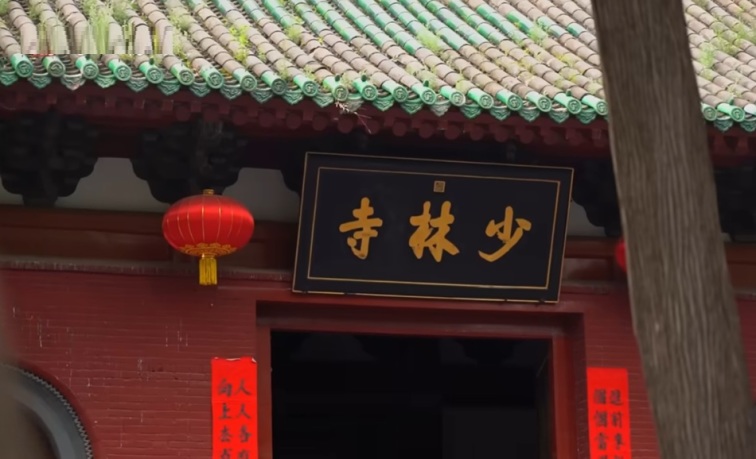
A Historic Ancient Monastery: The Shaolin Temple (Video Screenshot)
[People News] The Communist Party has recently initiated financial inspections at various local temples and Taoist temples, focusing on financial transactions, donation records, and account management. Numerous reports from mainland media indicate that over 30,000 temples and more than 9,000 Taoist temples have begun a comprehensive financial audit simultaneously. Citizens interviewed suspect that several local governments are facing financial difficulties and have previously borrowed money from these religious institutions without success, leading them to resort to seizing funds. Monks, nuns, and Taoist priests who refuse to be exploited are being forced out.
Under the atheistic governance of the Communist Party, religious sites are overseen by the Religious Affairs Bureau and the Civil Affairs Bureau, with involvement from the United Front Work Department and local political advisory bodies. Issues such as contracted operations, private payment codes, unclear accounts for merit boxes, and overpriced blessings have resulted in rampant commercial irregularities. Many renowned mountains and large temples charge high entrance fees to visitors. By 2026, the four major Buddhist mountains—Wutai Mountain, Putuo Mountain, Emei Mountain, and Jiuhua Mountain—will charge adult single-entry tickets priced at 135, 160, 160, and 160 yuan, respectively.
Reports from mainland media reveal that the ticket price for the Lingshan Grand Buddha in Wuxi has reached 210 yuan, generating an annual revenue of approximately 762 million yuan. The Nanshan Temple in Sanya, Hainan, has surpassed 600 million yuan in annual ticket revenue, with the
Estimates suggest that the overall market size of Buddhist temples in mainland China has surpassed an annual output value of 100 billion yuan, with an average temple generating at least 3 million yuan in annual revenue. When considering all related industries, the total market size for Buddhist temples could be as high as 200 billion yuan per year.
The considerable wealth of monks and nuns has understandably sparked jealousy among local governments under the Chinese Communist Party (CCP).
In recent years, various media outlets have reported that civil servants in regions such as Shanghai, Jiangsu, Tianjin, and Shandong have faced unpaid salaries. Some governments, struggling financially, attempted to borrow money from temples, but the temples refused, stating, "We are the ones who solicit donations; no one has ever come to our Buddhist community for donations; we are not the donors."
At that time, some netizens speculated that if the temples declined to lend, the CCP might resort to a 'borrow-and-don't-repay' strategy. Historically, the CCP has seized money from citizens, engaged in kidnappings, and extorted funds; previously, this was done overtly, but now it is cloaked in legal terms. Indeed, within two years, the CCP initiated financial audits of these temples. In essence, this was a legal means to extract money from the pockets of monks, nuns, and Taoists. What will you do about it?
Consequently, they encountered a monk who was bold enough to resist.
In 2006, Xu Zhiqiang, the abbot of Huacheng Zen Temple in Jiangxi Province, became a notable example of resistance against the CCP's financial exploitation. However, the CCP's response to Xu Zhiqiang was to have him expelled from the temple by religious authorities. Xu Zhiqiang stated that he was ousted from Yichun City in Jiangxi Province due to his restructuring of the temple's finances, which angered local corrupt officials.
In a recent interview with foreign media, Xu Zhiqiang revealed that certain officials from the Yichun City Buddhist Association have been meddling in the affairs of Huacheng Zen Temple, treating it like a personal ATM. This interference has resulted in disorganised finances and significant debts within the temple. After assuming the role of supervisor, Xu initiated an audit of the accounts and implemented financial transparency measures, while also hiring an accounting firm for a financial audit. This has upset corrupt officials from the local religious bureau, as the United Front Work Department's religious bureau oversees the temple and prefers to keep its financial practices hidden.
As reported by Voice of America, local authorities deployed a large contingent of police to encircle the temple and forcibly removed Xu Zhiqiang from the premises. He is currently in Shenzhen. Xu plans to expose to the international media how Chinese Buddhist organisations are manipulated by the Communist Party of China to suppress Buddhist practitioners, while also seeking to assert his legal rights through appropriate legal channels.
An anonymous master at Huacheng Zen Temple told reporters that since Master Shengguang's departure, some lay practitioners have felt unsafe and are preparing to leave as soon as they receive their salaries.
According to statistics from the Communist Party of China, there are over 100 million Buddhists among the religious believers it manages, making up about 8% of the total population. Most of these individuals are frustrated with the Party's financial exploitation but feel unable to voice their concerns. Some netizens have commented that the Buddhist community should ideally be free from material interests, focusing on self-improvement and disregarding fame, wealth, and desires. However, under Communist Party rule, the larger entities exploit the smaller ones, leaving the latter voiceless and suffering in silence.
(This article was first published by People News) △






News magazine bootstrap themes!
I like this themes, fast loading and look profesional
Thank you Carlos!
You're welcome!
Please support me with give positive rating!
Yes Sure!