

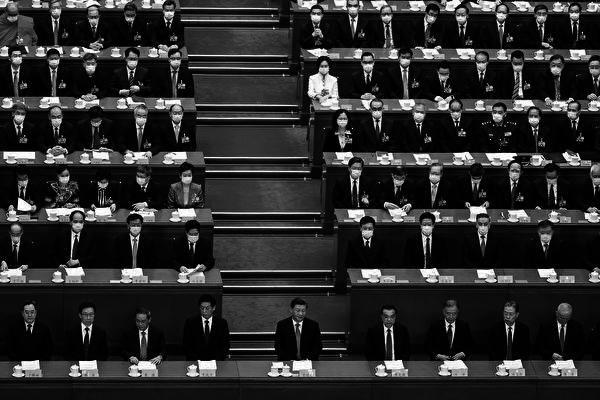
The Central Military Commission of the Communist Party of China originally consisted of 7 members, but now only Xi Jinping and Zhang Shengmin remain. (Video screenshot)
[People News] As per tradition, on November 9, the first briefing session for the military to study and implement the spirit of the Fifth Plenary Session of the Communist Party of China was held in Beijing. Zhang Shengmin, who has recently been promoted to a member of the Political Bureau of the Central Committee, met with the members of the briefing group and delivered a speech. This meeting hall is the same place where, after last year's Fourth Plenary Session, he met with the briefing group alongside the then Vice Chairman of the Central Military Commission, Zhang Youxia, and the Chief of the Joint Staff Department of the Military Commission, Liu Zhenli.
In contrast to last year, this year's scene is rather amusing: Zhang Shengmin sits alone in the main seat, distanced from others, creating a rather 'one-man show' atmosphere. Some have jokingly speculated whether this means he will end up in Qincheng prison. However, Zhang Shengmin must feel wronged: who made the Military Commission have no other members? With only my brother here, I can only sit like this.
Returning to the main topic, how does this briefing session differ from those of the Fourth and Third Plenary Sessions of the Communist Party?
Firstly, the Military Commission is dwindling, with no new members as of now. After the Fourth Plenary Session in 2025, there will still be three Military Commission members, and after the Third Plenary Session in 2024, there will be five Military Commission members. Now, only Zhang Shengmin remains; isn't it quite desolate?
Secondly, Zhang Shengmin's speech downplays Xi Jinping, placing the 'Party' in a more important position than Xi. In the briefing sessions of the Fourth, Third, and Twentieth National Congresses, the emphasis of the two Vice Chairmen of the Military Commission was somewhat different, while now Zhang Shengmin has to integrate the statements of the previous two Vice Chairmen into one.
Zhang Shengmin initially remarked that the Fifth Plenary Session serves as an important reflection, questioning its so-called significance. He then emphasised that learning and implementing its spirit is a 'major political task for the current and future period', stressing the need to 'follow the unified deployment of the Party Central Committee'. He called for a deep study of Xi Jinping's thoughts on Party building and the essence of Xi's speeches, aiming to 'effectively unify the thoughts and actions of the entire military with the important speeches of Chairman Xi and the spirit of the plenary session.'
In light of this, how did Zhang Youxia respond when meeting with members of the propaganda team after the Fourth and Third Plenary Sessions? Following the Fourth Plenary Session, Zhang Youxia stated, 'We must treat the study and promotion of the spirit of the plenary session as a significant political task, guiding officers and soldiers to deeply grasp the essence of Chairman Xi's important speeches... and to more firmly and consciously support the 'Two Establishments'.' After the Third Plenary Session, he remarked, 'We must approach the study and promotion of the plenary session's spirit with a strong sense of political responsibility, guiding officers and soldiers to thoroughly understand the essence of Chairman Xi's important speeches... and align our thoughts and actions with the decision-making and deployment of the Party Central Committee and Chairman Xi.'
It is evident that even after news of Xi Jinping's stroke surfaced following the Third Plenary Session, Xi's military authority has been diminishing. Nevertheless, publicly, both the Communist Party and Zhang Youxia continue to show deference to Xi. Following the Fourth Plenary Session, particularly in June 2026 and the Fifth Plenary Session, the Communist Party has made clear the 'centralised and unified leadership of the Party Central Committee' and emphasised the role of the 'Party'. There are various indications that Xi's status in official media reports has been weakened. Thus, Zhang Shengmin's comments downplaying Xi are not without justification.
Thirdly, after emphasising the importance of the 'Party', Zhang Shengmin expressed his loyalty to Xi, referencing the 'Two Establishes' and 'Two Safeguards'. He stressed the need to 'implement the responsibility system of the Chairman of the Military Commission and resolutely follow the commands of the Party Central Committee, the Central Military Commission, and Chairman Xi.'
In the meeting following the Fourth Plenary Session, Zhang Shengmin, who has been promoted to Vice Chairman of the Military Commission, highlighted the political nature of his statements, mentioning '2442' and reiterating the importance of 'implementing the responsibility system of the Chairman of the Military Commission and effectively aligning thoughts and actions with the decision-making and deployment of the Party Central Committee.'
In similar contexts after the Third Plenary Session, He Weidong, who was then Vice Chairman of the Military Commission, only referred to the 'Two Establishes' and 'Two Safeguards', along with the implementation of the responsibility system of the Chairman of the Military Commission.
A comparison of the reports from the three plenary sessions reveals that, while standard phrases are still present, it can be inferred that Xi remains unable to participate in decision-making and deployment. With Zhang Shengmin being the sole member of the Military Commission, his directive for the entire military to 'obey the commands of the Party Central Committee, the Central Military Commission, and Chairman Xi' raises the question of whether there are individuals within the military who do not follow his and Xi's commands.
Lastly, this year's news did not provide specific reports on the conditions in the sub-venues or the number of members in the propaganda team. The reports only mentioned that 'the report meeting will be held via a television conference. After the meeting, members of the propaganda team will be divided into groups to conduct tours throughout the military,' and there were no visuals of the sub-venues in CCTV news, which differed from the previous two occasions.
A report from 2025 indicates that "the briefing will take place via video conference, with the main venue located at the Bayi Building, and sub-venues established in various departments of the Military Commission and the Joint Command Centre, where over 11,000 officers and soldiers will attend the briefing. Following this, the 10 members of the propaganda team will be divided into 5 groups to tour the entire military for further briefings."
A report from 2024 mentions that "leaders from relevant departments of the Military Commission and the Joint Command Centre will gather at the main venue in the Bayi Building, with over 7,500 officers and soldiers listening to the report at 176 sub-venues. Afterwards, the 10 members of the propaganda team will split into 5 groups to conduct a tour of the entire military for further briefings."
News following the 20th National Congress in 2022 states that "leaders from various departments of the Military Commission, directly affiliated institutions, and the Joint Command Centre will be present at the main venue in the Bayi Building, with over 7,700 officers and soldiers attending the report at 183 sub-venues. Afterwards, the 14 experts from the propaganda team will be divided into 7 groups to tour the entire military for further briefings."
In all three reports, CCTV news included footage of the sub-venues. So why was there no such coverage after the Fifth Plenary Session? Could there have been issues with the sub-venues?
Military media have reported irregularities in the briefing for the Fifth Plenary Session of the entire military. This, combined with the absence of loyalty language at a routine press conference held by the Ministry of National Defence a few days ago, and the lack of promotions to the position of Vice Chairman of the Military Commission during the Fifth Plenary Session, all suggest that the internal situation within the military remains tense, and Xi Jinping has yet to establish firm control over the military.
(First published by People News) △




News magazine bootstrap themes!
I like this themes, fast loading and look profesional
Thank you Carlos!
You're welcome!
Please support me with give positive rating!
Yes Sure!