

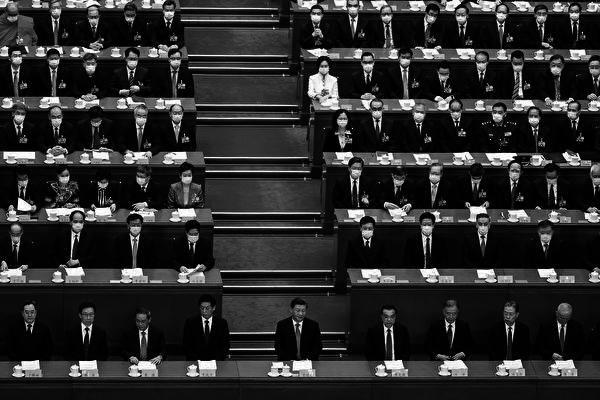
The CCP has constructed the Great Firewall, obstructing citizens from accessing truthful information from overseas. (Dajiyuan composite image)
[People News] On November 3, the 2026 World Internet Conference Wuzhen Summit officially commenced. In his keynote address, Chinese Premier Li Qiang extolled Wuzhen, noting that this ancient water town, renowned for its powder walls and black tiles, has transformed into a benchmark for global internet development. This year's summit, themed 'Open Source and Openness,' featured a record 27 sub-forums, the highest number in recent years. Additionally, officials expressed their opposition to the establishment of a 'digital iron curtain' in cyberspace and condemned the use of technology to deepen divisions.
These remarks are pleasing to hear and can be translated into any language without issue. However, for the Chinese audience outside the venue, understanding these statements requires no translation—just a bit of memory.
A New Regulation from a Month Ago
On October 1, a new regulation from the Ministry of Public Security took effect. According to this regulation, personal mobile phones and other electronic devices are explicitly designated as items that public security agencies may inspect, allowing police to probe, extract, and copy data from them. The regulation came into effect on 'National Day,' the first day of the seven-day holiday when people across the country travel, coinciding with the enforcement of the new rules.
While the summit discusses open source, the new regulation also pertains to open source—what is being opened up are the mobile phones of ordinary citizens.
Historically, firewalls have acted as sentinels at national borders, monitoring the entry and exit points of optical cables, filtering keywords, and disrupting circumvention protocols. In those days, ordinary users primarily encountered technical difficulties when attempting to bypass these barriers; if a node failed, they would simply switch to another, and at worst, they might be unable to access the external internet for a few days. However, the nature of the issue has now shifted. It is now a specific individual who faces interception, demands to unlock their device, and scrutiny of their photo albums and chat histories. An icon of circumvention software on a mobile phone, a screenshot of foreign news, or a forwarded message that was not deleted in time could all potentially serve as 'criminal evidence.'
This approach is not novel. Around 2017, authorities in Xinjiang mandated that residents install monitoring software known as 'Clean Network' on their mobile devices, with random checks conducted on the streets and at checkpoints. Detailed technical analyses have been carried out by overseas research institutions and media. The practices trialled in Xinjiang have now been codified into regulations applicable nationwide.
Individuals bypassing firewalls for work
In 2023, a programmer in Chengde, Hebei, was fined 200 yuan by local police for using circumvention tools, and an additional 1.058 million yuan was confiscated as 'illegal income.' According to the punishment documents he publicly shared, this amount represented his earnings from coding for an overseas company between 2019 and 2022. He completed tasks via GitHub, participated in remote meetings on Zoom, and was engaged in legitimate work.
A few years of a person's earnings were classified as 'illegal income' simply because he accessed a website that programmers in most countries use daily, as determined by an official ruling. What transpired afterwards remains unknown to the public. However, it can be assumed that his colleagues, upon reviewing this ruling, would likely reassess their own computers and mobile devices.
The deterrent effect of regulations is evident here; the minority are the ones who are actually scrutinised, while the majority refrain from crossing the line.
Openness and closure arise from the same underlying logic.
Many commentators have juxtaposed Wuzhen's notion of 'openness' with the police's practice of 'checking phones,' labelling it as a form of schizophrenia. I disagree with this assessment. Schizophrenia suggests that those involved are confused, but the Chinese Communist Party (CCP) is quite clear about its intentions.
When it speaks of openness, it refers to the outward flow of goods, capital, technical standards, and open-source models, while welcoming foreign enterprises and investments. The only thing it seeks to restrict is information, particularly information about itself. These two aspects are not contradictory; they both serve the same objective: to generate revenue from the global market while silencing domestic dissent.
China's large models serve as a prime example. In early 2025, DeepSeek's open-source model created a global sensation, with its weights publicly available for anyone to download and study. The 'open-source openness' discussed at Wuzhen likely pertains to such achievements. However, when a user inquired about the events of June 4, 1989, in Tiananmen Square, it politely indicated that it could not answer that question at the moment and suggested changing the topic.
While code can be open-sourced, memory cannot.
What is stored on our phones?
Why would a regime invest decades and immeasurable resources to maintain a 'wall,' only to embed it into everyone's pocket? Because what lies behind the 'wall' cannot withstand scrutiny.
In March 2020, 'People' magazine published an article titled 'The Whistleblower', which recounted how Ai Fen, the director of the emergency department at Wuhan Central Hospital, was among the first to issue a warning about the outbreak and how she faced reprimand for doing so. The article was removed within hours, but netizens quickly began to share it in various forms, including English, German, traditional Chinese characters, Morse code, oracle bone script, and even emojis, repeatedly reposting it. During those days, many Chinese citizens witnessed for the first time how a piece of information could vanish from the internet and how it managed to survive through the smartphones of ordinary people.
In this relay of information, smartphones became a repository of memories, with screenshots serving as proof. The new regulations turned smartphones into devices that could be inspected at any moment, effectively transforming the memories stored by ordinary individuals into items that could be confiscated at will. The official narrative has endured for so many years not only through what is promoted but also through what is deliberately hidden from view.
Li Qiang praised the beautiful white walls and black tiles from the stage in Wuzhen, which indeed are striking, reflecting in the water. Yet, there exists another 'wall' surrounding the Chinese populace—an invisible barrier that has been constructed over decades, and starting in October, a segment of it was built into everyone's pockets. A regime that genuinely fears no comparison does not need to inspect anyone's smartphone.
△








News magazine bootstrap themes!
I like this themes, fast loading and look profesional
Thank you Carlos!
You're welcome!
Please support me with give positive rating!
Yes Sure!