
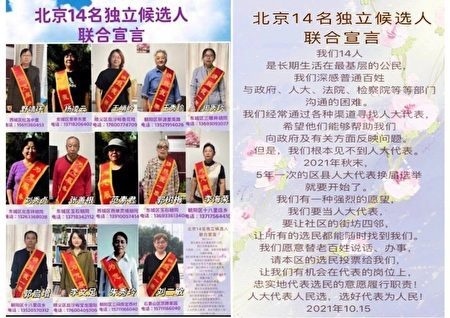
On October 16, 2021, 14 citizens from Beijing announced their intention to participate in the elections for representatives of the Beijing district and county people's congresses. However, just half a month later, all 14 were compelled to withdraw from the elections due to threats from the Chinese Communist Party (CCP), fearing for their safety. (Withdrawn candidates provided)
[People News] Beijing recently held elections for representatives at the district and township levels of the people's congress. On the voting day, Xi Jinping and members of the CCP Politburo Standing Committee cast their votes at polling stations in their respective electoral districts in Beijing. While voting at the Huairentang polling station in the Zhongnanhai electoral district of Xicheng, Xi Jinping remarked: 'To elect representatives of the people's congress... we must practice whole-process people's democracy, uphold the leadership of the Party, fully promote democracy,... and strengthen supervision throughout the entire election process...'.
The CCP Beijing Municipal Government announced that a total of 13,054 polling stations were established for this election. In the lead-up to the voting day, each electoral district sent out 'one-on-one' voting notifications to voters through communities and enterprises. Registered voters were required to present their 'voter cards' to receive ballots and cast their votes at the polling stations in their respective electoral districts.
From the announcements made by state media and the CCP authorities, it appears that the CCP's approach to the elections for representatives of the people's congress aligns closely with democratic procedures, featuring 'one-on-one' voting notifications, registered voters needing to show 'voter cards' to obtain ballots, and members of the Politburo Standing Committee personally participating in the voting.
This raises the question: how many candidates are there? What are their backgrounds? What governance ideas do they have? And how many of the so-called 'voters' recognised by the Chinese Communist Party (CCP) actually participated in the voting? Is the CCP willing to disclose the real figures?
In reality, most citizens are completely unaware of who the candidates are, where they come from, or their backgrounds, and they have no idea why they should vote for them. Reports suggest that many people only learned the day before the election that voting was happening the next day, through notifications in community groups. They were told they could register to vote at their local polling stations, but no one knew who the candidates actually were. Can this really be considered an 'election'?
The people in mainland China are well aware that the authorities are merely going through the motions. Xi Jinping often speaks of wanting 'whole-process democracy,' yet in the grassroots elections for local people's representatives, the common people are treated as mere decorations, indicating that the CCP's so-called elections are just for show.
Recently, elections in Taipei City, Taiwan, and the U.S. midterm elections have also been taking place. A comparison reveals that the electoral processes in Taiwan and the United States evoke very different sentiments compared to the grassroots elections in Beijing.
The recently concluded U.S. midterm elections undoubtedly showcase the American democratic system. Although the Republican Party, led by Trump, faced defeats in both the Senate and House elections, these elections genuinely reflect 'public opinion' within this democratic framework, as voters determine the government's authority through their votes. The government's power is derived from the voters' authorisation, and voters can also hold the government accountable through their ballots.
Turning our attention to Taiwan, the most notable event this year is the mayoral election in Taipei City, where Shen Boyang is challenging Jiang Wan'an. During his campaign, Shen Boyang not only promised voters improvements in many aspects of life in Taipei but also emphasised in his speeches that voters should cast their ballots for 'the life they desire.'
This statement is likely to stir envy among the people of mainland China, as in a genuine democratic election, voters wield their ballots like gods, choosing those they truly wish to elect. Through their votes, they can genuinely 'select the life they want.'
As Taiwanese netizens conveyed on social media in a message directed at Xi Jinping:
'Your people have envied us for over seventy years. When will you allow them to feel a bit of envy for themselves?'
'You claim Taiwan is yours, yet the people of Taiwan have never voted for you—what kind of 'ownership' is that?'
The words of these Taiwanese netizens reveal a stark truth. Despite Xi and other high-ranking officials of the Communist Party of China (CPC) participating in grassroots voting in Beijing, attempting to project an image of 'democratic' elections to the outside world, the reality contradicts the CPC's narrative. The populace lacks genuine ballots, and democracy is merely a façade; this sham democracy, under the scrutiny of Taiwan and the United States, exposes its hypocritical nature.
Furthermore, the true reason behind the CPC's threats to unify Taiwan by force is that Taiwan's democratic system can unveil the true nature of the CPC's dictatorial regime. As Shen Boyang articulated in an exclusive interview with Minshi, 'Every election is a slap in the face to them (the CPC)!' because 'what can genuinely defeat the CPC is democracy.' This statement is spot on!
△




News magazine bootstrap themes!
I like this themes, fast loading and look profesional
Thank you Carlos!
You're welcome!
Please support me with give positive rating!
Yes Sure!