
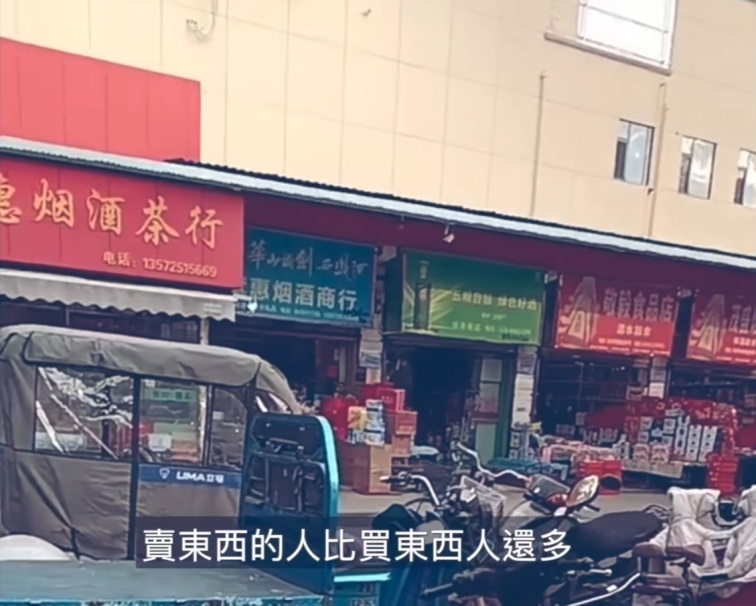
China’s economic downturn has left both major cities and remote towns struggling, with malls and markets facing a wave of closures and street vendors outnumbering customers. Many people have fallen into despair as a result. (Video screenshot)
[People News] By the end of 2025, around 100 million adults in China are expected to face overdue debt issues, with household non-performing debt reaching at least 22.2 trillion yuan, marking a 21% increase from the previous year. This estimate is based on an analysis of financial reports from 26 banks conducted by the research institution Jiafulongzhou, and has been supported by institutions such as the Financial Research Institute of Zhejiang University.
The Chinese Communist Party has stopped publishing aggregated data on personal overdue debts and defaults; however, data from the Credit Reference Centre, semi-annual bank reports, and consumer finance companies provide consistent corroborative evidence. In the first half of 2026, just 24 licensed consumer finance companies reported a total of 122 non-performing asset packages, with an outstanding principal and interest totalling 53.2 billion yuan, representing a significant year-on-year increase. The scale of unsecured consumer loans that banks and consumer finance institutions have offloaded and transferred reached approximately 454 billion yuan by the end of 2025, which is more than 20 times the 18.6 billion yuan recorded at the beginning of the pilot program in 2021.
Analysis of borrower characteristics indicates that the defaulting group is not primarily made up of young, forward-consuming individuals, but is more concentrated among middle-aged employed individuals around 40 years old. Their defaults are often directly linked to setbacks in business operations, declining incomes, or unemployment. This situation is not merely a simple financial risk event; rather, it reflects structural economic problems that are manifesting as concentrated pressure on the household sector.
The trend over the past decade: moving from low exposure to concentrated exposure at the retail end.
Regulatory data indicates that between 2016 and 2020, the overall bad loan rate for personal housing loans and consumer loans remained low, thanks to advancements in urbanisation, rapid growth in residents' incomes, and the expansion of the real estate market. A turning point emerged in the later stages of the three-year pandemic; following the launch of a pilot program for the bulk transfer of personal bad loans in 2021, the scale of these transfers expanded rapidly: approximately 18.6 billion yuan in 2021, with annual increases thereafter. By 2024, the total principal and interest had reached between 158.3 billion and 225.8 billion yuan, and in 2025, the listed principal and interest scale surpassed 370 billion to 450 billion yuan. Credit cards and consumer loans became the primary drivers of these transfers.
Data from several listed banks show that the bad loan rate for personal loans is generally rising from 2024 to 2026. For instance, the mid-2026 report from the six major state-owned banks indicates that the bad loan rate for personal loans has increased across the board compared to the end of the previous year, ranging from approximately 1.31% to 2.02%. The bad loan rate for credit cards is even more striking, with the Industrial and Commercial Bank of China rising from 4.61% at the end of 2025 to 5.37% in mid-2026, and Bank of Communications also experiencing a notable increase. Among the sample of listed banks, most institutions have reported an increase in the bad loan rate for personal loans compared to the beginning of the year, with some small and medium-sized banks and city commercial banks facing even greater pressure.
To lower the bad loan rate, banks are employing multi-channel write-offs, and the expansion of bulk transfer scales has masked some of the newly added bad loans, indicating that the actual pressure may be significantly higher than the reported ratios.
This reflects a positive correlation with economic downturns.
The increase in personal loan defaults is clearly synchronised in both time and direction with the macroeconomic downturn experienced by the Chinese Communist Party. Since 2021, the GDP growth rate has noticeably slowed. In the first three quarters of 2026, it recorded a year-on-year growth of approximately 4.6% (around 4.5% in the third quarter), which is lower than the previous mid-to-high growth phase. The overall non-performing loan ratio hovers around 1.5%, but the default rates for personal loans, particularly credit cards and unsecured consumer loans, continue to rise. The period of accelerating retail non-performing loans closely coincides with the decline in GDP growth and the diminishing contribution of domestic demand to GDP.
Banks are managing to reduce reported non-performing loans through bulk transfers and write-offs; however, the emergence of new non-performing loans is increasing in tandem with the economic slowdown, indicating a strong positive correlation. On a micro level, approximately one-tenth of adults are experiencing debt defaults that resonate almost simultaneously with a contraction in consumption.
The simultaneous rise in layoffs, bankruptcies, and unemployment rates
In recent years, the National Bureau of Statistics of the Chinese Communist Party has maintained the urban surveyed unemployment rate within the range of 5.0% to 5.3% (about 5.2% in September 2026). Despite this, the youth unemployment rate has remained persistently high at around 18%. Sectors such as real estate, construction, internet, and education and training continue to face significant policy pressure from the Chinese government. The number of personnel in real estate development has sharply decreased from its peak, with estimates suggesting a net loss of over 2 million people over the past eight years, while the number of migrant workers in the construction industry has also seen a significant decline, estimated to be in the tens of millions.
According to reports from mainland media, between 2021 and 2025, the number of companies involved in bankruptcy in China has experienced a three-phase evolution characterised by a "rapid rise - high-level fluctuations - rational adjustment." Over the past five years, the total number of bankruptcy-related companies increased from 28,895 to a peak of 55,267 in 2024, before slightly declining to 45,068, marking a total growth of 55.9% over five years, with a compound annual growth rate of approximately 11.7%, resulting in an absolute increase of 16,173 companies.
By 2025, there are 11,941 companies with registered capital between 5 million and 10 million yuan, accounting for 28.07%, ranking first. This is followed by 10,466 companies in the 1 million to 5 million yuan range at 24.6%, and 9,157 companies with registered capital below 1 million yuan at 21.52%, making up the top three categories. In total, there are 28,229 companies with registered capital below 10 million yuan, which constitutes 66.35% of the total, indicating that small and medium-sized enterprises remain in the "high-incidence zone of bankruptcy." Only 2,546 companies have registered capital exceeding 100 million yuan, accounting for 5.98%, and these are concentrated in major restructuring cases characterised by high debt and high assets.
The income disruptions caused by company closures and layoffs directly lead to a decline in repayment capacity, creating a chain of defaults. The typical profile of defaulting borrowers is predominantly middle-aged individuals around 40 years old, which is closely linked to unstable employment and income fluctuations. Structural employment pressures and the wave of defaults are rising in tandem.
This situation aligns with the trends of real estate recession, supply chain disruptions, and the return of the middle class to poverty.
Real estate sales have been on a downward trend since peaking in 2021 at approximately 18 trillion yuan, with projections estimating around 8.4 trillion yuan in 2025. The first half of 2026 is expected to see a continued double-digit decline compared to the same period last year. New construction and investment are experiencing significant negative growth, while second-hand housing prices are falling in most cities, with a notable cumulative decline in second-hand residential prices across 100 cities. The balance of housing loans has decreased year-on-year, and there are instances of early repayments alongside localised supply disruptions.
Household assets in China are heavily concentrated in real estate, and the drop in housing prices has directly resulted in a contraction of the middle class's asset-liability balance. The middle-aged demographic represents a significant portion of defaults, which aligns in both timing and mechanism with the 'middle-class returning to poverty' phenomenon driven by property devaluation and tightening cash flows. The decline in real estate further impacts the household sector through asset shrinkage and mortgage pressures, becoming a major factor behind the increase in personal loan defaults.
This situation closely mirrors the slow growth of household income, the decline in bank personal loans, and the overall weakness in domestic demand.
In recent years, the actual growth rate of per capita disposable income for Chinese residents has mostly hovered between 4% and 5%, which is lower than the previous high-growth period. Meanwhile, the growth rate of consumption expenditure has lagged behind income growth, leading to a decrease in the average propensity to consume. Household loans experienced a net reduction of over 1 trillion yuan in the first three quarters of 2026, with both housing loans and short-term consumer loans contracting, and the balance showing a year-on-year decline. The growth rate of total retail sales of consumer goods has remained persistently low, with some months in 2026 seeing growth rates as low as around 1%, clearly indicating weak domestic demand.
Both the willingness of banks to issue personal loans and the willingness of residents to take on debt have declined, while the scale of non-performing asset packages has rapidly expanded. The slowdown in income growth, the contraction of loans, and weak consumption are closely linked, together forming the demand-side foundation for the rise in defaults. Short-term consumer credit, promoted by technology platforms like Ant Group and ByteDance through methods such as 'rapid loan disbursement,' quickly becomes a bad debt amplifier during economic downturns. The strategy of targeting lower-tier customer segments makes the data appear favourable, but when the income of these groups fluctuates, the most indebted borrowers will be the first to be impacted, making it difficult for different platforms to isolate themselves, ultimately leading to a surge in bad debts.
Macroeconomic Facade and Microeconomic Traps
While the macro data from the National Bureau of Statistics of China may continue to reflect 'stability with improvement' and 'progressing towards new and better', the microeconomic reality tells a different story. Banks are managing to suppress visible non-performing assets through bulk transfers and write-offs, with non-performing asset packages being sold at discounts of 5% to 7% of the principal or even lower. Debts are shifted to asset management companies, while the government steps in to clean up the aftermath with financial support, only to impose additional taxes to cover the shortfalls. By 2026, the tax bureau will be the busiest department in the Communist Party, aggressively collecting taxes.
The default of one hundred million people signifies that at least one hundred million households have their financial freedom constrained, their consumption capacity diminished, and social liquidity stifled. This is not merely an 'isolated incident', but rather a concentrated manifestation of structural economic decline and the lingering effects of prior stimulus measures. Middle-aged individuals, who serve as the economic backbone of families, when they falter, impact the intergenerational sense of security, public confidence, and the credibility of the government.
China lacks a nationwide personal bankruptcy system, leaving debtors with virtually no legal means to extricate themselves, resulting in a vicious cycle of 'the more they are pressured, the more they suffer; the more they suffer, the more they are pressured.'
The true deadlock lies not in the figures on the balance sheet, but in the breakdown of cash flow and the erosion of confidence among micro entities. Bad debts will continue to pile up, and the pressures at the micro level will gradually undermine the macro facade. The poor microeconomic experience of ordinary people is not without basis. While macroeconomic conditions can be maintained through statistical measures, asset divestiture, and policy narratives, the reality of collection calls, credit records, threats of supply cuts, and anxiety over unemployment are the tangible burdens that affect everyone.
The debts of one hundred million individuals are not merely a numerical game; they represent the dust of our times settling on personal wounds.
(First published by People News)△









News magazine bootstrap themes!
I like this themes, fast loading and look profesional
Thank you Carlos!
You're welcome!
Please support me with give positive rating!
Yes Sure!