
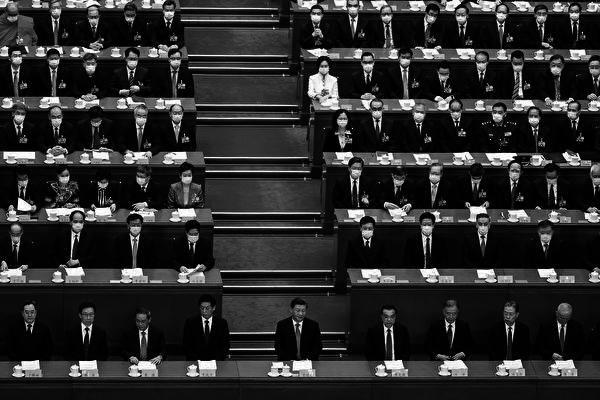
On March 5, 2023, CCP leaders attended the opening session of the National People's Congress.
[People News] It is worth noting that in the "Decision" passed at the recently concluded Fifth Plenary Session of the CCP, there is a section addressing the crises and challenges the Party faces: "Internally, the Party's ranks have undergone structural changes, with an increasing proportion of Party members and cadres born after the reform and opening up, which presents new demands for education and management. While the mainstream of the Party's ranks is positive, issues of impure thoughts, organisation, and style remain unresolved. The quality and capabilities of some Party members and cadres do not align with the demands of the current era. A minority of Party members and cadres, including senior officials, exhibit weak Party spirit, wavering or absent ideals and beliefs, a lack of connection with the masses, deviations in their views on achievements, and are significantly influenced by formalism, bureaucratism, hedonism, and extravagance. There is a lack of fighting spirit, responsibility, and action, non-compliance with discipline and rules, and even the misuse of power for personal gain, leading to corruption and moral decay."
In essence, many older Party members have either passed away or retired, resulting in a growing number of Party members born in the 1980s and 1990s, all of whom were born after the CCP's reform and opening up. The CCP is troubled by the numerous issues among its members, as some individuals from the 1980s and 1990s, like their predecessors, also struggle with problems of impure thoughts, organisation, and style, with a minority facing severe corruption and moral decline.
On November 10, Shi Taifeng, the Minister of the Organisation Department of the CCP, published a signed article in the "People's Daily" titled "Enhancing Party Spirit is the Fundamental Task of Strictly Governing the Party in All Aspects," which reiterated the aforementioned issues, particularly focusing on the challenges faced by those born in the 1980s and 1990s, providing data and further elaboration.
The article indicates that by the end of 2025, among over 100 million party members, 43.8% are aged 45 and below, and 59% hold a college degree or higher. In the cadre ranks, those born in the 1960s are gradually retiring, while those born in the 1970s and 1980s have become the majority, and the 1990s generation is 'coming of age'.
According to the Chinese Communist Party (CCP), the strengths of these young cadres lie in their higher education, which makes them 'active thinkers, broad-minded, and full of energy'. However, their weaknesses include a 'relative lack of rigorous training in intra-party political life and challenges from significant crises, leading to increasingly prominent issues regarding party spirit'. The CCP is concerned that in the face of the 'accelerated evolution of unprecedented global changes, rapid advancements in digitalisation, networking, and intelligence, the collision of various ideologies and values, and the sharp and complex struggles in the ideological arena', it may encounter the 'danger of internal strife, with the fortress being breached from within'.
The idiom 'disaster arises from within' suggests that calamities and upheavals stem from internal causes rather than external threats. In other words, these dynamic and open-minded individuals from the 1980s and 1990s could very well abandon and undermine the CCP from within. This has raised significant concerns among the current high-ranking officials of the CCP.
To counter this, the CCP has proposed to enhance what it calls 'party spirit education' for these individuals, encouraging them to 'inherit the red gene' and 'always remain clear-sighted and steadfast in navigating challenges'. In simpler terms, the CCP intends to intensify their indoctrination, ensuring they become unwavering supporters of the party.
The pressing question remains: how many individuals from the 1980s and 1990s can be completely indoctrinated?
According to online descriptions, individuals born in the 1980s are a generation that carries significant family expectations due to the one-child policy. They are generally pragmatic, steady, and conservative, with a strong sense of family responsibility and crisis awareness, accustomed to enduring pressure. They commonly believe that 'a house is a home' and are deeply committed to buying property, getting married, saving money, and securing stable employment. Many of them, now entering middle age, find themselves burdened by multiple realities such as housing loans, children's education, and retirement planning. Among these individuals are also officials from the Chinese Communist Party (CCP).
As civil servants, CCP officials are not typically expected to worry about unpaid salaries. However, in the current climate of economic decline, rising unemployment, sharply decreased fiscal revenues, and local governments facing potential financial crises, many civil servants—including those in government departments in third- and fourth-tier cities—are experiencing delayed salaries and unpaid bonuses. When the daily lives of these family-oriented individuals from the 1980s face challenges, can the CCP's propaganda still convince them that it is 'serving the people'?
Now, turning to those born in the 1990s. This generation, raised during China's rapid economic growth, the widespread availability of the internet, and relatively abundant material conditions, possesses a strong sense of self-awareness, an open and transparent mindset, and a pursuit of spiritual depth and personalised expression, characterised by a more carefree attitude. They are the primary supporters of renting and marrying. Additionally, they show a greater interest in 'brain hole' internet phenomena, such as two-dimensional culture and niche interest communities.
For this generation that values self-expression and individuality, to what extent can the CCP's grand narratives, false loyalty propaganda, and demands for allegiance to the Party persuade them and inspire action?
From my understanding of some civil servants born in the 1980s and 1990s within the system, they often present themselves as 'two-faced' or 'three-faced' individuals. Privately, they recognise the authoritarian nature of the Chinese Communist Party (CCP) and are aware that it lacks popular support. However, for the sake of their careers and livelihoods, they choose to outwardly conform.
This situation is likely one of the CCP's greatest concerns. The high-ranking officials of the CCP, who claim to have weathered 'great storms,' seem to overlook the fact that even they do not genuinely believe in Marxism-Leninism or communism. What makes them think that brainwashing will effectively change the next generation? In reality, a regime that does not prioritise the welfare of its people will inevitably be rejected by all conscientious individuals, regardless of whether they belong to the post-50s, post-60s, post-70s, post-80s, post-90s, or even post-00s generations, as this reflects the historical trend.
(First published in People News) △







News magazine bootstrap themes!
I like this themes, fast loading and look profesional
Thank you Carlos!
You're welcome!
Please support me with give positive rating!
Yes Sure!