
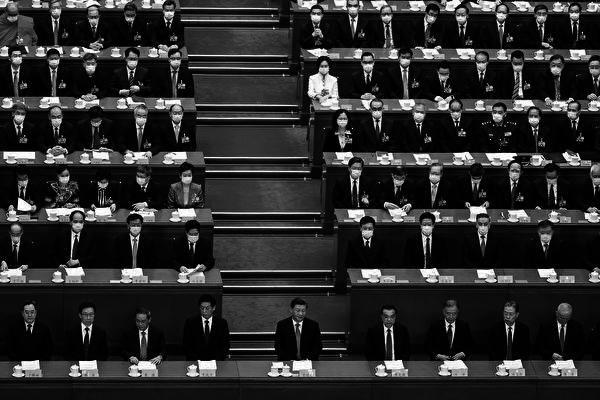
On March 5, 2023, CCP leaders attended the opening session of the National People's Congress.
[People News] On October 29, 2026, the four-day Fifth Plenary Session of the 20th Central Committee of the Communist Party of China came to a close. The conference communiqué revealed that both the number of absentees and the number of high-ranking officials facing disciplinary action reached unprecedented levels; 33 central committee members and alternate members were expelled from the Communist Party, including 16 senior generals and 7 high-ranking officials and executives from the military-industrial sector. Additionally, 10 individuals were appointed as central committee members, while Central Military Commission Lieutenant General Fu Wenhua, Zhu Wenxiang, and 3 others were bypassed. The plenary session only elected Zhang Shengmin, the vice chairman of the Military Commission, as a member of the Politburo, and did not elect any members of the Military Commission or its vice chairman.
The numerous irregularities observed during the Fifth Plenary Session underscore the peculiar political dynamics within Zhongnanhai, with fierce internal power struggles at the upper echelons. Notably, the communiqué deviated from the norm by omitting the phrase 'two-four-four-two' and instead emphasised 'democratic centralism', further fueling speculation regarding the actual power status of Xi Jinping, the leader of the Communist Party.
1. 33 Individuals Expelled from the Communist Party, Setting a New Record
According to the communiqué from the Fifth Plenary Session, it was confirmed that 24 central committee members were expelled from the Communist Party, including Ma Xingrui, Zhang Youxia, Liu Zhenli, Lan Tianli, Liu Jianchao, Wang Lixia, Jin Zhuanglong, Lei Fanpei, Yi Huiman, Wang Xiangxi, Sun Shaocheng, Wang Renhua, Liu Qingsong, Huang Ming, Li Qiaoming, Li Wei, Zhang Hongbing, Wang Haijiang, Zhang Lin, Wang Peng, Liu Faqing, Yang Cheng, Zhong Shaojun, and Zhao Xiaozhe. Additionally, 9 alternate committee members were expelled from the Communist Party, including Fei Dongbin, Wu Shenghua, Yu Jianfeng, Yuan Jie, Zhang Zhongyang, Wen Gang, Jin Donghan, Fang Hongwei, and Fang Yongxiang. Furthermore, alternate committee member Li Yunze received a penalty involving the revocation of his party positions.
During the Fifth Plenary Session, a total of 33 individuals were expelled from the Chinese Communist Party (CCP), which is the highest number of expulsions from a Central Committee meeting since the 20th National Congress. In comparison, only 3 individuals were expelled during the Third Plenary Session of the 20th Central Committee, and 14 during the Fourth Plenary Session.
2. Among those expelled were 16 senior generals and 7 officials from the military industry.
Of the 33 Central Committee members and alternate members expelled during the Fifth Plenary Session, 23 were senior generals and military industry officials, making up 70% of the total.
In total, 24 Central Committee members were expelled from the CCP, including 15 senior military generals, 9 of whom held the rank of full general. This group includes notable figures such as Zhang Youxia, a former member of the Politburo and Vice Chairman of the Central Military Commission; Liu Zhenli, former Chief of the Joint Staff; Wang Renhua, former Secretary of the Political and Legal Committee of the Central Military Commission; Li Qiaoming, former Army Commander; Li Wei, former Political Commissioner of the Information Support Force; Zhang Hongbing, former Political Commissioner of the Armed Police; Liu Qingsong, former Political Commissioner of the Eastern Theater; Huang Ming, former Commander of the Northern Theater; and Wang Haijiang, former Commander of the Western Theater. Additionally, there were 6 lieutenant generals, including Zhang Lin, former Political Commissar of the Logistics Support Department; Wang Peng, former Minister of the Training Management Department; Liu Faqing, former Minister of the Defence Mobilisation Department; Yang Cheng, former Political Commissioner of the Xinjiang Military District; Zhong Shaojun, former Director of the General Office of the Central Military Commission and Political Commissioner of the National Defence University; and Zhao Xiaozhe, former Director of the Science and Technology Committee of the Central Military Commission.
Among the alternate members expelled was Lieutenant General Fang Yongxiang, the former Director of the General Office of the Central Military Commission.
Among those mentioned, Zhang Youxia and Liu Zhenli were officially announced to have been removed from their positions eight months ago. Wang Renhua, Li Qiaoming, Li Wei, Zhang Hongbing, Zhang Lin, Wang Peng, and Zhong Shaojun had already been dismissed from their roles as representatives of the National People's Congress. Liu Qingsong, Huang Ming, Wang Haijiang, Liu Faqing, Yang Cheng, Zhao Xiaozhe, and Fang Yongxiang had previously shown unusual activities, and this marks the first official confirmation of their downfall by the authorities.
During the Fifth Plenary Session, 33 Central Committee members and alternate members were expelled from the Communist Party of China, including seven high-ranking officials from the military-industrial sector. These officials are former Minister of Industry and Information Technology Jin Zhuanglong, former Executive Deputy Director of the Office of the Central Committee for Military-Civilian Integration Development Lei Fanpei, former Chairman of China National Nuclear Corporation Yu Jianfeng, former Chairman of China Aerospace Science and Industry Corporation Yuan Jie, former General Manager of China Aerospace Science and Technology Corporation Zhang Zhongyang, former Chairman of China Shipbuilding Group Wen Gang, and former Director and Chief Engineer of the 711 Institute of China Shipbuilding Heavy Industry Group Jin Donghan.
Jin Donghan had previously been dismissed from his position as a representative of the Tianjin Municipal People's Congress and was removed from the list of academicians of the Chinese Academy of Engineering on their official website. The other six individuals have been missing for an extended period, and their public handling has confirmed the rumours of their downfall.
3. 32 Central Committee members and alternate members were notably absent from the Fifth Plenary Session.
According to the communiqué from the Fifth Plenary Session, there were 162 Central Committee members and 117 alternate members present, totalling 279 attendees; the number of absentees reached a new high.
Out of the 205 members of the 20th Central Committee, only 162 attended the Fifth Plenary Session, with 43 absent. This marks the lowest attendance at a Central Committee plenary session in the past 50 years. The attendance rate for Central Committee members was 79%, the first time in 50 years that the attendance rate has fallen below 80%.
Among the 43 absent members of the Central Committee, 24 were expelled from the Communist Party of China (CPC) during the Fifth Plenary Session, while another 19 members were absent. Notably, former Zhejiang Provincial Party Secretary Yi Lianhong, Chongqing Mayor Hu Henghua, and Jiangxi Province Governor Ye Jianchun have been dismissed. Additionally, CPC generals Xu Xueqiang, Li Fengbiao, Guo Puxiao, and Ju Qiansheng have been removed from their positions as representatives of the National People's Congress; these seven Central Committee members were not expelled from the CPC during the Fifth Plenary Session. Furthermore, 12 Central Committee members were unusually absent from the session.
Prior to the Fifth Plenary Session, there were originally 152 alternate Central Committee members, but only 117 attended, leaving 35 absent. During the session, 9 alternate Central Committee members were expelled from the CPC, and alternate member Li Yunze had his party position revoked. Five alternate Central Committee members are currently under investigation and were not expelled from the CPC during the Fifth Plenary Session, including Fei Gaoyun, Xu Liuping, Wang Kangping, Qin Weizhong, and Xia Linmao. Additionally, 20 alternate Central Committee members were unusually absent from the session.
4. 24 Central Committee members were expelled from the party, with only 10 replacements.
At the Fifth Plenary Session, 24 Central Committee members were expelled from the CPC, and 10 were replaced: Lu Dongliang, Bao Gang, Xing Shanping, Qu Yingpu, Lü Jun, Zhu Tianshu, Zhu Guoxian, Liu Jun, Liu Jie, and Liu Qiang. The number of replacements is significantly lower than the number of Central Committee members expelled from the party.
According to past practices, the number of replacements at the plenary session typically equals the number of departing Central Committee members. In previous sessions, such as the Third and Fourth Plenary Sessions, the number of replacements matched the number of departing members. However, this time, the Fifth Plenary Session left 14 seats vacant, reducing the total number of members in the 20th Central Committee from 205 to 191, marking an unprecedented change.
5. 10 individuals were promoted to Central Committee members, with 5 skipped, including 2 major generals.
At the Fifth Plenary Session, 10 alternate members were elevated to Central Committee members: Lu Dongliang, Bao Gang, Xing Shanping, Qu Yingpu, Lv Jun, Zhu Tianshu, Zhu Guoxian, Liu Jun, Liu Jie, and Liu Qiang.
After removing the alternate members who were skipped and those dismissed from the 20th Central Committee's Third and Fourth Plenary Sessions, the normal order of the alternate member list prior to the Fifth Plenary Session is as follows: Lu Dongliang, Fu Wenhua, Cong Liang, Bao Gang, Xing Shanping, Jilin, Qu Yingpu, Lv Jun, Zhu Tianshu, Zhu Wenxiang, Zhu Guoxian, Zhu Hexin, Liu Jun, Liu Jie, and Liu Qiang.
During the promotion of Central Committee members at the Fifth Plenary Session, Fu Wenhua, Cong Liang, Jilin, Zhu Wenxiang, and Zhu Hexin were skipped.
Among these, Fu Wenhua and Zhu Wenxiang hold the rank of major general. Fu Wenhua has served for a long time in the 16th Group Army of the former Shenyang Military Region and is a former subordinate of Zhang Youxia. Following the 19th National Congress of the Communist Party of China, during Zhang Youxia's tenure as Vice Chairman of the Military Commission, Fu Wenhua was promoted to Commander of the Beijing Garrison in April 2020. In March 2025, he was reassigned as Deputy Commander of the Armed Police Force and promoted to major general, and in October of the same year, he became Deputy Commander of the Army. Zhu Wenxiang is a major general in the Armed Police, having served as Deputy Commander of the Armed Police Force since July 2020.
To date, none of the military's 20th alternate members has been promoted to Central Committee members. Previously, Major General Ding Xingnong was skipped at both the Third and Fourth Plenary Sessions; four major generals—Wang Liyan, Wang Kangping, Fang Yongxiang, and Shi Zhenglu—were skipped at the Fourth Plenary Session. Wang Kangping was dismissed from his position as a representative of the National People's Congress in June 2026, and Fang Yongxiang was expelled from the Communist Party of China during the Fifth Plenary Session.
6. The Fifth Plenary Session did not add any members to the Military Commission or appoint a new Vice Chairman.
The initial members of the Central Military Commission from the 20th National Congress of the Communist Party of China include Chairman Xi Jinping, Vice Chairmen Zhang Youxia and He Weidong, and members Li Shangfu, Liu Zhenli, Miao Hua, and Zhang Shengmin. Of these, five have been removed from their positions, leaving only Xi Jinping and Zhang Shengmin.
During the Fourth Plenary Session in October 2025, Military Discipline Commission Secretary Zhang Shengmin was promoted to Vice Chairman of the Military Commission, succeeding He Weidong. However, the Fifth Plenary Session did not appoint any new Vice Chairmen or members to the Military Commission. Previous rumours regarding Li Qiang and Hu Chunhua being added as Vice Chairmen at the Fifth Plenary Session proved to be unfounded.
Dong Jun succeeded the ousted Li Shangfu as Minister of National Defence in December 2023, but has not yet been promoted to a member of the Military Commission or State Councillor, as is customary.
On July 3, 2026, Army Discipline Commission Secretary Zhang Shuguang was promoted to General and took over from Zhang Shengmin as Secretary of the Military Discipline Commission; however, he was not promoted to a member of the Military Commission at the Fifth Plenary Session as per convention.
Zhang Youxia and Liu Zhenli have been officially removed from their positions for eight months now, and their roles as Vice Chairman of the Military Commission and Chief of Staff of the Joint Staff Department of the Military Commission have yet to see any replacement arrangements.
Currently, there are only six active generals in the Communist Party of China, including Zhang Shengmin, Military Discipline Commission Secretary Zhang Shuguang, Minister of National Defence Dong Jun, Central Theatre Command Commander Han Shengyan, Eastern Theatre Command Commander Yang Zhibin, and Air Force Commander Wang Gang.
7. Only Zhang Shengmin was elected as a member of the Political Bureau.
The Fifth Plenary Session elected Zhang Shengmin as a member of the Central Political Bureau. This marks the first time in 32 years that a member of the Political Bureau has been elected at a Central Plenary Session since Huang Ju was elected during the 14th Central Committee's Fourth Plenary Session in 1994.
In October 2025, Zhang Shengmin was appointed as the Vice Chairman of the Central Military Commission of the Communist Party of China during the Fourth Plenary Session, although he was not simultaneously promoted to a member of the Politburo.
At the 20th National Congress of the Communist Party of China in October 2022, 72-year-old Zhang Youxia retained his position as a member of the Politburo and Vice Chairman of the Central Military Commission. It is anticipated that by the 21st National Congress, 69-year-old Zhang Shengmin will be re-elected as a member of the Politburo and Vice Chairman of the Military Commission, despite being over the typical age limit.
Currently, the 20th Central Politburo has 22 members, which is two fewer than at the beginning of the term. Over the past year, three members of the Politburo, including Vice Chairman of the Military Commission He Weidong, Zhang Youxia, and former Xinjiang Party Secretary Ma Xingrui, have been dismissed from their positions.
Chen Xiaojiang, who succeeded Ma Xingrui as the Xinjiang Party Secretary, was not elected as a member of the Politburo during the Fifth Plenary Session, contrary to earlier rumours. Additionally, rumours about Hu Chunhua and Shaanxi Provincial Party Secretary Zhao Yide being added as members of the Politburo during the Fifth Plenary Session did not come to fruition.
8. The Fifth Plenary Session did not clarify Xi Jinping's successor.
The communiqué from the Fifth Plenary Session announced that the 21st National Congress of the Communist Party of China will take place in the second half of 2027 in Beijing.
On the eve of the Fifth Plenary Session, Li Qiang, a member of the Standing Committee of the Politburo and Premier of the State Council, engaged in a series of high-profile activities, which led to speculation; various political rumours circulated regarding Li Qiang potentially being appointed as Vice Chairman of the Military Commission during the Fifth Plenary Session and succeeding at the 21st National Congress.
Hu Jintao was appointed as Vice Chairman of the Military Commission during the Fourth Plenary Session of the 15th Central Committee in September 1999, clearly establishing his status as a successor. Xi Jinping was appointed as Vice Chairman of the Military Commission during the Fifth Plenary Session of the 17th Central Committee in October 2010, confirming his status as a successor.
At the 20th Central Committee's Fifth Plenary Session of the Communist Party of China, the only notable personnel change was the customary promotion of Zhang Shengmin, the Vice Chairman of the Military Commission, to a member of the Politburo. There were no other high-level appointments or dismissals, and no unexpected candidates emerged who could potentially succeed Xi Jinping. It is highly likely that Xi will continue in his role at the 21st National Congress; alternatively, his successor may be chosen from the current members of the Politburo Standing Committee or the Politburo.
Notably, there has been no appointment of civilian high-ranking officials to supplement the Vice Chairman of the Military Commission, following the precedent set by Hu Jintao and Xi Jinping, which could indicate that Xi will at least retain the position of Chairman of the Military Commission at the 21st National Congress.
9. The communiqué from the plenary session emphasises "democratic centralism" and notably omits the phrase "Two Establishes, Four Consciousnesses, Four Confidences, Two Safeguards."
In comparison to the communiqués from previous plenary sessions following the 20th National Congress, the Fifth Plenary Session's communiqué shows significant irregularities.
The Fifth Plenary Session communiqué does not include terms such as "Two Establishes, Four Consciousnesses, Four Confidences, Two Safeguards" that praise and uphold Xi. In contrast, the communiqués from the Second, Third, and Fourth Plenary Sessions after the 20th National Congress all included this phrase.
Conversely, the Fifth Plenary Session communiqué emphasises "democratic centralism" five times. However, the communiqué from the Fourth Plenary Session in October 2025 and the one from the Third Plenary Session in July 2024 did not mention "democratic centralism."
Since Xi Jinping assumed power at the 18th National Congress, he has reinforced centralisation through a method known as "group governance," effectively sidelining the Politburo Standing Committee and functional departments like the State Council. At the 18th Central Committee's Sixth Plenary Session, he was designated as the so-called "core of Xi." Around the time of the 19th National Congress, he solidified his "supreme position" through the so-called "Two Establishes, Four Consciousnesses, Four Confidences, Two Safeguards."
Since the Third Plenary Session in mid-July 2024, rumours about Xi Jinping's health and power crisis have proliferated, leading to ongoing purges of high-ranking officials from the party, government, and military associated with him. The Chinese Communist Party (CCP) media's propaganda efforts to support Xi and 'maintain the core of Xi' have noticeably decreased.
In addition, the CCP military media has consistently voiced opinions that diverge from Xi's, emphasising 'democratic centralism,' 'collective leadership,' and 'intra-party democracy,' while clearly opposing 'one-man rule' and no longer mentioning the responsibility system of the Chairman of the Central Military Commission. In parallel, the CCP Politburo and party media have also highlighted the importance of 'centralised and unified leadership.'
The Central Committee of the Communist Party of China asserts that it is the highest power organ of the CCP. In a break from tradition, the Fifth Plenary Session of the 20th Central Committee has chosen not to mention 'two-four-four-two,' instead focusing on 'democratic centralism,' which sends sensitive political signals.
Conclusion
During the Fifth Plenary Session of the CCP, the nearly incapacitated Central Military Commission has yet to add new members; among the 33 high-ranking officials who have been dealt with, there are 16 senior generals and 7 military industry officials. Furthermore, a significant number of 'missing' senior generals have not been publicly addressed, underscoring that the crisis within the CCP military remains unresolved, and the purging actions continue to evolve.
With three positions in the CCP Politburo vacant, only Zhang Shengmin has been appointed during the Fifth Plenary Session; the successor to Xi remains unclear, and various political rumours have proven unfounded. There are indications of intense power struggles among the CCP's senior leadership regarding personnel arrangements for the 21st National Congress. Notably, the meeting's communiqué unusually omits 'two-four-four-two,' instead emphasising 'democratic centralism,' which again reflects Xi Jinping's power crisis and introduces variables and new points of interest for the personnel arrangements at the CCP's 21st National Congress.
The Fifth Plenary Session saw a record number of absentees, as well as a significant increase in the number of high-ranking officials facing disciplinary actions. The meeting's theme and the language used in the communiqué underscored the so-called 'advancement of comprehensive strict governance of the Party,' setting the stage for a new wave of intensified internal power struggles in the lead-up to the 21st National Congress of the Communist Party of China.
--Dajiyuan
△






News magazine bootstrap themes!
I like this themes, fast loading and look profesional
Thank you Carlos!
You're welcome!
Please support me with give positive rating!
Yes Sure!