

The black-and-white image from the CCP's "Eleventh" reception resembles rows of large floral wreaths found in a funeral home. (Video screenshot)
[People News] The Communist Party of China (CPC) commenced its Fourth Plenary Session of the 20th Central Committee on October 26, which will last for four days. Party leader Xi Jinping presented a report detailing the policy draft on 'Continuously Advancing Comprehensive Strict Governance of the Party on Several Major Issues.' The report outlined the challenges the CPC faces, including enhancing governance capabilities, preventing complacency, and combating corruption.
After reviewing the news from the party media, one gets the impression that the CPC's 'Comprehensive Strict Governance of the Party' is an ongoing endeavour, perpetuating the ironclad rules established over a century ago since its inception. From the rectification of the AB Group in the early 1930s to the purges during the Northwest retreat, from the Yan'an Rectification Movement to the Three Anti and Five Anti Campaigns, and from the Cultural Revolution's Anti-Rightist Movement to today's efforts in tiger hunting and anti-corruption, the Party has consistently faced 'several major issues' that require rectification. What is happening within this Party?
The CPC's current emphasis on strict governance of the Party serves as a demonstration of authority against the earlier call for 'Strengthening Centralised and Unified Leadership.' It is essential for the entire Party to understand who this centralised authority is focused on, and each member must deeply recognise that there should be no illusions about 'collective leadership'; any such notions must be self-defeating.
On the 27th, the disciplinary inspection department of the Communist Party of China released a so-called report card on its strict governance efforts this year. According to the China Discipline Inspection and Supervision News, in the first three quarters of this year, national disciplinary inspection and supervision agencies dealt with a total of 680,000 individuals. This included 105 officials at the provincial level and above, which is an increase of 36 compared to last year, marking a rise of approximately 52%. Additionally, 3,680 officials at the department and bureau level were also implicated. There were 29,000 cases filed against bribers, with 3,020 of these cases referred to prosecutorial authorities. National disciplinary inspection and supervision agencies received a total of 3.506 million reports and addressed 2.149 million problem clues.
Senior commentator Cai Shenkun, in an interview with Radio Free Asia, remarked that the ongoing intensity of anti-corruption efforts following the 20th National Congress serves to politically assess individuals' absolute loyalty. The media also cited retired official Yamamoto Taiyuan, who noted that the focus on lifelong accountability in anti-corruption efforts is somewhat linked to the upcoming 21st National Congress of the Communist Party next year, suggesting that there will be even more actions taken in the future, primarily due to the numerous political adversaries from the past.
Beijing political observer Mr Xin believes that the Fifth Plenary Session acts more like a mobilisation order for 'comprehensive strict governance of the Party' directed at the Communist Party's internal members. He stated: 'The official release of these figures and the Fifth Plenary Session's discussions on several significant issues regarding comprehensive strict governance of the Party are all aimed at paving the way for senior personnel arrangements for next year's 21st National Congress.'
Analysts suggest that while power can force officials to publicly declare their loyalty, it is challenging to ensure their true inner agreement. Consequently, the demands for loyalty from those in power and the suspicions of disloyalty may intensify. Xi Jinping's (Xi Jinping) predicament mirrors that of past dictators: he struggles to secure absolute loyalty from everyone. Even in a landscape with virtually no competitors, there remains a need for ongoing purges to reaffirm his authority, indicating that as Xi seeks a fourth term, he continues to grapple with a profound sense of insecurity regarding his power. However, the tools at his disposal are dwindling, which underpins the anxiety surrounding his re-election and the isolation experienced by dictators.
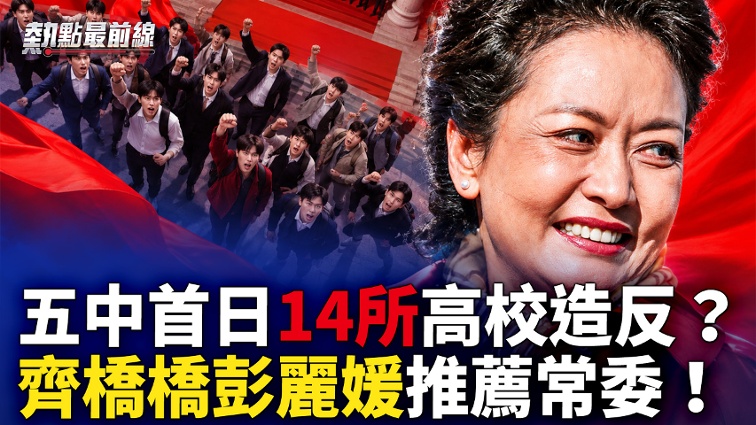
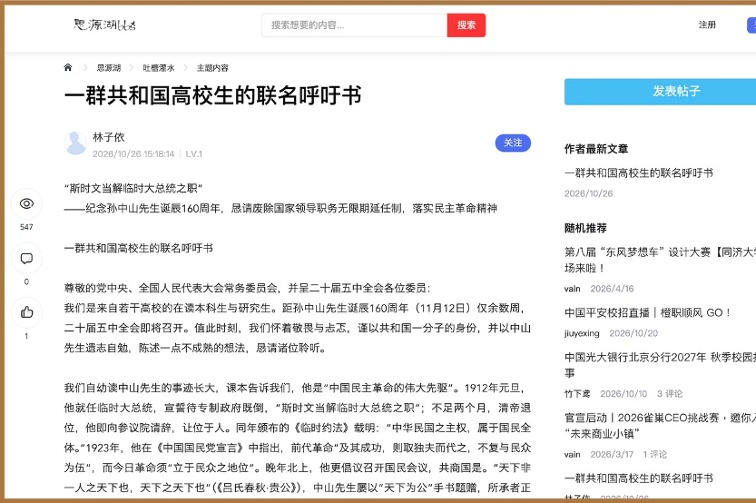
For nearly a century, the Chinese Communist Party (CCP) has repeatedly proposed reforms to its political system, often advocating for more open dialogue, democracy, or what they term 'whole-process democracy.' They have also stressed the importance of developing the private economy and allowing capitalists to join the party, among other initiatives. While the rhetoric may shift, it has been demonstrated that the party's core essence remains unchanged; it consistently demands strict governance. On the first day of the Fifth Plenary Session, on the 26th, it was reported online that students from Peking University and other institutions at the undergraduate level and above had jointly signed an article, referencing the CCP's numerous commitments over the past 50 years and calling for the 'abolition of lifelong leadership systems.' The article was swiftly deleted.
This incident exemplifies the CCP's inconsistency and its unchanged nature. Naive students find themselves ensnared in the CCP's web of deceit, making demands that could inadvertently lead to political persecution.
Does the 'strict governance' of the party proposed at this Fifth Plenary Session have any real impact? Certainly not; next time, this slogan will likely resurface, and strict governance will be enforced once again. The repeated calls are merely temporary, deceptive slogans aimed at prolonging the party's existence.
(People News first published) △




News magazine bootstrap themes!
I like this themes, fast loading and look profesional
Thank you Carlos!
You're welcome!
Please support me with give positive rating!
Yes Sure!