
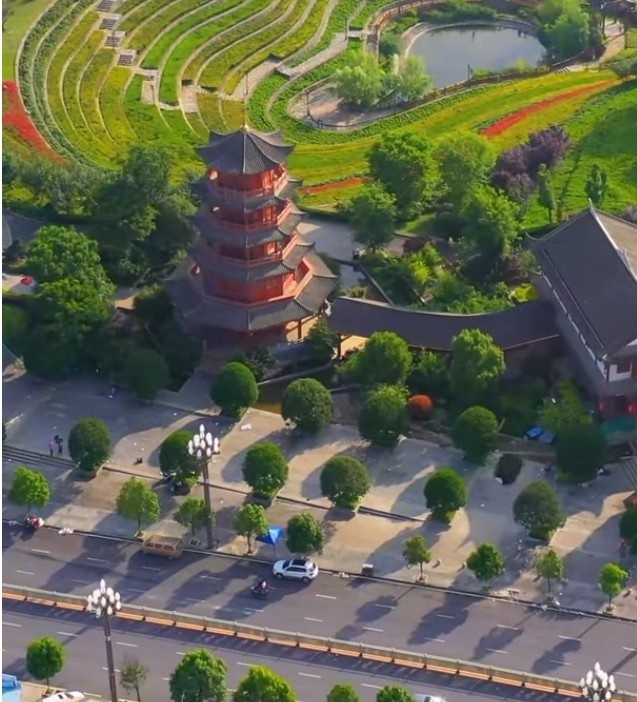
An artificial ancient town in Guizhou appears eerily quiet. (Video screenshot)
[People News] During this year's National Day holiday, the number of travellers in China reached impressive levels. However, the once-thriving 'artificial ancient towns' have lost their allure, attracting very few visitors and resulting in many shops being closed. Data indicates that over the past eight years, more than 50 billion yuan (RMB) has been invested in these artificial ancient towns, and currently, the vast majority have become desolate ruins awaiting their end. This situation exemplifies the 'concentrating efforts on foolishness' phenomenon characteristic of the Xi Jinping era.
Fewer than 300 of the 2,800 Artificial Ancient Towns Survive
Recently, several videos showcasing artificial ancient towns have circulated on Chinese social media, highlighting the common complaint that these heavily invested towns attract very few visitors, resulting in a desolate atmosphere with many shops remaining empty. One blogger remarked in a video that there are often more security personnel than tourists in these towns. Another video stated, "500 billion spent on a ghost town, the truth is heartbreaking."
According to trending searches on Baidu, over the past eight years, more than 50 billion yuan has been invested in China's artificial ancient towns.
Research from the China Ancient Cities and Culture Research Institute and related tourism statistics indicate that there are over 2,800 ancient cities, towns, and imitation scenic areas that have been developed or are currently under development nationwide. Among these, well-managed towns like Wuzhen and Gubei Water Town, which have formed a mature commercial ecosystem, account for about 5% to 10%; those barely maintaining balance or experiencing slight losses make up about 40% to 45%; and those facing severe losses or even becoming ghost towns, some entering bankruptcy restructuring, account for approximately 45% to 50%. This includes places like Zhangjiajie Dayong Ancient City and Guizhou Dushan Water Temple.
According to a report from the Economic Daily on July 29, 2025, fewer than 300 artificial scenic areas have survived to date.
The Model of Using Ancient Towns for Real Estate Development Has Failed
Baidu's trending searches attribute the poor management of these artificial ancient towns to a model that emphasises real estate over operations.
The provincial news comprehensive client platform "Elephant News," organised by Henan Radio and Television Station, reported insights from industry insiders who revealed that many artificial ancient towns were not originally designed for profit through tourism. The industry uses the term "cultural tourism land grabbing" to describe the practice of developing cultural tourism ancient towns as a means to package enterprises, subsequently seeking favourable land policies and support from local governments.
Further explanations from insiders indicate that the ancient town itself serves as a showcase, while the actual revenue is generated from various residential communities, commercial streets, and apartments constructed around the ancient town. By leveraging the concept of the ancient town to enhance the value of surrounding land and selling these properties to recover funds, many projects can achieve rapid capital turnover.
Authentic ancient towns are rich in traditional Chinese cultural heritage and vibrant life, enticing visitors to "escape the hustle and bustle for a few days"; in contrast, artificial ancient towns are merely hollow facades, where tourists may spend two hours taking photos before leaving, with little intention of returning.
Moreover, numerous influencers have commented on Baidu, noting that the architecture of artificial ancient towns is repetitive, and the investment attraction strategies are similar, resulting in a lack of uniqueness, leading tourists to feel that "seeing one is like seeing a hundred." Additionally, these artificial towns often lack local characteristics and the essence of local life, making it challenging for purely "hard cement imitation ancient" scenic spots to draw in contemporary tourists.
For instance, the construction of Zhangjiajie Dayong Ancient City cost 2.4 billion yuan, covering an area equivalent to 22 standard football fields, and its architectural style blends elements from Ming and Qing dynasty architecture with Tujia ethnic features. Initially, it was positioned as a new benchmark for cultural tourism with national demonstration significance.
Since its trial opening in June 2021, Dayong Ancient City has faced ongoing losses. From 2021 to 2024, the total losses over four years have amounted to 1.08 billion yuan, with the only profitable venture being the parking lot.
While the artificial ancient town once enjoyed a period of prosperity filled with laughter and joy, its lack of authentic cultural roots and sustainable business logic means that this flourishing was nothing more than a 'bubble flower' inflated by substantial capital investment.
Xi Jinping's Government Characteristic: 'Concentrating Power to Do Foolish Things'
The proliferation of artificial ancient towns across the country primarily stems from 'the impulse of local officials for political achievements and rent-seeking'. However, the 'highly centralised and lacking checks and balances' system under Xi Jinping's leadership objectively magnifies the scale and cost of this 'concentrating power to do foolish things'.
The essence of the Xi Jinping government's prominent promotion of 'concentrating power to accomplish significant tasks' revolves around government leadership, rapid resource mobilisation, inter-departmental coordination, and substantial financial investment. The explosive construction of artificial ancient towns aligns perfectly with this operational model.
Many of these artificial ancient towns are not simply commercial ventures but are instead 'dual-point projects' or political achievement projects spearheaded by local governments. Local authorities leverage administrative approval rights, allocate land, coordinate bank loans, and engage local state investment (state-owned asset platforms) to swiftly mobilise billions in funding within a very short timeframe (with some projects going from approval to commencement in just a few months).
Investments typically range from 2 billion to 5 billion yuan, forcibly constructing high-rise buildings on thousands of acres of land to create a 'millennium ancient town' seemingly out of nowhere. This capacity to concentrate capital and engineering resources in a short period is a hallmark of an administrative directive system.
Officials Quietly Amass Wealth
In the corruption-ridden landscape of the Chinese Communist Party, the swift advancement of investment projects worth tens or even hundreds of billions of yuan is closely tied to layers of officials eagerly seeking to siphon off national funds, collectively 'making a fortune in silence'.
The development of artificial ancient towns involves significant financial turnover at every stage, including land allocation, bidding, planning changes, project subcontracting, and fund disbursement. Regardless of whether these projects will be profitable in the future, the construction funds are already depleted and divided during the construction phase.
These large-scale political achievement projects enable officials to gain political capital by completing impressive projects, while behind-the-scenes dealings can yield substantial profits through kickbacks and grey income. The resulting massive debts and risks associated with unfinished projects are entirely shouldered by local finances, banks, and future officials.
As the saying goes: "When a project begins, it’s worth a fortune; when it fails, pockets are emptied." When the personal profits of officials and unscrupulous businessmen far outweigh the costs of illegal activities, and the burden falls on the state—meaning all taxpayers—officials face no accountability for their decision-making errors. Consequently, the practice of "concentrating efforts on foolish endeavours" has become standard in the Chinese Communist Party (CCP) bureaucracy.
These projects consume vast land resources, leaving behind significant hidden debts for local governments and non-performing loans for banks, which ultimately must be covered by local finances and the general populace.
Although the construction of artificial ancient towns is not directly directed by the central government, the governance philosophy and institutional restructuring under Xi Jinping have indeed created a fertile ground for "concentrating efforts on foolish endeavours," which is a hallmark of CCP governance.
During Xi's administration, political and social controls have been significantly intensified, with media oversight, public scrutiny, academic dissent, and the supervisory role of local people's congresses being greatly diminished.
Decision-makers are often insulated from the truth: In an environment characterised by 'no reckless criticism of the central government' and a strong emphasis on political loyalty, dissenting voices struggle to be heard, whether it concerns major projects at the central level or initiatives led by local 'first secretaries'. This situation results in flawed decisions that cannot be addressed early on, leading to numerous unfinished projects across China that have consumed astronomical sums of money but ultimately yield no results.
Take, for instance, the 'ghost city' of Xiong'an, which was personally approved by Xi Jinping: The Xiong'an New Area is heralded as a 'millennium plan, a national priority', with investments reaching hundreds of billions. However, due to violations of the natural laws of regional economics—specifically, the forced guidance of population and industry through administrative means—its commercial vitality has significantly underperformed expectations, leading outsiders to regard it as Xi Jinping's colossal 'unfinished project'.
Another case is the 'trillion' chip leap forward: The central government focused its resources on allocating hundreds of billions to rejuvenate the semiconductor sector, which sparked a wave of fraudulent subsidy claims across various regions, resulting in the bankruptcy of numerous chip projects and the downfall of several key officials due to severe corruption.
Moreover, there is the 'Belt and Road' overseas investment initiative: Some projects have been driven more by political considerations than by economic viability, leading to substantial bad debts and the stagnation of projects in multiple countries.
These projects are all major initiatives prominently championed by Xi Jinping's government. However, their disappointing returns exemplify the tendency of Xi Jinping's administration to 'concentrate efforts on foolish endeavours'. △








News magazine bootstrap themes!
I like this themes, fast loading and look profesional
Thank you Carlos!
You're welcome!
Please support me with give positive rating!
Yes Sure!