
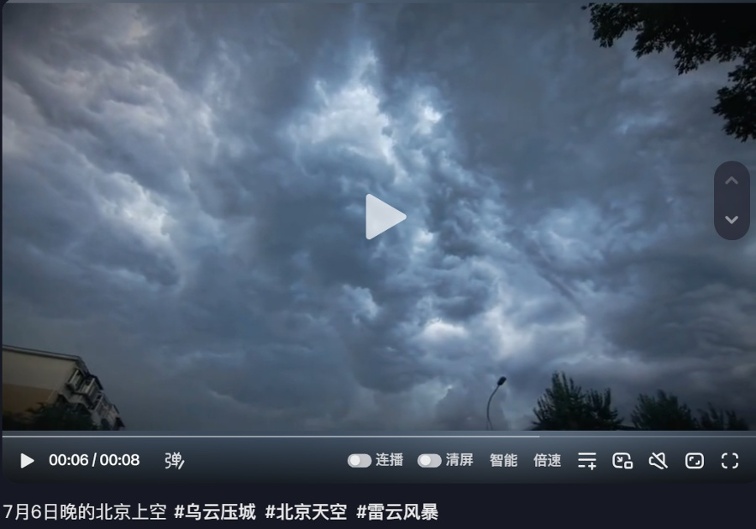
Beijing Sky (video screenshot)
[People News] In recent years, various phenomena such as fireballs, earthquakes, solar eclipses, lunar eclipses, strong winds, and hail have been increasingly frequent, with heaven issuing repeated warnings. This serves as a warning to Xi Jinping, the leader of the Communist Party, and the Communist Party itself, indicating that heaven is extremely angry about their regressive actions, and divine punishment is on the horizon.
On November 13, another unusual phenomenon was observed in Mudanjiang, located in the southeastern part of Heilongjiang Province in northern China. A video shared by local citizens showed a black snake basking in the sun. On that day, the daytime temperatures in Mudanjiang ranged from 9 to 11 degrees Celsius, while nighttime temperatures fell to between -3 and -1 degrees Celsius.
Historical data indicates that in previous years, the average temperature in Mudanjiang in mid-November was around 1°C during the day and approximately -8°C at night, suggesting that the region had already entered winter mode. Thus, it is not surprising that the black snake did not hibernate but instead came out to bask in the sun due to the unusual temperatures on the 13th.
This year, winter officially began on November 7, marking the start of Mengdong (the first month of winter). Mengdong (the tenth month of the lunar calendar) is traditionally the first month of winter, a time when the weather should turn cold, the earth should close up, and all living things should lie dormant. The ancient text from the Pre-Qin period, 'Liji: Monthly Orders,' states, 'If Mengdong follows summer regulations, the country will experience many violent storms; winter will not be cold, and hibernating insects will emerge again.'
The essence of this is that if, during Mengdong, the severe winter regulations of the month are disregarded and summer regulations and climate norms are instead applied, it will lead to frequent storms in the country, and the winter that should be cold will instead be unusually warm, causing insects that should be hibernating to emerge once more.
According to a report from the Central Television Meteorological Station of the Communist Party of China, from November 7 to 10, many regions were affected by strong cold air, resulting in strong winds, heavy rain, cold waves, and blizzards.
Specifically, areas such as southern Anhui, southeastern Hubei, northern Hunan, and northern Jiangxi experienced heavy rainfall ranging from 50 to 90 mm, with localised instances of intense precipitation and thunderstorms. Eastern Xinjiang, central and western Inner Mongolia, North China, and the Huang-Huai region saw winds of 5 to 6 on the Beaufort scale, with gusts reaching 7 to 8; in the Bohai Sea and the Taiwan Strait, gusts could reach levels 9 to 11. In the western and northern parts of Beijing, northern Hebei, and western Liaoning, there were moderate to heavy snowfalls, with some areas experiencing extremely heavy snow.
The sighting of a black snake in Mudanjiang is a typical example of "insects awakening from hibernation." In addition to Mudanjiang, villagers in Zhejiang and Anhui have also reported seeing snakes, which is considered an unusual occurrence.
According to the Western Han Confucian scholar Dong Zhongshu in his work "Chunqiu Fanlu: Governance and Disorder of the Five Elements," he stated: "Wood dries water, and insects do not hibernate in winter; earth dries water, and insects emerge in winter; fire dries water, and stars fall; metal dries water, and winter is extremely cold." The ancients associated the five elements with the four seasons: spring corresponds to wood, summer to fire, autumn to metal, and winter to water. The transition of seasons and the growth and decline of all living things are influenced by the five elements.
The essence of this statement suggests that the wood energy associated with spring disrupts the water energy associated with winter, resulting in warmer climatic conditions that prevent insects, which should be hibernating in winter, from remaining dormant. If the earth energy interferes with the appropriate water energy during winter, insects that are supposed to hibernate will anomalously emerge during the winter.
When the fire energy, symbolising heat, unusually encroaches upon the water energy, it disrupts the balance of yin and yang, resulting in meteors falling from the sky. In November of this year, many areas recorded temperatures above the seasonal average, and recently, meteors were discovered to have landed on Earth. When the metal energy, representing harshness, excessively interferes with the water energy, it causes a rise in cold air, leading to extremely severe winter conditions.
Moreover, the Tang Dynasty text "Kaiyuan Zhanjing" states: "If the ruler fails to govern properly in spring, green snakes will appear in the city, resulting in numerous disasters that year; if governance is poor in summer, red snakes will appear (in the city); if autumn governance is lacking, white snakes will appear (in the city); and if winter governance is inadequate, black snakes will appear (in the city)."
The essence of this is that if the ruler mismanages affairs in spring, green (the term '青' refers to a bluish-green colour) snakes will emerge in the city, leading to many calamities that year; if mismanagement occurs in summer, red snakes will appear; if autumn governance is flawed, white snakes will appear; and if winter governance is poor, black snakes will appear.
In the "Kaiyuan Zhanjing," Jing Fang remarks: "If the black snake emerges in winter, it signifies danger for the ruler." This indicates that the appearance of black snakes in winter poses a threat to the monarch.
Additionally, the "Hongfan Wuxing Zhuan" states: "The emperor's failure to achieve extremes is termed as not establishing; its blame is obscure, its punishment is consistently hidden, and its extremes are weak. At times, there are shooting demons, at times, calamities involving dragons and snakes, at times, horse disasters, and at times, lower individuals attacking those above them..."
The central theme is that the monarch has strayed from the path of righteousness, indicating that the ruler's virtue has 'failed to be established.' This has led to the monarch's faults of ignorance and lack of discernment, resulting in divine punishment characterised by a persistent presence of negative energy and frequent overcast conditions. Furthermore, when the monarch loses virtue, the royal family weakens, and yin energy dominates over yang, unusual phenomena such as 'serpent calamities,' 'horse disasters,' and 'subordinates rebelling against their superiors' begin to manifest.
In the last two years, the increasingly frequent occurrences have pointed to the ominous situation surrounding Xi Jinping, who occupies the highest position in Zhongnanhai. Additionally, Xi's deteriorating health and lacklustre appearance serve to reinforce this notion, suggesting that the Chinese Communist Party is already in a state of decline. Eventually, on some unforeseen day, everything will come to a resolution.
(First published in People News) △




News magazine bootstrap themes!
I like this themes, fast loading and look profesional
Thank you Carlos!
You're welcome!
Please support me with give positive rating!
Yes Sure!