
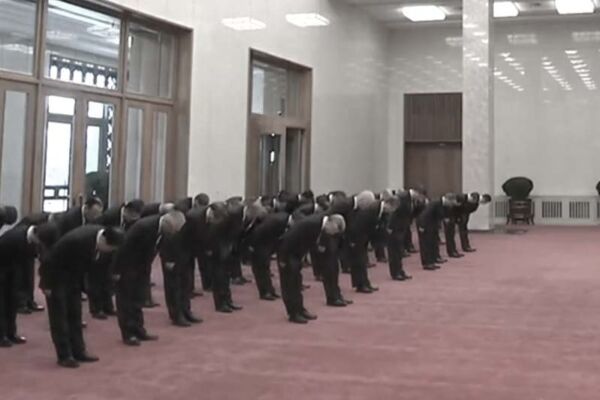
"Paying Respects" Is Actually a Tactic for "Drawing Vital Energy" (Photo: On December 26, 2023, members of the CCP Politburo Standing Committee and senior officials in Beijing bowing to the statue of Mao Zedong. Screenshot from a video.)
[People News] The body of former Chinese Premier Zhu Rongji was cremated in Beijing on the 18th. In the obituary issued by the Chinese Communist Party, it was noted that he was 'daring to speak the truth, unafraid of offending others, and not engaging in special treatment.' However, the Communist Party did not specify what truths Zhu had spoken, who he had offended, or what was meant by 'special treatment.' Such language is quite rare in the obituaries of deceased high-ranking leaders within the Communist Party. Some interpret this statement as having an underlying message, suggesting that officials within the Communist Party are reluctant to speak the truth, that there is significant infighting among corrupt officials, and that privilege is widespread.
So, what truths did Zhu Rongji actually express? Is the Communist Party genuinely praising him? Let’s examine:
In March 1998, shortly after being elected Premier, Zhu Rongji stated at a press conference: 'Regardless of whether there are landmines ahead or a bottomless abyss, I will forge ahead without hesitation, dedicated to my duty, and will not stop until death.'
In 1998, during an anti-corruption meeting, Zhu Rongji remarked: 'Anti-corruption means first tackling the tigers and then the wolves; we will show no mercy to the tigers. I have prepared 100 coffins here, 99 for corrupt officials and one for myself.'
In 1998, when a major flood struck the Yangtze River, Zhu Rongji discovered serious quality issues with the flood control dikes during his visit to Jiujiang, Jiangxi. He angrily reprimanded the local officials: 'Didn’t you claim it was as solid as a fortress? Who would have thought the dike was made of tofu dregs!' He also denounced the related projects as 'tofu dregs projects, bastard projects,' and emphasized that 'history cannot be deceived.'
During his visit to Hong Kong in 2002, Zhu Rongji stated, "If Hong Kong does not perform well, not only do you bear responsibility, but we do as well. If the return of Hong Kong to the motherland is mishandled under our watch, wouldn't we become national sinners?"
Zhu Rongji's remarks appear more tangible and pragmatic compared to the Chinese Communist Party's superficial slogans such as "paradise on earth," "common prosperity," "public servants of the people," and "great savior." But can he truly deliver on these promises? Or are his words even effective? The answer is clear, as history has shown us.
For example, in the year following Zhu Rongji's term as Premier, Jiang Zemin, the General Secretary of the Chinese Communist Party, initiated an unprecedented and brutal crackdown on citizens practicing qigong for health, which has caused irreparable harm to humanity.
Zhu Rongji, who had once been denounced as a rightist, ultimately could not withstand Jiang Zemin in the face of overwhelming adversity. The notion of being "unwavering" was far from reality. At that time, Jiang Zemin was a notorious corrupt official, and Zhu must have been aware of this, yet he still ended up with a coffin prepared for him by others in 2026. Isn't the current corruption merely an extension of what began back then? As for the increasing number of shoddy construction projects, they have only worsened over time, and Hong Kong's situation is even more dire now; who would admit to being a sinner?
This situation is primarily dictated by the system of the Chinese Communist Party. "History can only be a continuous deception," and the century-long history of the CCP demonstrates that it has consistently relied on violence and lies to uphold its authoritarian rule, deceive the populace, and prolong its existence. Unfortunately for Zhu, his death will only serve as a tool for the CCP's deception.
It would be a mistake to assume that the Chinese Communist Party (CCP) calling Zhu 'someone who dares to speak the truth and is not afraid of offending others' in the obituary indicates a newfound conscience within the party. The CCP's willingness to make such statements can be attributed to two main reasons: first, Zhu's 'truth' holds no real significance, as he does not offend any major figures; his claim of 'offending' is equally ineffective. Second, the CCP is leveraging Zhu's image to appeal to party officials and the public who still harbor hopes for reform.
This is similar to Xi (Xi Jinping) praising Jiang Zemin (Jiang Zemin) during his speech commemorating the centenary of Jiang's birth, where he lauded Jiang for his steadfast support and execution of the Party Central Committee's crackdown on the Tiananmen Square protests. Xi praised Jiang's unwavering commitment to the policies and fundamental lines established since the Third Plenary Session of the 11th Central Committee, serving as a warning to all current CCP officials that they must demonstrate absolute loyalty to the Party and consistently implement the Supreme Leader's political security policies. Jiang Zemin is merely being used as a figure to rally public support and maintain the current regime's stability.
So, does the CCP's high-profile endorsement of Zhu and Jiang, a tactic that seems to resurrect the dead to invigorate the living, actually prove effective?
Analysts have pointed out that this is of little significance. The reasons are as follows: First, the Chinese Communist Party (CCP) has a long history of employing deceptive tactics akin to 'borrowing a corpse to resurrect the soul.' The global community has witnessed enough to understand that the CCP is unlikely to move away from its brutal dictatorship and malevolent governance in the future; who still believes its ghostly narratives? Second, what have Zhu Rongji and Jiang Zemin done, particularly since Jiang permitted capitalists to join the party, thereby completely abandoning the Marxist-Leninist and Maoist foundations of the Communist Party? The CCP's current high praise for him is, in fact, a veiled criticism—a superficial commendation that carries a sarcastic undertone, merely shifting the blame for the massacre of the populace and the party's ideological transformation onto him, all for the sake of self-interest. Third, the Communist Party promotes atheism, asserting that when a person dies, they simply turn to smoke and ashes. Specifically, Jiang Zemin's corpse has been exposed to the sun, and his spirit has long been entirely extinguished. The CCP attempts to rally party officials and public sentiment around Zhu, but Zhu is ultimately not Jiang. Thus, whether it is Zhu's soul or Jiang's soul, aside from the brainwashed supporters who might be indoctrinated again, it has little impact otherwise.
(First published in People News) △








News magazine bootstrap themes!
I like this themes, fast loading and look profesional
Thank you Carlos!
You're welcome!
Please support me with give positive rating!
Yes Sure!