
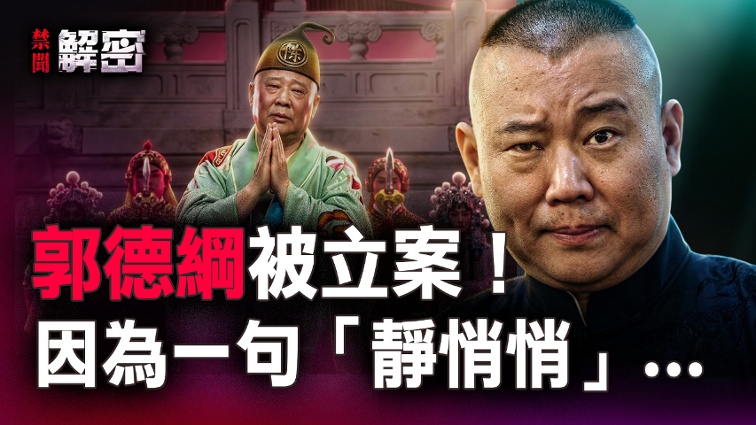
Guo Degang Under Investigation for a Single Sentence: Is the 'Powerful Country'Too Weak? (Video)
[People News] On July 24, during a performance of 'Jigong the Living Buddha' in Wuhan, Guo Degang improvised changes to the lyrics of the song 'Play My Beloved Earth Pipa'. He altered the line 'The sun in the west is about to set, the Weishan Lake is quiet' to 'The sun in the west is about to set, the Forbidden City is quiet', and added some humorous remarks.
However, Guo Degang's performance was reported to the Wuhan Municipal Bureau of Culture and Tourism. The complaint stated that Guo Degang 'openly altered a well-known red song in a mocking manner... distorting this widely recognized classic red song'. The report raised three questions: Was the content of Guo's alteration of the red song reported and approved? Did Guo Degang possess the performance and adaptation rights for this red song? Should Guo's alteration of the red song face any consequences?
On August 11, the Wuhan Bureau of Culture and Tourism officially replied, stating that Guo Degang's 'altered singing segment was not included in the reporting materials, which may violate the 'Regulations on the Administration of Commercial Performances', and an investigation has been initiated'. Following this, the Qilin Theatre Company removed the altered segment from subsequent performances and cleared related promotional materials, but the performance originally scheduled for August 15 in Xi'an was canceled.
This incident has sparked intense discussions among netizens, with the majority believing that it was simply an improvisational moment during the performance. They argue that the complainant intentionally escalated the issue to a political level, labeling Guo Degang with terms like 'alteration' and 'distortion' of the red song, while the authorities uncritically supported the complainant, which could have very negative repercussions for society as a whole.
Simultaneously, the practice of 'reporting' has sparked a growing aversion among the public. The recent backlash against Feng Xiaogang's film 'Catching Spies' and the incident in Henan where an elderly man reported Xia Fugang have led to a widespread dislike for the term 'reporting.' If this trend continues, it could become a toxic presence, ultimately undermining the trust between individuals and creating divisions among them.
The informant stated that this red song was included in the '100 Red Songs to Celebrate the 70th Anniversary of the Founding of the People's Republic of China,' published by the Central Propaganda Department in 2019. This may explain why the informant felt compelled to defend the red song. If even such a red song can be altered, the 'masses' will certainly not stand for it.
However, if we rewind 60 years, the official assessment of this song back then would likely leave him speechless. During the Cultural Revolution, the song 'Play My Beloved Earth Lute,' which served as the theme for the film 'Railway Guerrillas,' was condemned as 'very unhealthy' and 'of low quality,' even being labeled 'extremely reactionary.'
In the 1968 official document 'Poisonous Weeds and Films with Serious Errors: 400 Films,' this so-called red brainwashing film was included, and the Central Cultural Revolution Group along with Jiang Qing denounced it as 'big poisonous weeds,' arguing that it 'failed to acknowledge the party's leadership and promoted individual heroism,' while also specifically noting that 'the film's interlude is very unhealthy.'
As a result, the main creators of the film faced severe persecution during the Cultural Revolution. Liu Zhixia, the screenwriter and author of the novel of the same name, was branded as the 'leader of the Shandong literary black line' and subjected to imprisonment, public humiliation, and struggle sessions. He narrowly escaped death by risking his life to jump from the third floor using a bed sheet as a rope.
In contrast, the renowned actor Feng Zhe, who portrayed the political commissar Li Zheng in the film, was not as fortunate. He tragically hanged himself while imprisoned in a cowshed in 1969 at the age of just 48. The circumstances surrounding his death remain ambiguous, with no clear answers as to whether it was a suicide or if he was killed and made to appear as if he had taken his own life.
The lyricist Lu Mang and composer Lü Qiming also faced brutal persecution during the Cultural Revolution. They were criticized for having revolutionary masses sing 'The East is Red, the Sun Rises' in praise of the great leader. The opening line of their song, 'The sun in the west is about to set,' was interpreted as a 'malicious' comparison of Chairman Mao to 'the setting sun,' and they were accused of 'viciously attacking the great leader Mao Zedong with a vulgar song.' This was deemed 'extremely reactionary!' and considered 'intolerable,' leading to even harsher punishments.
This illustrates that their condemnation of the song as 'reactionary' was based on its opposition to 'The East is Red, the Sun Rises,' thereby establishing the notion that the song 'The East is Red' is sacred and inviolable.
However, if we delve deeper, what is the origin of the song 'The East is Red'? This song is adapted from a folk song from Shaanbei, with the original lyrics stating, 'Sesame oil, cabbage heart, to eat green beans and cramp, three days without seeing, I want to die, call my brother, only my third brother.' The literary figures of the Chinese Communist Party (CCP) appropriated this popular Shaanbei folk song, altered its lyrics, and transformed it into the well-known revolutionary anthem 'The East is Red.'
Currently, informants believe that Guo Degang has 'altered' and 'distorted' this red song, crossing a red line, and the Wuhan Municipal Bureau of Culture and Tourism supports this stance. So, is the version of 'The East is Red' that was adapted from the Shaanbei folk song not a more significant alteration and distortion? How does this differ from the interpretation during the Cultural Revolution that viewed it as 'maliciously attacking the great leader'?
The fate of this song illustrates that while its content remains unchanged, the standards of the CCP can shift dramatically. Songs that were once labeled as 'reactionary' and heavily criticized are now promoted as 'red classics' when they can be utilized for mass indoctrination.
Essentially, the CCP has never wavered in its control over all aspects of society. Consequently, the CCP's performance management department mandates that all performance scripts be submitted for prior approval, as any improvisation by actors could lead to 'inappropriate associations' among the audience. The core issue surrounding the Guo Degang incident lies here: how much longer can the CCP, which fears even the laughter of the people, sustain its grip?
(First published in People News) △






News magazine bootstrap themes!
I like this themes, fast loading and look profesional
Thank you Carlos!
You're welcome!
Please support me with give positive rating!
Yes Sure!