
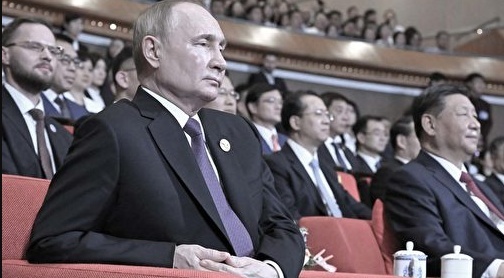
On the afternoon of May 16, 2024, Putin (front left) attended a concert in Beijing commemorating the 75th anniversary of China-Russia (Soviet) diplomatic relations. His gaze was unfocused on the performance, appearing deep in thought. Putin's body also leaned slightly away from Xi Jinping (front right, second from the right).
[People News] Just two days ago, a noteworthy event occurred during the press conference of the Chinese Ministry of Foreign Affairs, and surprisingly, it was sparked by 'our own people.' Alina, a reporter from 'Russia Today,' posed a question that nearly left spokesperson Guo Jiakun at a loss for words. What exactly transpired?
Alina recounted the striking comments made by Estonian Foreign Minister Margus Tsahkna on March 5: 'Putin's friends are either in heaven, or in hell (most likely in hell), or in prison, with only a few remaining, such as North Korea and China.' She then asked, 'What is China's response to this?'
In previous instances, Russian media typically came to 'offer warmth' during such occasions. However, this time, to be frank, reporter Alina showed no restraint, instantly freezing the atmosphere in the room. After posing such a question, she calmly sought China's viewpoint.
The spokesperson present was Guo Jiakun. What do you think he should say? If he replies, 'Yes, we are friends,' it would imply that he acknowledges sharing the same fate as Putin's associates; if he quickly tries to distance himself, wouldn't that undermine the golden principle of 'China-Russia cooperation has no limits' right then and there? Furthermore, it would be a significant embarrassment for the party leader! Regardless of how he responds, he would be in a difficult position. Alina's question was indeed both striking and precise.
However, we should not underestimate the spokesperson for the Chinese Communist Party. In terms of rhetoric, evading questions is their forte, and it is a fundamental skill for any competent Chinese Communist diplomat. Despite his displeasure, Guo Jiakun could only respond with a stern expression, hoping that the other party would view China-Russia relations objectively and rationally, and refrain from making irresponsible statements.
It is noteworthy that Guo Jiakun did not blame the Russian journalist who posed the question; instead, he directed his criticism at the Estonian Foreign Minister. Guo Jiakun clearly did not dare to confront Russia directly, vividly illustrating the helplessness of diplomacy.
In reality, Alina was well aware that asking this question would put Beijing in a very awkward position. So, why did the Russian media suddenly turn against them?
There have actually been signs of this shift for some time. Russia is quietly moving closer to the West, while Beijing has little ability to counter this. To put it bluntly, both China and Russia feel that the other is 'not being sincere enough.'
From Russia's perspective, Beijing has been playing a 'double-sided betting' game in recent years. They publicly claim neutrality while secretly providing Russia with significant supplies. However, Foreign Minister Wang Yi inadvertently revealed during a meeting with the EU's High Representative for Foreign Affairs and Security Policy, Josep Borrell, last July, that Beijing does not want Russia to suffer a defeat in Ukraine, as they do not wish for the United States to focus all its attention on China.
At that time, some analysts believed that Wang Yi's comments were not a slip of the tongue but rather a deliberate leak, indicating that Beijing's overarching strategy is to hope that the Russia-Ukraine war does not come to an end, in order to restrain European and American countries and seize the opportunity to attack Taiwan.
However, Russia is no longer the power it once was. Regardless of the ultimate outcome of the war, its military has sustained significant damage, and its economy is teetering on the edge of a major crisis. A weakened Russia can only exist as a vassal of Beijing, with no option but to submit to the Chinese Communist Party. This situation greatly satisfies the vanity of the party leader.
Reports indicate that discontent is spreading not only among high-ranking officials but also within the general public and elite circles in Russia. Many feel that Beijing views Russia merely as a 'shield' and 'cannon fodder' in its confrontation with the West, and that if the battlefield situation deteriorates, it would sell out Russia without hesitation. This growing distrust has shifted from private gossip to open questioning at press conferences.
Meanwhile, Putin is not to be underestimated. At the Alaska summit in 2025, he publicly expressed his willingness to discuss Ukraine's security issues with the United States and Europe, even extending an olive branch to the U.S. regarding nuclear matters.
This has placed Beijing in a difficult position. China has been supporting Russia against Western pressure, proclaiming its opposition to NATO expansion, yet Putin has gone behind their backs to negotiate directly with Washington, leaving Beijing without even the right to be informed. How can Beijing reconcile the feeling of 'I am taking bullets for you while you negotiate behind my back'?
In the realm of adult relationships, is there such a thing as 'limitless' friendship? Ultimately, it all boils down to interests. Alina's astute question essentially relayed a message from Putin to Beijing: stop pretending, everyone knows the reality. When 'limitless partners' harbour their own agendas at critical moments, whose 'great power dream' has been jolted awake by this resounding slap in the face?
(First published by People News)
△






News magazine bootstrap themes!
I like this themes, fast loading and look profesional
Thank you Carlos!
You're welcome!
Please support me with give positive rating!
Yes Sure!