
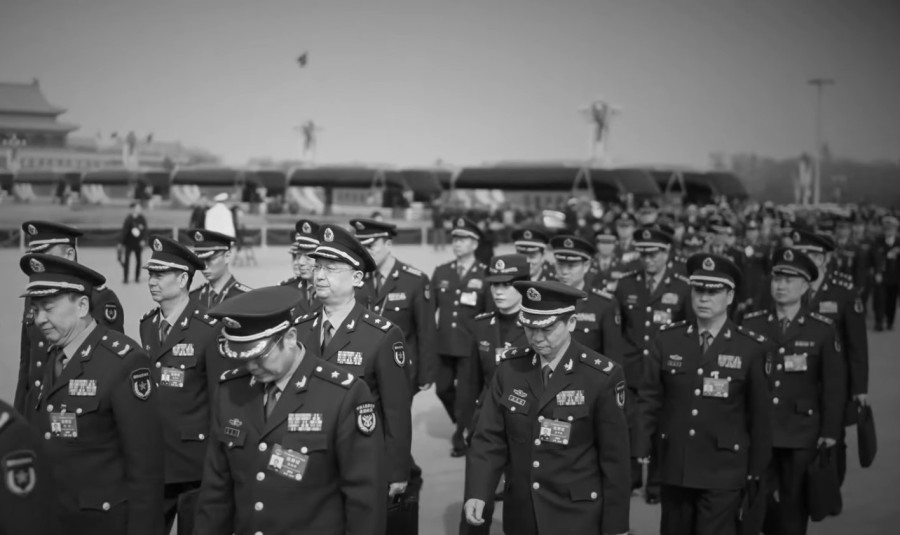
The representatives of the Chinese military attending the Two Sessions in Beijing. (Video screenshot)
[People News] In the earlier article Party Chief Anxious, No Longer Concerned with Military Development but Focused Only on Loyalty, I inferred from Chinese Communist Party leader Xi Jinping’s speech at the full meeting of the military delegation during the Fourth Session of the 14th National People’s Congress on March 7, where he strongly emphasized “political army-building,” that Xi still has not obtained genuine loyalty from top to bottom within the military, still lacks the confidence to fully take back military power, and that his repeated emphasis on loyalty shows he is inwardly quite anxious and very lacking in confidence.
After the party chief set the tone with “political army-building,” military media and the military delegation both highlighted political loyalty. For example, in the March 10 military newspaper report on officers and soldiers throughout the armed forces studying Xi’s speech at the full meeting of the military delegation, the opening immediately echoed Xi’s tone and declared loyalty: “We must uphold well, apply well, and develop well the important magic weapon of political army-building, continuously deepen political rectification, and push forward discipline correction and anti-corruption in depth.”
At the second full military meeting held the same day, the 12 delegates who spoke, in addition to saying as they did last year that they “must resolutely implement the decisions and deployments of the Party Central Committee and the Central Military Commission” and carry out Xi’s speech, also added the phrase “strengthen political guidance,” which had not appeared in the same setting during the previous two years.
In 2025, military delegates said they would “strengthen their sense of mission and tackle difficulties with concentrated effort.” In 2024, they said they would “strengthen their sense of mission, deepen reform and innovation, and comprehensively enhance strategic capabilities in emerging fields.” The reaction of the military delegates shows that the military has already received the signal sent by Xi: loyalty is above everything else, and all disloyal generals are highly likely to be purged.
The military delegates, who are likewise immersed in the Chinese Communist Party’s officialdom, put forward opinions and suggestions on strengthening ideological and political education, accelerating the improvement of combat capability, strengthening supervision over sectors and fields, and doing a good job in grassroots construction. Compared with the previous two years, military development of any kind is no longer the focus.
A look at the statements of the military delegates from the previous two years shows just how dull this year’s proposals are. In 2025, the 12 military delegates put forward opinions and suggestions on accelerating the enhancement of joint operational command capability, strengthening battlefield medical rescue capability, improving national defense mobilization capability, promoting the accelerated development of cyber-information systems, and optimizing the model for military theory research.
In 2024, the 15 military delegates put forward opinions and suggestions on strengthening joint combat capability building, reinforcing national defense science and technology innovation, promoting the application of advanced achievements in emerging fields, optimizing the capability-generation model for new-quality equipment, improving the quality of reserve force organization and construction, implementing the principle of frugal military building to improve the quality and efficiency of war preparedness and construction, and strengthening grassroots training and war preparedness.
The focus in both years revolved around military capability and preparations for war. By comparison, do this year’s proposals from the delegates still look like what one would expect from a military? And this is also one of the consequences of Xi removing Zhang Youxia and Liu Zhenli, who paid attention to the development of Chinese Communist Party military power and had real combat experience.
Xi’s move is highly likely to lead to placing greater reliance on political work and discipline inspection cadres in the military while sidelining generals with military talent, and this will inevitably intensify divisions within the armed forces. Although the military newspaper says the military must strive to achieve a good start for national defense and military construction during the “15th Five-Year Plan,” judging from the tone Xi has set for the military and the statements by the military delegates, the military’s new start is not favorable for it. How much cohesion can a military facing yet another purge and another round of loyalty tests still have? How much energy can it still have to improve combat capability? How much fighting strength can it still possess?
One noteworthy point is that this year the military delegates who spoke came respectively from the Central Theater Command, Northern Theater Command, Air Force, Rocket Force, Navy, Army, Information Support Force, National University of Defense Technology, the national defense mobilization system, and the Armed Police Force, of whom 3 came from the Army.
In 2025, the military delegates who spoke came respectively from the Western Theater Command, Army, Rocket Force, Navy, Air Force, Joint Logistics Support Force, Cyberspace Force, national defense mobilization system, Academy of Military Sciences, and the Armed Police Force, of whom 2 came from the Army and 2 from the Navy.
In 2024, the military delegates who spoke came respectively from the Central Military Commission Joint Operations Command Center, Western Theater Command, Army, National University of Defense Technology, national defense mobilization system, Central Military Commission Political and Legal Affairs Commission, Joint Logistics Support Force, Navy, Air Force, Armed Police Force, Eastern Theater Command, national defense mobilization system, Central Military Commission Discipline Inspection Commission, National Defense University, and Rocket Force. There was one person from each system, and 3 came from the Central Military Commission.
Judging from the fact that this year 3 of the delegates expressing loyalty came from different Army units, and from the Central and Northern Theater Commands, does this show that Xi has obtained more support from Army commanders? As for the other theater commands and other systems, how is Xi supposed to make them loyal? The result of rectification is very likely to produce the opposite effect.
(First published by People News) △






News magazine bootstrap themes!
I like this themes, fast loading and look profesional
Thank you Carlos!
You're welcome!
Please support me with give positive rating!
Yes Sure!