
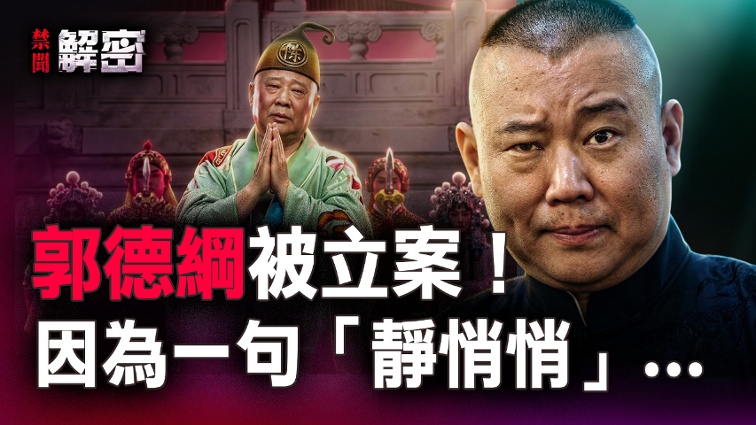
Guo Degang Under Investigation for a Single Sentence: Is the 'Powerful Country' Too Weak? (Video)
[People News] Guo Degang is under investigation: When 'current performance' meets literary imprisonment, who is afraid of the truth on stage?
Hello, dear audience, and welcome to 'Forbidden News Decoded'. I am Sun Ning.
Recently, a significant piece of news emerged from the crosstalk community, sparking widespread discussion online: renowned crosstalk artist and founder of the De Yun Society, Guo Degang, has been placed under investigation by the Wuhan Municipal Bureau of Culture and Tourism!
On July 24 this year, Guo Degang and his Qilin Theatre Company performed the Peking opera 'Jigong the Living Buddha' at the 'Renyi Central South Theatre' in Wuhan. Guo Degang portrayed the character Jigong, and during an enthusiastic moment, he showcased his trademark eclectic knowledge and improvisational skills by singing a piece from the Chinese Communist Party's propaganda film 'Railway Guerrillas'—'Play My Beloved Earth Pipa'.
The original first line of this song is: 'The sun in the west is about to set, the Weishan Lake is quiet.' However, Guo Degang, with a playful twist, altered 'Weishan Lake' to 'Forbidden City', singing: 'In the Forbidden City, it is quiet.'
After the audience erupted in laughter, they were simply there for some entertainment. However, no one expected that the phrase 'quietly in the Forbidden City' would strike a chord with certain individuals. Almost immediately, a wave of real-name reports flooded the internet, with the 'little pinks' (a term for nationalistic internet users) harshly criticizing Guo Degang for 'distorting red classics,' 'mocking revolutionary songs,' and 'lacking respect.' On August 11, the Wuhan Municipal Bureau of Culture and Tourism released a notice stating that the adapted content performed by Guo Degang had not been included in the materials submitted in advance, which allegedly violated the 'Regulations on the Administration of Commercial Performances,' leading to an official decision to initiate an investigation.
The Disappearance of 'Xian Gua' and 'Za Gua'
To fully appreciate the absurdity of this situation, we need to understand what Guo Degang was doing on stage and how it relates to traditional Chinese performing arts.
Chinese crosstalk and opera have never been mere mechanical repeaters, nor are they the type of political propaganda that allows for no errors, like the evening news. The core of traditional crosstalk is found in 'xian gua' and 'za gua.' What does 'xian gua' mean? It refers to performers improvising jokes based on unexpected occurrences during the performance, audience reactions, or even the day's weather and trending topics. What about 'za gua'? This involves making jokes about colleagues, partners, familiar backstage acquaintances, or well-known audience members.
Crosstalk masters often say, 'What is performed live is true skill.' A crosstalk performer who can only recite memorized lines is referred to as a 'book craftsman,' not an artist. The dynamic changes on stage are the essence of traditional performing arts. The appeal of crosstalk lies in the fact that each performance is unique, with performers and audiences collaboratively creating a distinct artistic experience in real time.
This tradition is not limited to crosstalk; it also has deep roots in traditional operas like Peking opera and Pingju opera, where improvisation plays a significant role. In the world of opera, this practice is known as 'grabbing the joke.'
While Peking opera is known for its strict adherence to form and structure, a well-timed 'grabbing the joke' can often elicit enthusiastic applause, provided it does not disrupt the main storyline. For instance, in classic plays like 'The Temple of the Law' or 'The Jade Bracelet,' the character of the eunuch Jia Gui is a master of this technique. The actor portraying Jia Gui, typically a clown, often improvises lines based on the day's political and economic news, the weather, or the notable figures in the audience. If a prominent official is present, Jia Gui might suddenly deliver a witty remark, instantly energizing the atmosphere.
Another example can be found in the clown character from 'The Chain of Events,' who also shines in their role. When Dou Er Dun steals the imperial horse, the authorities send a clown to deliver the news. Upon taking the stage, the clown often incorporates local place names, seasonal references, and even the latest social news to enhance their performance. What is this called? It is referred to as being grounded and sharing joy with the people.
In the past, Master Ma Lianliang and comedy legend Mr. Xiao Changhua performed 'Wulongyuan.' While Ma Lianliang, in the role of Song Jiang, was on stage preparing to deliver his lines, a spectator in the audience suddenly began to cough loudly and uncontrollably. This incident disrupted the atmosphere of the performance. However, Mr. Xiao Changhua, who played Zhang Wenyuan, quickly took advantage of the situation and remarked to Ma Lianliang, 'Brother Song, look, someone in the audience is coughing for you!' This spontaneous remark not only diffused the awkwardness in the theater but also seamlessly incorporated the unexpected event into the performance, leading to thunderous applause from the audience. This exemplifies the wisdom and charm of traditional Chinese stage art. It does not aim for rigid, unchanging performances; instead, it thrives on the vibrant sense of live interaction, creating a warm and lively atmosphere through the interplay between the stage and the audience.
However, today, under the suffocating censorship and stringent new regulations imposed by the Chinese Communist Party, this artistic legacy, which has been cherished for over a century, is being crushed. According to the current 'Regulations on the Administration of Commercial Performances' set by the Chinese Communist Party, all performance content must be submitted for review several months or even half a year in advance, and the script must be printed verbatim in the submitted materials. The delivery of lines, the singing of songs, and even the small movements on stage must strictly follow what has been reported.
This situation is akin to compelling crosstalk performers to memorize textbooks and Peking opera actors to perform puppet shows. In this absurd management system, 'live performance' has been redefined as 'illegal performance,' and 'catching a joke' is now considered 'unreported violations.' Guo Degang, while on stage, is simply following the artistic instincts inherited from his ancestors; when he senses the right atmosphere, he improvises a joke and performs a live act. What is the result? He is immediately branded as violating regulations, which leads to an investigation. While this appears to be an inquiry into Guo Degang, it is, in fact, a deliberate effort to extinguish the last flickers of spirituality in Chinese traditional culture.
The rise of whistleblowing
The case against Guo Degang is set against a chilling backdrop: the pervasive red-tinted public opinion in today's Chinese society.
In modern China, if your speech deviates even slightly from the Communist Party's official narrative, or if you are judged to be 'not sufficiently clear in praising the Party,' you may face merciless reporting and censorship.
In November of last year, Guo Degang and Yu Qian staged a crosstalk performance titled 'Art High, Courage Low' at the Beijing Exhibition Center. During the show, Guo Degang criticized the strange situation where amateurs in state-owned cultural troupes and arts groups were guiding professionals, forcing performances, and making anonymous accusations in major competitions from thirty years ago. What happened next? Immediately after the performance, certain so-called 'positive energy audience' members called the 12345 hotline to file real-name reports against Guo Degang, accusing him of 'spreading rumors and tarnishing the reputation of state-owned troupes.' This prompted the Beijing Xicheng District Bureau of Culture and Tourism to summon the Deyun Society for a serious discussion, issuing a stern warning regarding their alleged 'vulgarity and indecency.'
In April this year, Guo Degang traveled to Sydney, Australia for a special performance. On the international stage, he boldly declared, 'The idea of a hundred flowers blooming is nonsense.' Following this remark, domestic 'little pinks' quickly took action, reporting the incident across the ocean by submitting video screenshots to the relevant authorities and harshly condemning him for 'openly defying the Party's cultural policy.'
(‘Forbidden News Decoded’)
△







News magazine bootstrap themes!
I like this themes, fast loading and look profesional
Thank you Carlos!
You're welcome!
Please support me with give positive rating!
Yes Sure!