
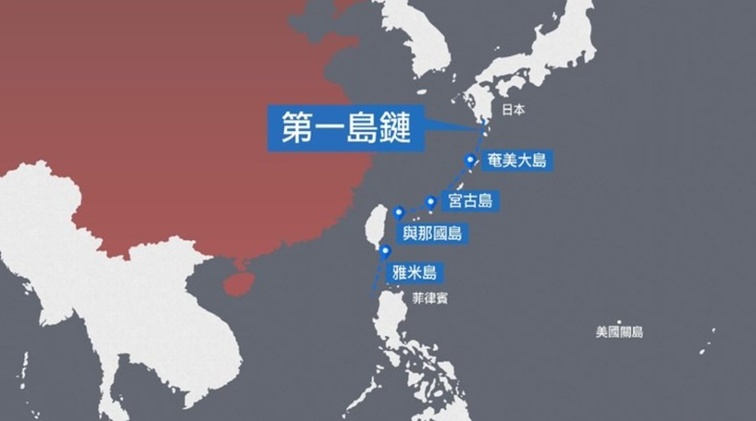
Japan occupies a crucial geographical position in the First Island Chain. (NTD)
[People News] The Shangri-La Dialogue (Shanghui) is taking place in Singapore from May 29 for three consecutive days. Japan's assertive stance in its confrontation with the CCP has emerged as a significant point of interest.
The 'China-Japan confrontation' has become a hot topic.
On May 30, Meng Xiangqing, the head of the Chinese delegation, questioned Japan's 'qualification to discuss defence cooperation in international forums' during a speech at a parallel group meeting. He urged vigilance against any resurgence of militaristic ideologies and emphasised the importance of maintaining the achievements of World War II and the post-war international order.
The following day (May 31), Japanese Defence Minister Koizumi Shinjiro met with Philippine Defence Secretary Gilberto Teodoro Jr. After their meeting, both parties issued a joint statement pledging to further strengthen their 'comprehensive strategic partnership.' This follows a recent summit between the leaders of the two nations. Teodoro also publicly countered the CCP's claims of Japan's 'new militarism,' labelling these accusations as 'unfair' and 'a misuse of history,' and referred to Japan as a 'model citizen of the world.'
Koizumi remarked, "Japan's commitment to being a peaceful nation will not be swayed by false accusations." He further criticised the Chinese Communist Party for its rapid military development without transparency, which only breeds distrust and miscalculations. He posed the question, "Consider this: there is a country with a vast nuclear arsenal and strategic bombers. Japan has neither nuclear weapons nor strategic bombers, yet it is branded as 'new militarism'?"
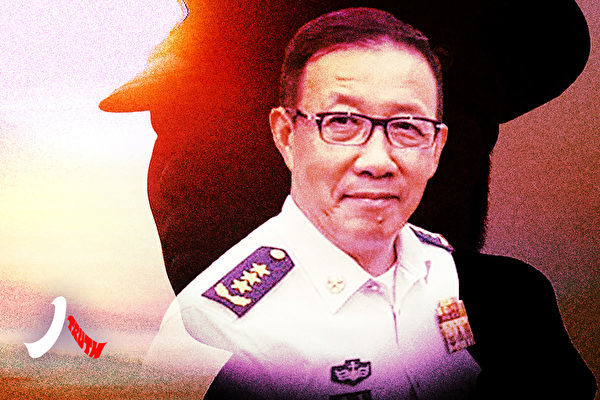
Koizumi also noted during the meeting that Chinese Defence Minister Dong Jun's absence meant a missed opportunity for dialogue, which he regretted. He stressed that the existence of differing opinions between the two sides makes dialogue even more essential, reiterating Japan's readiness to communicate with China for the sake of regional stability.
For many years, the Shangri-La Dialogue in Singapore has primarily focused on the U.S.-China rivalry, with the Taiwan Strait being a recurring topic raised by the U.S. at each session. However, this year's conference saw "China-Japan confrontations" emerge as a key point of interest.
Japan has chosen to confront the issue directly.
In this context, Akio Yaita, Executive Director of the Indo-Pacific Strategic Institute, pointed out that historically, Japan would avoid confrontation in similar situations, but its current decision to engage directly signifies that Japan is entering a new phase where it can actively express its views and assume regional security responsibilities.
According to a report by the Liberty Times, Akio Yabuki stated on Facebook on June 1, 'This year's Shangri-La Dialogue in Singapore has attracted more attention to the confrontation between Japan and China than in previous years. The catalyst for this was the criticism from the Chinese (Communist Party) delegation regarding Japan's increased defence budget and its enhanced security cooperation with allies, suggesting that this represents a 'resurgence of militarism.' In response, Japan's Defence Minister Shinjiro Koizumi addressed the issue directly, stating, 'Isn't it odd that a country with a vast nuclear arsenal and strategic bombers criticises a non-nuclear Japan for militarism?'
Akio Yabuki pointed out that, unlike the abstract diplomatic language typically employed by previous Japanese officials, Defence Minister Koizumi directly highlighted the logical inconsistencies in China's arguments. 'What stands out is not only the content of Koizumi's statements but also the shift in Japan's overall approach to responding. Historically, Japan's security policy has leaned towards 'explaining while avoiding confrontation.' Even when historical issues are raised by China, Japan often responds with principled statements. However, this time is different; Japan did not shy away from or adopt China's narrative framework but instead countered it with clear and logical arguments.'
This change is driven by the ongoing deterioration of the security environment. The expansion of Chinese military aircraft and naval activities, the escalating tensions in the Taiwan Strait, and North Korea's missile development have prompted Japan to address the gap between 'threat perception' and 'policy actions.' Since the shift in defence policy initiated by the Abe Cabinet, this has accelerated further under the Kishida Cabinet. Another notable trend is the contrasting approaches of the U.S. and Japan. This year, the U.S. has adopted a relatively restrained stance, while Japan has taken a more proactive role. This does not signify a weakening of the alliance; rather, it indicates that Japan is entering a new phase where it can actively express its views and assume regional security responsibilities.
In conclusion, Akio Yabuki remarked: 'A country like China, which continues to expand its nuclear capabilities, criticises neighbouring countries for enhancing their defences. This time, the contradiction has been laid bare before the international community.'
Japan is at the forefront of resisting China.
Taiwanese defence expert Hsieh Pei-hsueh told The Epoch Times that there have indeed been structural changes in the current Indo-Pacific situation. The United States appears to have taken a step back, providing a nuclear umbrella and strategic military protection, while Japan has emerged as the frontline, serving as a conventional deterrent force.
He noted that the Chinese Communist Party has always been cautious of Japan, even more so than of the United States. This is not only due to historical factors but also because Japan has a robust industrial base and advanced technological capabilities, and it occupies a critical geographical position in the first island chain. Should Japan effectively rearm, such as by deploying missiles with long-range strike capabilities, it would pose a direct threat to the military activities of the Chinese Communist Party in the East China Sea and the Taiwan Strait.
He believes that there have been some changes in the division of responsibilities between the U.S. and Japan. Japan is assuming some regional security defence responsibilities that the U.S. is relinquishing. In the future, the Indo-Pacific region is expected to develop into a structure led by the U.S., with Japan taking the forefront. Japan is likely to become a regional anchor point to counter China's military expansion.
Formation of the U.S.-Japan Security Alliance
Shen Mingshi, a senior researcher at the Taiwan National Defence Security Research Institute, argues that the U.S.-Japan alliance is similar to the U.S.-Philippines alliance; fundamentally, when one of these countries faces an external attack, it poses a challenge to the entire alliance system. This security commitment has remained largely unchanged, whether during the Cold War or in the present day.
He notes that while China's military expansion is occurring rapidly, its strategic intentions remain insufficiently transparent. Therefore, how the U.S. fosters regional cooperation to collectively address the pressures posed by the Chinese Communist Party has become increasingly important. In recent years, many large-scale joint military exercises and security cooperation initiatives have been conducted in this context. For instance, Japan's inaugural participation in the U.S.-Philippines 'Shoulder to Shoulder' joint military exercise illustrates that regional nations are progressively enhancing their cooperation and connections to build a stronger deterrent capability. △







News magazine bootstrap themes!
I like this themes, fast loading and look profesional
Thank you Carlos!
You're welcome!
Please support me with give positive rating!
Yes Sure!