

According to reports from state media, during his visit to the Joint Operations Command Centre on November 8, 2022, Xi Jinping was flanked by He Weidong, Liu Zhenli, Zhang Shengmin, Li Shangfu, Zhang Youxia, and Miao Hua from left to right. (Video screenshot)
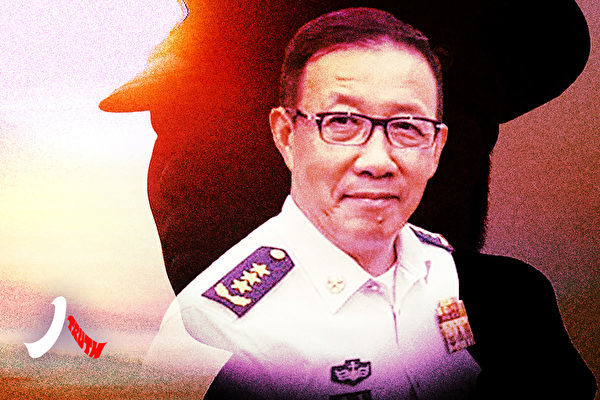
[People News] Following the official dismissal of Zhang Youxia, Vice Chairman of the Central Military Commission, and Liu Zhenli, Chief of the Joint Staff, in January this year, Zhang Shengmin, the last remaining member of the Military Commission, was promoted to Vice Chairman. He has become Xi's spokesperson within the military's upper ranks and the implementer of military purges.
It is evident that Zhang Shengmin, who has spent a long time in political work without any combat experience and possesses only theoretical military knowledge, differs significantly from Zhang Youxia, who has seen battle and risen through the ranks. In a military culture that values 'mountain peaks' and seniority, Zhang holds little prestige. As the executor of Xi's military purges, he is not only a target for criticism but is also unlikely to have a favourable future. The history of the CCP has shown that those who engage in purging others often end up being purged themselves, illustrating a cycle of cause and effect.
In a somewhat isolated position within the military, Zhang Shengmin recently participated in two significant events: the first was a meeting on May 26 with Munir, Pakistan's most influential Chief of Army Staff and Defense Military Commander; the second was his attendance at a special meeting on May 27 focused on deepening Xi Jinping's thoughts on military strengthening, where he delivered a speech attended by leaders from various military departments and units. Given Zhang Shengmin's lack of military expertise, his meeting with the Pakistani Defence Military Commander can only be interpreted as a symbolic gesture; conversely, his speech at the latter event can primarily be viewed from a political standpoint.
According to the official summary from the Chinese Communist Party, Xi Jinping's thoughts on strengthening the military encompass eleven key aspects, which mainly emphasise the party's leadership over all matters, the necessity of a strong military for a strong nation, adherence to the party's command, and the importance of political military building, among others. Based on reports from military publications, Zhang Shengmin's remarks largely consist of standard phrases, such as 'persistently arming our minds with Xi's thoughts, guiding practice, and promoting work,' 'learning and understanding, unwaveringly implementing Xi's military strengthening thoughts,' and 'maintaining the unity of armed thought and transformative thought,' among others.
The author noticed that Zhang Shengmin used an unusual expression, namely: “to translate the results of study into concrete actions that firmly support the ‘Two Establishes,’ resolutely uphold the ‘Two Safeguards,’ and implement the system of responsibility of the Chairman of the Central Military Commission.”
Examining the statements made by the previous two vice chairmen of the Military Commission reveals why this situation is deemed unusual. In April 2023, then Vice Chairman Zhang Youxia and He Weidong attended a military meeting focused on 'Studying and Implementing Xi Jinping's Thought'. During his speech, Zhang emphasised the need to 'resolutely implement the decisions and deployments of the Party Central Committee, gathering the soul and essence of Xi Jinping's Thought'. However, his remarks on 'establishing and maintaining' were quite formulaic, mirroring those of other senior Communist Party officials, consisting of clichés that stressed the importance of 'deeply comprehending' and 'achieving'. While the underlying message suggested that many had yet to 'comprehend' or 'achieve', Zhang appeared unconcerned and did not call for any specific actions.
In contrast, at the Central Military Commission's Political Work Conference held in Yan'an in June 2024, the often-suspected Zhang Youxia likely received signals from Xi indicating a desire to purge the military's upper ranks, prompting him to emphasise his loyalty. He described the meeting as 'having milestone significance', stating it would 'lead the People's Army to embark on a new journey and open a new chapter in political military building'. He also asserted the need to adhere to Xi's 'political military building decisions and deployments, focusing on strengthening absolute loyalty through ideological roots', and to 'improve the education and management of senior cadres, ensuring that the Party firmly controls the troops in terms of ideology, politics, and organisation '.
Meanwhile, He Weidong continued his unwavering praise for Xi, claiming that Xi's speech served as 'the scientific guidance and action guide for political military building in the new era'. He urged everyone to deeply comprehend Xi's 'political connotation of leading us back to Yan'an' and to grasp the significance of the 'two establishments'... without specifically mentioning any actions.
However, just a month after the Military Commission's Political Work Conference, Xi Jinping suffered a stroke during the Third Plenary Session of the Communist Party of China. Since then, both military and party power have gradually diminished, with rumours suggesting that CPC elders are pulling the strings behind the scenes. Zhang Youxia has taken control of the military, and the CPC has revived the notion of 'central collective leadership.' Many senior generals promoted by Xi, including Miao Hua, the director of the Political Department of the Military Commission, and He Weidong, have fallen from grace, resulting in a personnel reshuffle within both the military and the party.
Nevertheless, to maintain the CPC's regime, those behind the scenes continue to project Xi as the supreme party leader and chairman of the Military Commission. They are also misled by Xi's apparent 'compliance,' which ultimately enables him to secretly consolidate power. After removing Zhang Youxia and Liu Zhenli in January, Xi regained some authority, complicating the internal power struggles within the party. Many high-ranking officials are deeply dissatisfied with Xi's actions and are particularly frustrated that the 'central collective leadership,' which had already been reinstated, has once again fallen apart. Among the members of the Standing Committee of the Political Bureau, whether it is Premier Li Qiang, National People's Congress Chairman Zhao Leji, or Political Consultative Conference Chairman Wang Huning, their expressions of loyalty to Xi have noticeably diminished compared to the past.
Although Xi still occupies the headlines of official and military media as he did before his stroke, it has become increasingly difficult for him to return to the height of his power. This is not only due to health issues but also because there is widespread dissatisfaction with Xi among the public and within official circles, with many openly criticising him. Additionally, the CPC's international reputation is becoming increasingly tarnished, making Xi's situation more challenging. Particularly, it has been six months since he apprehended Zhang, yet the military remains largely outside his control. Xi is very concerned about the possibility of assassination, which is why he rarely travels outside Beijing as he used to.
In this context, Zhang Shengmin, who is already closely associated with Xi, must rally his spirits and once again call for the military's loyalty to Xi. The expression 'transforming learning outcomes into... practical actions' suggests that the preparatory work before these 'practical actions' is still lacking and remains largely rhetorical. This reflects that the military's genuine loyalty to Xi is still only verbal, and in terms of the 'two establishments and maintenance,' it is merely a slogan being chanted. For example, over the past few months, various branches of the military have made statements about 'establishing a correct view of political achievements,' but have largely failed to mention Xi.
The pressing question is, how can the largely unrespected Zhang Shengmin change the military's mindset? By arresting a large number of people? But wouldn't that risk provoking a mutiny? (First published by People News) △



News magazine bootstrap themes!
I like this themes, fast loading and look profesional
Thank you Carlos!
You're welcome!
Please support me with give positive rating!
Yes Sure!