

Floods Raging: Why Has Xi Jinping Never Visited the Scene? (Video)
[People News] Hello, dear viewers, and welcome to "Decoding Zhongnanhai." I am Sun Ning.
Disasters serve as an unmaskable mirror, reflecting the joys and sorrows of ordinary people, while also exposing the fundamental governance logic of a regime.
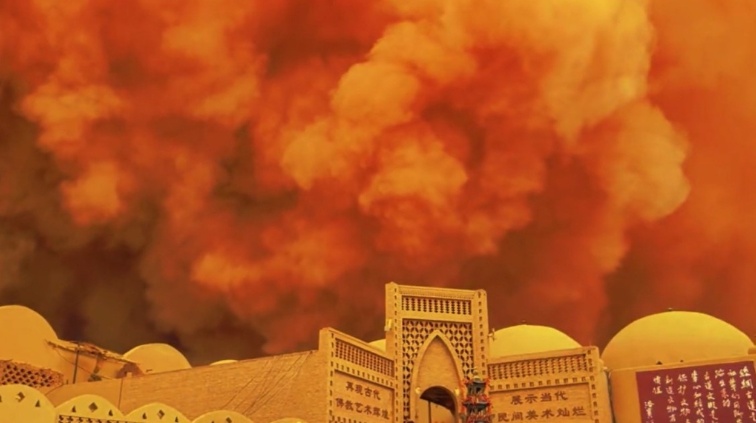
In July 2026, Typhoon No. 10 "Maysak" struck with fierce winds and torrential rain, leading to an unprecedented catastrophic flood in the Guangxi Zhuang Autonomous Region. The main dam of the Liulan Reservoir in Hengxian County was breached, creating a deadly gap of 50 meters, and the flood surged down like a ferocious beast, submerging countless villages. In the Guigang Education Park, the muddy floodwaters even reached the 7-meter-high traffic lights, leaving over 10,000 teachers and students from Guigang Senior High School and Guangxi Logistics Vocational Technical College in a state of panic, waiting for dozens of hours without water, electricity, or food.
In the face of this major disaster that threatens the lives of the people, what is the Chinese Communist Party doing?
At the onset of the disaster, local official media loudly declared: "All the masses have been safely relocated, and there are no casualties." However, just a few days later, a directive from Zhongnanhai explicitly stated that the disaster had caused "significant casualties." With such contradictory statements, who is lying? Who is covering up the truth?
What is even more puzzling is that while floods rage across the land and the people are trapped in dire conditions, where is that so-called "Supreme Leader" Xi Jinping, who claims to be "personally directing and deploying" the response?
He did not visit the most turbulent levee, nor did he go to the disaster area with the deepest flooding, and he certainly did not set up tents for the victims. What people witnessed were still the same few phrases from the Xinhua News Agency that have remained unchanged for over a decade, lacking any human warmth. It seemed as if the lives and deaths of 1.4 billion people and the displacement of millions were entirely disconnected from the highest leader. General Secretary Xi (Xi Jinping) merely needed to jot down a few bland remarks on a lightweight piece of paper in Zhongnanhai to meet his obligations.
This raises an inevitable question: why, over a decade ago, did the leaders of the Communist Party of China rush to the scene even when they knew it was a performance, while in the era of Xi Jinping, the highest leader is increasingly distancing himself from the front lines of disaster? In his value hierarchy, what importance do the lives and deaths of ordinary people hold?
From 'Biopolitics' to 'Meritocratic Politics'
To understand why Xi does not visit disaster sites, we first need to delve into his inner world and 'self-positioning'.
The fundamental logic of modern state governance is to place human value at its core. Every elevated power and every implemented policy ultimately serve the most microscopic and specific individual life. People are both the starting point and the endpoint of governance.
When a major disaster strikes, threatening the safety and property of the populace, the head of state or government should promptly arrive at the scene, not only to demonstrate the country's commitment to disaster relief but also to provide direct psychological support to the affected individuals on a micro level. This approach, which centers on vibrant individuals and focuses on specific lives, is known as 'biopolitics.'
However, in the current ruling logic of Zhongnanhai, 'biopolitics' has been entirely supplanted by 'meritocratic politics'.
What does meritocratic politics entail? It means that the ruler's gaze never falls on the muddy ground beneath their feet, but rather fixates on the historical landscape; their ears do not hear the cries of disaster victims, but only the calls for 'national rejuvenation'. In Xi Jinping's political vision and timeframe, he reflects on the 'great changes unseen in a century', aiming for a historical positioning of 'the East rising and the West declining', the dream of a strong military, and the 'great rejuvenation' of the Chinese nation.
Under the influence of such an imperial historical perspective, politics has become abstracted. In his public speeches, Xi proclaims the word 'people' with great fervor, even asserting that 'the country is the people, and the people are the country'. However, it is crucial to understand that the 'people' he mentions lack any sense of pain, do not have specific identities, and serve as a highly abstract political symbol, merely a facade to lend legitimacy to the regime.
Meanwhile, those farmers who lost their homes in the dam collapse in Guangxi, and the students who are starving in educational parks, are not seen as living, dignified individuals within the framework of great achievements; they are merely statistics in the 'disaster-stricken areas', figures that can be overlooked, stabilized, or even considered a 'reasonable cost' necessary for achieving grand objectives.
A ruler striving for a legacy of "immortal achievements," he sees himself as a "lighthouse guiding the way," a "timeless emperor" orchestrating strategies from Zhongnanhai. From his perspective, engaging with disaster-stricken areas by wading through muddy conditions, confronting grieving victims, and addressing the seemingly minor "local livelihood issues" amidst grand narratives not only fails to highlight his "lofty ambitions" but could also undermine the sense of sanctity and distance he maintains as a "leader."
This explains why, in the face of overwhelming floods, Xi Yizun believes that simply writing a few lines of directives in Zhongnanhai suffices to fulfill all his responsibilities to that abstract concept of "the people."
Ubiquitous Security Anxiety
A critical principle of totalitarian regimes is that as power becomes increasingly concentrated, the supreme leader's sense of security diminishes. Since the 20th National Congress of the Communist Party of China, the previous balance of factions has been entirely disrupted, leading to an unprecedented monopolization of power at the top. However, this apparent "unified authority" has not provided Xi with peace of mind; instead, it has resulted in heightened tension within Zhongnanhai and a profound anxiety about the constant threat of being "assassinated."
This situation has also created a significant security dilemma for him. At disaster sites, the environment is chaotic, personnel are constantly on the move, local troops and armed police can be deployed at any moment, and various unknown civilian rescue teams and volunteers are present—this scenario is an unimaginable nightmare for Secretary Xi, who is characterized by extreme insecurity and deep suspicion.
Every individual in the disaster zone may succumb to despair from losing their family and home, potentially leading to unpredictable extreme actions. Additionally, every corner of the disaster area may be unable to achieve a complete 'clearing' and 'mine-sweeping' due to communication breakdowns and damaged terrain. For a top leader who is hesitant to even stay overnight in Hong Kong during inspections and insists that all windows in nearby communities be closed during local visits, how could he possibly allow himself to be placed in a situation that is entirely beyond his control?
The more critical issue is the deepening trust crisis between Zhongnanhai and local bureaucrats. Xi Jinping is acutely aware that while officials may enthusiastically chant political slogans, they have long been 'cold and lying flat' when it comes to the micro-level of people's livelihoods. Local politicians routinely shirk responsibility and conceal information during crises, which has become a common practice.
If he were to 'recklessly' visit the disaster area frontline at this moment, his security and itinerary would be completely compromised by these opportunistic local bureaucrats. In the eyes of 'One Respect', this would be akin to voluntarily surrendering his life and political image to a group of bureaucrats he himself finds untrustworthy and disdainful.
Consequently, retreating to Zhongnanhai and managing affairs through 'remote control' has become his sole strategy for maintaining absolute authority and ensuring his personal safety.
From 'people-friendly performances' to 'stability above all'.
At this juncture, some viewers might wonder: Didn't previous leaders of the Chinese Communist Party frequently visit disaster areas in person?
In the aftermath of the 2008 Wenchuan earthquake on May 12, then Premier Wen Jiabao took a flight to Chengdu just two hours after the disaster struck. A few days later, then President Hu Jintao also visited the front lines in Beichuan and Wenchuan, offering support to the victims in the devastated areas.
In 2014, a 6.5 magnitude earthquake hit Ludian, Yunnan, prompting then Premier Li Keqiang to rush to the disaster zone immediately. Due to road collapses, he walked several kilometers on foot to reach the epicenter.
The actions of Hu Jintao, Wen Jiabao, and Li Keqiang at that time included elements of 'political performance' or 'emotionalism.' However, one undeniable fact remains: during that era, the Chinese Communist Party (CCP) system relied on 'people-oriented politics' to garner grassroots support and needed the presence of leaders to affirm the legitimacy of the regime to society. At that time, those in power were still willing to show warmth and concern for the people.
However, by the mid to late period of Xi Jinping's administration, the operational logic of the regime underwent a significant transformation.
Today, the CCP's governance no longer heavily depends on micro-level 'public opinion' and 'grassroots approval.' Instead, it relies entirely on top-down political pressure, comprehensive digital surveillance, and absolute loyalty driven by fear within the bureaucracy. With the regime's legitimacy no longer needing to be upheld through 'people-oriented' methods, the act of risking significant security threats and diminishing one's authoritative image to 'perform' in disaster areas has become, in the eyes of the rulers, an exceedingly unwise 'losing deal.'
More importantly, the Chinese economy is currently facing a downturn, and public discontent is rising, making society akin to a powder keg ready to explode. If Xi Jinping were to visit the flood control site in Guangxi, what would happen if desperate disaster victims managed to break through the blockade, stop traffic, and accuse local officials of underreporting the death toll, of poor construction quality, and of inadequate rescue efforts? If such scenes were captured by social media or foreign media, the carefully crafted image of the 'leader being eternally wise, great, and correct' would come crashing down in an instant.
During the Hu-Wen era, political discourse allowed for some flexibility; however, in today's strictly authoritarian system, public opinion cannot afford the slightest flaw or unexpected incident. The political risks associated with visiting disaster areas far outweigh any potential political gains, which is why, since Xi Jinping took office, the tradition of 'personally visiting disaster sites' has been actively and completely abolished within this system.
The Subservient Premier
In this grand political spectacle of the Communist Party of China, where 'not going to the scene' has become the norm, not only has the General Secretary vanished, but even the Premier of the State Council, who should be at the forefront of administration and responsible for disaster relief efforts, has also disappeared.
Historically, within the power structure of the Communist Party, there has typically been a division of responsibilities between the General Secretary and the Premier. The General Secretary focused on ideology and party matters, while the Premier took a pragmatic approach, managing the economy and specific governance tasks. Therefore, when a major disaster strikes, it is customary for the Premier, as the 'chief steward', to be present on the front lines. The visits to disaster areas by Wen Jiabao and Li Keqiang were consistent with this role.
Since Li Qiang assumed office, the State Council has experienced a significant transformation. Under the 'Regulations on the Work of the State Council' that Li Qiang oversaw, the State Council has been explicitly redefined as a purely 'policy execution agency,' tasked primarily with implementing the decisions made by the Central Committee of the Communist Party of China, which reflects the directives of the supreme leader. Li Qiang has shifted his role from that of a 'great country prime minister' with independent administrative authority to that of the 'close secretary' to the supreme leader.
In a political landscape where 'serving the emperor is akin to serving a tiger,' the Prime Minister, as a subordinate, must exercise extreme caution in every action and statement. The unexpected death of former Prime Minister Li Keqiang has served as a stark and instructive political lesson for all technical bureaucrats and senior officials.
Li Qiang understands that if he were to make a high-profile visit to the disaster-stricken area in Guangxi at this sensitive time—walking through the mud and confidently directing operations in front of the media, while presenting a relatable image by sharing the same food and living conditions as the disaster victims—this would not only fail to enhance his reputation but could also become a significant 'time bomb' in his political career. In a system characterized by absolute centralization, no subordinate's 'prominence' can overshadow that of the supreme leader. Your capabilities merely highlight the shortcomings of your superiors; your approachability starkly contrasts with the indifference of those above you.
In the reverse elimination mechanism of 'the more you do, the more mistakes you make; the less you do, the fewer mistakes you make; and if you do nothing, you make no mistakes,' Li Qiang's most astute strategy is to synchronize his actions with those of the top leader. Given that the General Secretary remains firmly ensconced in Zhongnanhai, issuing only written directives, the Premier's best option is to stay in Beijing as well, forwarding these directives in the name of the State Council while filling the text with the cliché of 'resolutely implementing the General Secretary's important instructions.'
In contemporary China, disaster relief has devolved into a mere verbal exercise, with disaster victims reduced to mere props in a political game.
The dragon throne that cannot be submerged, the lives that cannot be saved.
Historically, feudal emperors in China recognized the necessity of 'issuing edicts of self-blame' and personally visiting disaster-stricken areas to calm public discontent during years of great calamity. However, this so-called 'advanced' modern regime has regressed to the point of trembling in fear at a few mud balls.
From the devastation in Guangxi to the unyielding stance of Zhongnanhai, the absence of leadership at disaster sites is not due to the demands of modern command but rather reflects the arrogance, fear, selfishness, and hypocrisy that a totalitarian regime cannot overcome as it nears its demise.
While the floods cannot wash away their solid dragon throne, they will erase the last remnants of hope for ordinary people. When floodwaters invade homes, and Zhongnanhai is left with only a cold directive, every Chinese citizen will come to realize: in this country, filled with 'great achievements,' we are merely a number that can be easily crossed out.
That wraps up today's content. If you liked our program, we encourage you to like, subscribe, and activate the notification bell. If you have any opinions regarding the absence of Chinese Communist Party leaders from the disaster areas, please share your thoughts in the comments section. We look forward to seeing you in the next episode!
(‘Decoding Zhongnanhai’)
△







News magazine bootstrap themes!
I like this themes, fast loading and look profesional
Thank you Carlos!
You're welcome!
Please support me with give positive rating!
Yes Sure!