
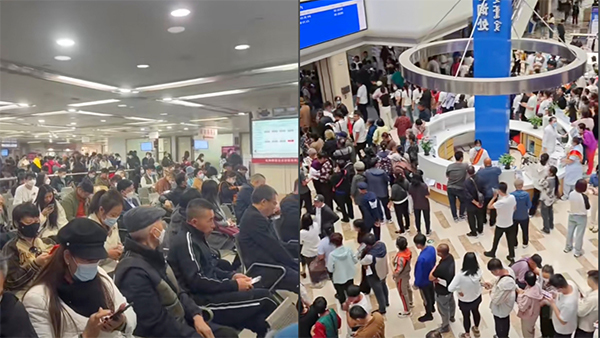
Reports have emerged of multiple people in Nanjing contracting influenza A ("H1N1") and subsequently experiencing paralysis, drawing widespread attention. (Screenshot from video compilation)
[People News] In 2025, disasters struck repeatedly across China. From the continued spread of influenza A outbreaks nationwide, to Hong Kong’s most devastating Level-5 fire in decades; from the ongoing exposure of industrial, mining, and environmental safety crises in Gansu, Inner Mongolia, and other regions, to extreme floods and droughts sweeping across both northern and southern China— a succession of accidents and natural disasters overlapped and compounded one another, resulting in heavy casualties and incalculable economic losses.
According to reporting by The Dajiyuan, these disasters were not isolated or accidental incidents, but rather a concentrated eruption of failed safety oversight, absent institutional accountability, and the systemic depletion of ecological and public governance capacity. Under a governing logic in which “regime stability” is prioritized above all else, truth has been obscured, people’s livelihoods ignored, and the environment exhausted.
I. Influenza A Outbreak Spreads Nationwide, Deaths Surge; Guangdong’s Mosquito-Control Measures Spark Controversy
Since October 2025, mainland China has been experiencing a severe outbreak of influenza A (H3N2), with serious and fatal cases rising sharply year-on-year.
According to recent reports by CCP state media, influenza activity levels in many Chinese cities are rising rapidly, with infection cases increasing significantly. Beijing has already entered a peak period, and Shanghai is expected to reach its peak soon.
Based on the latest monitoring data from the Chinese Center for Disease Control and Prevention, the influenza A outbreak is spreading rapidly nationwide, with 17 provinces at high epidemic levels. Over the past three months, severe and fatal influenza A cases nationwide have increased by approximately 40.2% compared with the same period last year. Observers worry that the real situation may be even worse.
Children have been the most severely affected group. Schools have become major hotspots, with large-scale clustered infections reported in Guangdong, Beijing, Zhejiang, Henan, and other regions. Many classes were forced to suspend lessons as more than half of students took sick leave. Beijing’s “Health Protection Guidelines” show that the number of susceptible individuals in the city has exceeded 12 million.
Multiple cases show rapid disease progression: a 3-year-old boy in Puyang, Henan, died just one day after developing a fever; a 12-year-old girl in Zhejiang developed a “white lung” condition in her left lung after one day of fever; and a 7-year-old girl in Zhengzhou, Henan, saw her right lung turn completely white within hours of infection and fell into a prolonged coma. Pediatric emergency departments in many hospitals were overwhelmed, with some doctors processing 700 blood routine tests in a single night.
Doctors warned that the circulating H3N2 subtype is highly pathogenic and can cause severe complications such as pneumonia, myocarditis, and acute necrotizing encephalopathy.
Dr. Liu, a professor at the Canadian College of Traditional Chinese Medicine and director of the Kangmei TCM Clinic, told The Dajiyuan that the severity of this outbreak may be related to immune dysfunction caused by the previous COVID-19 (CCP virus) pandemic.
Prior to this influenza A outbreak, multiple areas in Guangdong Province experienced outbreaks of chikungunya fever, with confirmed cases exceeding 25,000 across the province. Although no severe or fatal cases were reported, the authorities’ campaign-style prevention and control measures triggered widespread controversy.
Local governments launched blanket mosquito-eradication campaigns, even ordering residents to close windows for large-scale disinfection during the onslaught of the super typhoon “Hagibis.”
Mr. Wang, a resident of Shantou, Guangdong, told The Dajiyuan that he suspected official blood draws from residents were for organ transplant matching. He said that such forced blood collection by the authorities was simply creating panic.
The outbreak also spread to neighboring provinces as well as Hong Kong and Macau. The CCP authorities subsequently convened a national meeting, calling for strict prevention of epidemic spillover. (Extended reading: “‘Whoever goes out will be beaten to death’: A Review of CCP Extreme Pandemic Propaganda)
II. Hong Kong Level-5 Inferno Claims 161 Lives: Exposing Construction Chaos and Stability-Maintenance Repression
On November 26, 2025, a Level-5 fire broke out at Hong Fuk Court in Tai Po, Hong Kong—the most serious such fire since 1948. According to a report released by the Hong Kong Police Force on December 20, the death toll rose to 161.
The fire originated from large-scale exterior wall renovation works being carried out on eight buildings in the estate. Investigations found that the contractor, “Hung Yip Construction,” illegally used large quantities of highly flammable foam materials to seal windows, and that the protective netting failed to meet flame-retardant standards.
Key evidence showed that the construction party was suspected of using counterfeit quality inspection reports. The protective netting was produced by a manufacturer in mainland China, and its inspection serial number could not be verified through official channels, raising suspicions that it was sourced from online shopping platforms.
Prior to the disaster, residents had repeatedly issued public warnings about more than a hundred violations in the project and reported fire hazards to the Labour Department. However, the relevant authorities responded that the “risk was relatively low” and failed to take effective intervention measures.
After the fire, victims’ families and citizens launched joint petitions demanding the establishment of an independent investigation committee. In response, the Hong Kong government and national security agencies intervened, arresting several concern-group initiators and former district councilors.
On December 1, the Hong Kong Association for Democracy and People’s Livelihood and the Democratic Party organized a “civilian press conference” on Hong Kong’s high-rise maintenance policy in response to the Hong Fuk Court fire. The press conference was subsequently canceled by the authorities. The next day, the CCP’s Office for Safeguarding National Security in Hong Kong issued a statement accusing “a small group of external hostile forces of taking advantage of the fire to cause trouble.”
On December 2, the National Security Department of the Hong Kong Police invited Wang On-yin, deputy convener of the Civil Human Rights Front, and others to meet at a police station. Afterwards, Wang admitted on Facebook that he had met with national security officers. On December 6, he was arrested for disclosing related information on social media, and a judge denied his bail application.
This case marked Hong Kong’s first instance in which an individual was charged under the National Security Ordinance for disclosing details of a national security investigation, carrying symbolic significance and sparking public discussion on freedom of speech in Hong Kong.
Amnesty International called on the Hong Kong government to “immediately conduct an open and transparent investigation into the causes of the Hong Fuk Court fire, rather than ‘solving the people who raise the questions.’”
III. Hebei Nursing Home Fire Kills 20; Beijing Floods Claim 31 Lives in Elderly Care Facility
Two accidents involving elderly care institutions in mainland China in 2025 resulted in the tragic deaths of dozens of incapacitated elderly people, exposing deficiencies in emergency response, facility construction, and staffing.
On the night of April 8, a fire broke out at Guoen Elderly Apartment in Longhua County, Chengde City, Hebei Province. Many residents were unable to care for themselves, and most were asleep when the fire occurred, making escape difficult. Ultimately, 20 elderly residents lost their lives.
Investigations showed that narrow evacuation routes were one of the main causes. Although the institution had been rated a first-class nursing home by the Hebei Provincial Department of Civil Affairs in 2022, the accident still exposed serious shortcomings in fire protection and emergency evacuation design.
Another incident that drew attention occurred on July 28, when an elderly care center in Taishitun Town, Miyun District, Beijing, was besieged by flooding triggered by extreme rainstorms.
Among the 69 elderly residents in the center, most were fully or partially incapacitated, with only eight staff members on duty. Floodwaters rapidly submerged the streets, reaching depths of up to 2 meters, resulting in the deaths of 31 elderly people trapped indoors.
Families questioned why no advance evacuation was carried out after reservoir discharge and heavy rainfall warnings were issued. At the time of the incident, the staff-to-resident ratio was severely imbalanced, making effective emergency response impossible.
IV. Frequent Extreme Weather: Flooding in Beijing-Tianjin-Hebei; “Central Plains Granary” Heavily Hit
In the summer of 2025, northern China experienced historic rainstorms, while traditional grain-producing regions such as Henan were trapped in alternating extremes of drought and persistent rainfall.
In late July, rainfall in the Beijing-Tianjin-Hebei region exceeded historical extremes. Severe flash floods broke out in Miyun, Beijing, and Chengde, Hebei. Officials stated that such disasters caused 64 deaths.
Multiple monitoring stations in Hebei recorded torrential rain levels. Some villages in Tianjin were submerged in floods unseen in 70 years, and several reservoirs were forced to release water while operating at high levels.
Meanwhile, Henan suffered its worst drought in 25 years. Crops such as peanuts and corn withered on a large scale due to water shortages. July’s high temperatures pushed 41% of monitoring stations into severe drought classification.
During the October autumn harvest season, Henan, after the drought, encountered prolonged overcast and rainy weather. Waterlogged farmland prevented large harvesters from entering fields, forcing farmers to manually salvage mold-affected crops while standing in water.
This natural disaster not only devastated farmers’ livelihoods but also raised concerns about food security, intensifying expectations of reduced grain output.
V. Multiple Vessel Capsizing Incidents in Chinese Waters; South China Sea Collision Draws International Attention
In 2025, multiple maritime accidents occurred in Chinese waters, including the capsizing of passenger ships and sightseeing boats, as well as fishing vessel sinkings, resulting in significant casualties. These incidents exposed potential problems in vessel safety management, extreme weather response, and fisheries regulation, attracting widespread public concern.
On May 4, in the Baili Gallery scenic area at the source of the Wujiang River in Qianxi City, Bijie, Guizhou Province, four sightseeing boats capsized after encountering sudden strong winds. Despite meteorological gale warnings, the scenic area continued operations, leading to 10 deaths and more than 70 injuries. Rescue teams found that many victims were not wearing life jackets.
In addition, fishing vessel accidents occurred frequently in Liaoning Province. On October 18, the fishing vessel “Liaosuiyu 35261” capsized in waters near Changxing Island, Dalian, Liaoning, leaving 10 people missing. On November 10, another Liaoning-registered fishing vessel capsized near Gunsan City, North Jeolla Province, South Korea, with two rescued and nine missing.
Regarding the capsizing of a Chinese fishing vessel in Korean waters, Liaoning Daily reported that Xu Fang, Party secretary and director of the Bayuquan District Ocean and Fisheries Bureau in Yingkou City, failed to organize rescue efforts after learning of the incident. Instead, he allegedly arranged for personnel to collude with the shipowner and instructed them “not to call the police or seek help,” attempting to cover up the truth.
Notably, on August 11, the CCP Coast Guard vessel “3104” collided at high speed with the CCP Navy destroyer “Guilin” near Scarborough Shoal in the South China Sea— a rare and serious accident for the CCP Navy in nearly 20 years.
Video footage showed that while intercepting a Philippine patrol boat, the CCP Coast Guard vessel collided with its own naval ship, causing severe deformation of the bow and loss of navigational capability. The Philippine side stated that its vessel was delivering supplies to local fishermen when it was attacked with water cannons and subjected to dangerous maneuvers by China. Philippine sources said at least two Chinese coast guard personnel were killed, but CCP authorities did not disclose casualty information and imposed internal information blockades.
VI. 6.8-Magnitude Earthquake in Tibet Kills at Least 126
On the eve of the 2025 Chinese New Year, a strong earthquake struck Dingri County, Shigatse City, Tibet, on January 7. The tremors were felt as far as neighboring Nepal, causing damage to buildings in cross-border areas.
China’s Earthquake Networks Center measured the quake at magnitude 6.8 with a shallow focal depth of just 10 kilometers, while the U.S. Geological Survey measured it at magnitude 7.1.
The epicenter was located in a high-altitude, cold plateau region, resulting in extremely destructive impact. The earthquake dealt a heavy blow to the Shigatse area, with a population of about 800,000, reducing many homes to rubble in an instant.
According to official reports, at least 126 people were killed, and more than 3,600 homes were severely damaged or collapsed.
The disaster also caused partial collapses along National Highway 219, suspended operations on the Lhasa-Shigatse Railway, disrupted multiple communication fiber-optic lines, and disabled some base stations, leaving certain disaster areas temporarily isolated.
The sudden catastrophe left many residents homeless, while the bitter cold further intensified survival hardships.
VII. Two Bridge Collapses in Qinghai and Sichuan Labeled “Tofu-Dreg” Projects
In the second half of 2025, two major bridges constructed by state-owned enterprises in western and southwestern China suffered accidents in succession, raising questions about the quality of projects touted by CCP state media as part of China’s “infrastructure powerhouse.”
On August 22, a steel strand rupture occurred at the construction site of the Jianzha Yellow River Bridge in Qinghai Province. Officials stated that the accident caused 12 deaths and left four missing. The bridge, described by state media as the “world’s largest-span double-track railway continuous steel truss arch bridge,” was only days away from closure.
Official analysis cited anchor beam fracture as the direct cause. According to mainland media reports, in order to meet deadlines, the construction party had long engaged in nighttime operations, and fatigue construction may have triggered operational errors.
On November 11, the Hongqi Bridge in Maerkang City, Sichuan Province—less than 10 months after opening to traffic—collapsed, with the 220-meter main span plunging into the river, cutting off National Highway 317. After the incident, some articles about the project’s construction and closure were deleted.
Officials claimed the collapse was caused by a landslide that displaced the bridge pier. However, public opinion questioned whether geological risks in this disaster-prone area were adequately considered during the design phase.
VIII. 247 Kindergarten Children Poisoned by Lead in Tianshui, Gansu, Exposing Ecological Deterioration Hidden by Cover-Ups
In northwestern China, a large-scale lead poisoning incident at a kindergarten in Gansu Province exposed environmental pollution risks caused by local pillar industries.
From March to July 2025, a total of 247 children and multiple teachers at Heshipeixin Kindergarten in Maiji District, Tianshui City, Gansu, were diagnosed with severely elevated blood lead levels. Some children even exhibited chronic poisoning symptoms such as “lead lines” on their gums.
Official reports claimed the incident was caused by the illegal addition of “industrial pigments” to food at the kindergarten. However, parents and outside observers were more inclined to suspect pollution from nearby non-ferrous metal processing plants. Maiji District has a history of heavy metal pollution, with numerous lead smelters in the surrounding area.
Civil investigations revealed that local hospitals had repeatedly altered original test data, changing abnormal indicators to normal ones in an attempt to conceal the situation. The provincial CDC’s re-testing procedures were also found to be chaotic. (Related video)
Zhang Lan (pseudonym), an environmental activist in Lanzhou, told The Dajiyuan that the handling of this incident was highly similar to the earlier Wujihe incident: “The government and hospitals both concealed villagers’ elevated blood lead levels, altered lab reports, pollution enterprise rectifications were superficial, accountability under public pressure was perfunctory, and in the end, villagers only received a little over one thousand yuan each in compensation.”
IX. Six Northeastern University Students Drown During Visit to State-Owned Mine
On July 23, 2025, six students from Northeastern University died after falling into a flotation tank when a grating collapsed during a visit to study flotation processes at the beneficiation plant of the Wunugutu Mountain copper-molybdenum mine operated by China National Gold Group Inner Mongolia Mining Co., Ltd.
The accident exposed serious deficiencies in safety facilities at large state-owned enterprises. Previously, the company had published articles claiming it had achieved a “zero-accident” goal, despite having been repeatedly penalized for safety hazards and unauthorized construction. After the incident, the promotional article was deleted. (Extended reading: “Six University Students Die in Inner Mongolia; Involved Central SOE Deletes ‘Zero Accident’ Article”)
The incident caused a sharp drop in China National Gold Group’s stock price, wiping out tens of billions of yuan in market value.
Families of the victims told mainland media that the internship was a compulsory course required by the university. The school failed to rigorously assess the safety of the production environment when selecting the internship unit.
A Liaoning resident told The Dajiyuan: “At Northeastern University, internship accidents aren’t a one-time thing. The school should conduct comprehensive investigations of the companies it selects. A few years ago, a friend of mine followed a Northeastern University graduate advisor to work at a factory in Jinzhou—and he died.”
X. Xiaomi SU7 Fire Kills Three Female College Students; Authorities Suppress Public Opinion
As one of China’s “new forces” in electric vehicle manufacturing, the Xiaomi SU7—mockingly dubbed “Mi-Porsche” by netizens due to its resemblance to the Porsche Taycan—became embroiled in a tragic traffic accident just as the model marked its first anniversary, once again thrusting the safety of Chinese electric vehicles into the public spotlight.
On March 29, 2025, on a construction section of the Deshang Expressway (Chiqi section) in Anhui Province, a standard-version Xiaomi SU7 electric vehicle crashed into a guardrail and quickly caught fire. Three female college students traveling to take an exam were trapped inside. The doors locked and could not be opened, resulting in their deaths.
Xiaomi stated that the vehicle was operating in NOA intelligent assisted driving mode at the time. Although the system issued warnings, the forward collision assistance function did not respond to certain obstacles.
Families of the victims strongly questioned why the Xiaomi SU7’s AEB (automatic emergency braking) system failed to activate, pointing out that the door handles were not obvious and could not be easily opened after power loss. They also stated that Xiaomi had not contacted them.
After the accident, Xiaomi Group’s stock price fell sharply over two days, with total market value evaporating by more than HKD 120 billion, intensifying market concerns over intelligent vehicle safety.
Meanwhile, CCP regulatory authorities tightened control over online public opinion, banning what they termed speech that “smears corporate image.” △





News magazine bootstrap themes!
I like this themes, fast loading and look profesional
Thank you Carlos!
You're welcome!
Please support me with give positive rating!
Yes Sure!