
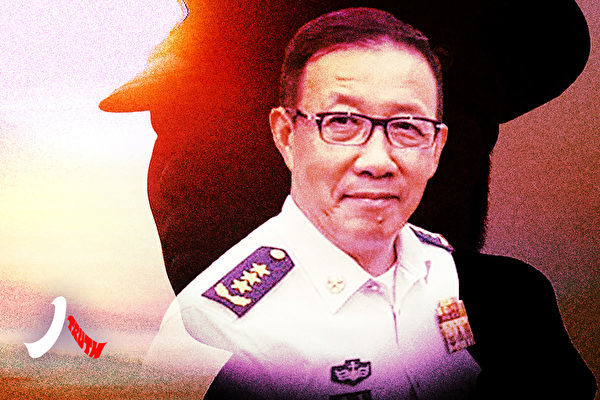
The new Defence Minister, Dong Jun, may add new drama to the 46th image (prophecy) of the Tui Bei Tu. (Truth of the People provided the report.)
[People News] In political science, there is a well-known concept called 'prediction market.' Recently, a betting market titled 'Who will Xi Jinping purge in 2026?' on the world's largest prediction platform, Polymarket, has generated significant attention.
Currently, the total amount wagered in this market has surpassed $150,000. Defence Minister Dong Jun ranks first, followed by Standing Committee member Wang Huning in second place, and Military Discipline Commission Secretary Zhang Shengmin in third. Additionally, Foreign Minister Wang Yi and several other standing committee members who are close to Xi are also prominently featured on the list. This raises a perplexing question: why, in 2026, when Xi Jinping is said to have achieved 'absolute leadership,' do the most dangerous individuals appear to be those closest to him? The explanation is straightforward: when a leader trusts no one, those around him who hold real power may band together for survival and might even seek external support.
Why is Dong Jun ranked first?
Current Defence Minister Dong Jun is the 'top candidate' on this list.
Dong Jun has only been in office for just over two years, so many are not surprised by his inclusion in the purge list, as events in the Celestial Empire are notoriously unpredictable. However, why does the global prediction market consider him the most dangerous? In reality, if you understand the logic of the Chinese Communist Party's military over the past two years, you will see that Dong Jun is not merely holding an official position; he is sitting on a 'volcano.'

(Network screenshot)
Firstly, Dong Jun's background has played a crucial role in determining his fate. Within the Chinese Communist Party (CCP) military, factionalism is a significant issue. Dong, who hails from the navy, is believed to have secured his position as Minister of National Defence largely due to the strong endorsement from Miao Hua, the former Director of the Political Work Department of the Military Commission, who has since been ousted.
On November 28, 2024, the CCP officially announced Miao Hua's removal from his position. Notably, just a day prior, the Financial Times reported that the CCP authorities were investigating Dong Jun. One can only speculate: with your political benefactor having fallen, and under accusations of 'disloyalty,' can Xi Jinping still place his trust in you, the individual personally promoted by this 'benefactor'?
Secondly, Dong Jun's role as minister is quite 'unjustified and unworthy.' Observers of the news may notice a peculiar detail: since Dong took over from Li Shangfu at the end of 2023, he has only held the title of 'Minister of National Defence.' Typically, according to CCP norms, the Minister of National Defence also serves as a 'Member of the Central Military Commission' and 'State Councillor.' However, in the two years since Dong's appointment, he has not been granted these additional titles. This 'mismatch between position and identity' suggests that Xi Jinping is closely monitoring him, or perhaps waiting for the opportune moment to replace him.
Nevertheless, it is worth noting that despite Dong Jun being the frontrunner in betting odds, he has thus far retained his position and has not experienced a sudden 'disappearance' like his predecessor. Even in 2024, when Miao Hua was reported to be 'suspended for investigation', the Ministry of National Defence denied any claims that Dong Jun was under investigation.
According to analysts and insiders, there are four main reasons why Dong Jun has managed to remain in his position until now.
The first reason is that Dong Jun reportedly has a good relationship with Xi Jinping's wife, Peng Liyuan, as they both hail from Shandong. This connection may explain why he was able to maintain some stability following the incident involving Miao Hua.
The second reason is that it is believed that Dong Jun has cooperated with the investigation to protect himself, even providing substantial information regarding Miao Hua's issues.
The third reason is that the international situation facing the Communist Party of China is currently very challenging. If the Minister of Defence is replaced frequently—one going missing today and another being arrested tomorrow—it would create a negative perception internationally and cause unease within the military. As a result, Xi Jinping is likely keeping Dong Jun in his position for the time being to avoid any immediate fallout.
The fourth reason is that there are currently 'no people' left in the military. This is perhaps the most pragmatic reason. With military leaders like Zhang Youxia and He Weidong facing issues, there has been a significant vacuum at the top of the military hierarchy. As a result, Dong Jun's problems are likely to be 'postponed for later handling.' This does not imply that he is safe; rather, it simply means that it is not yet his turn.
In summary, Dong Jun's current situation can be succinctly described as being in a 'probationary observation period.' This also clarifies why the odds on Polymarket have been fluctuating — everyone is still watching to see whether Dong Jun will be spared or ultimately face consequences.
Why is Zhang Shengmin, known for his role in arrests, also facing arrest?
The second military figure on the list is Zhang Shengmin. If Dong Jun's inclusion is attributed to 'factional issues,' then Zhang Shengmin's presence on the list is particularly alarming. Zhang Shengmin is a member of the Central Military Commission and serves as the secretary of the Military Discipline Inspection Commission. In recent years, many generals have been arrested within the military, and Zhang Shengmin has likely played a significant role in this. Logically, he should be one of Xi Jinping's most trusted individuals; so why does everyone feel he is in jeopardy? There are three very realistic reasons behind this.
Firstly, there is the peril of 'knowing too much'. Consider that Zhang Shengmin has served as the Secretary of the Military Discipline Inspection Commission for a considerable time; he likely possesses compromising information on many individuals, possibly even some 'special directives' from Xi Jinping. In the mindset of a dictator, such individuals are invaluable yet also pose significant risks. When Xi Jinping believes the military has been sufficiently cleansed, this 'knife of knowing too much' often becomes the next target for elimination.
Secondly, we see a power struggle during the 'military vacuum period'. Currently, aside from Xi Jinping, Zhang Shengmin stands out as the most qualified and influential figure within the Military Commission. In this context, his situation mirrors that of historical 'meritorious officials'. When the leader has removed all old adversaries, they may realise that you have emerged as the most powerful individual, and despite your loyalty, you could still be perceived as a potential 'threat' in the eyes of the leader.
It is evident that Zhang Shengmin's appearance on the list highlights the most ruthless side of the power struggle within the Chinese Communist Party: 'When the cunning rabbit dies, the hunting dog is cooked.' Once this 'knife' has helped its master eliminate all threats, it becomes unnecessary to keep it around. This explains why Zhang Shengmin's ranking has consistently remained high in market forecasts. The speculation is not about his greed, but rather about how much 'trust' Xi Jinping still places in him.
Why do 'insiders' seem most inclined to betray their own?
The prediction list includes prominent figures such as Wang Huning, Ding Xuexiang, Cai Qi, Li Qiang, Li Xi, Zhao Leji, and Wang Yi. Most of these individuals are among Xi Jinping's most trusted aides; why are they also at risk of being purged?

(This is a screenshot from the internet.)

(This is an image from the internet.)
This raises a crucial point: 'When loyalty no longer ensures survival, confidants can become the greatest threat.'
In the realm of the Chinese Communist Party, there is a tacit understanding: nearly everyone has some dirt on them. This was initially a tactic employed by Xi Jinping—' I possess your secrets, so you must remain completely loyal to me.' However, by 2026, this strategy will reach its limits. These confidants come to realise that no matter how compliant or diligent they are, if the leader perceives them as a 'potential threat' or needs someone to take the fall for economic missteps, they can be discarded at any moment. Consequently, the 'leverage' that was meant to control them transforms into a 'time bomb' in the hands of these officials.
Secondly, the instinct for survival outweighs everything else. Consider this from another's perspective. If you are Cai Qi or Li Xi, and you witness those 'old colleagues' who were in meetings and rallying together just yesterday suddenly disappearing today, only to reappear in a report from the Central Commission for Discipline Inspection tomorrow, how would you feel? You would come to understand that in this system, there is no such thing as a 'get out of jail free card.' When 'loyalty' no longer provides a sense of security, a person's instinct shifts from 'allegiance' to 'self-preservation.' This explains why outsiders perceive that these close aides are currently engulfed in extreme fear.
Thirdly, there is a trend towards collective self-preservation and seeking external assistance. While one person's resistance may lead to their demise, if everyone feels threatened, a collective understanding can emerge. For instance, if Cai Qi were to form an alliance with Zhang Shengmin or other factions, agreeing that 'if you act against me, we will all retaliate,' it would create a nightmare scenario for the top leader. Another potential avenue is to collaborate with the United States. Given the domestic insecurity, selling 'core secrets' such as high-level assets, nuclear codes, or internal scandals as leverage to the U.S. in exchange for family immigration becomes a very pragmatic choice.
Additionally, 2026 marks the year before the 21st National Congress. If Xi Jinping intends to replace his current aides with younger individuals lacking significant backgrounds, this current group of close aides becomes nothing more than 'obstacles.' They are aware that they are on the verge of being 'discarded,' so behind every expression of loyalty now, there may lurk a hidden sense of betrayal.
This explains why the betting odds for 2026 are likely to spotlight Cai Qi and his associates. The gamble is not on whether they will engage in corruption, but rather on when this 'trust chain' will ultimately break.
When a leader is distrusted by everyone, he effectively becomes isolated. Those around him who hold leverage may secretly unite, even reaching out to external forces, to avoid becoming the next victims of a purge. This scenario represents the most genuine and perilous backdrop for Zhongnanhai in 2026.
Is 2026 the critical point of collapse?
By 2026, Xi Jinping's rule may find itself in a 'dead end': in his quest to maintain power, he feels compelled to purge those close to him; however, the more individuals he removes, the more insecure those who remain will feel. As their insecurity grows, so too does the likelihood of them developing 'disloyalty' as a means of self-preservation.
This creates a 'self-cannibalisation' effect. When influential figures like Cai Qi, Li Xi, and Zhang Shengmin realise they have been placed on the betting table and that the secrets they possess are about to become crucial for their survival, cracks will already have formed in the red walls of Zhongnanhai.
History shows us that the strongest fortresses are often breached from within. Lin Biao in 1971 and Beria in 1953 both seemed to be the most trusted aides of the highest leaders just a day before their respective downfalls. Yet, when the pressure of life and death becomes overwhelming, the instinct for self-preservation in human nature will prevail over all political ideologies.
Xi Jinping currently resembles a high-pressure cooker with all its exhaust valves sealed shut. He thinks that the higher the pressure, the more secure the lid will be; yet, he fails to realise that when those at the bottom begin contemplating escape or rebellion, an explosion is the inevitable result.
(First published by People News)△



News magazine bootstrap themes!
I like this themes, fast loading and look profesional
Thank you Carlos!
You're welcome!
Please support me with give positive rating!
Yes Sure!