
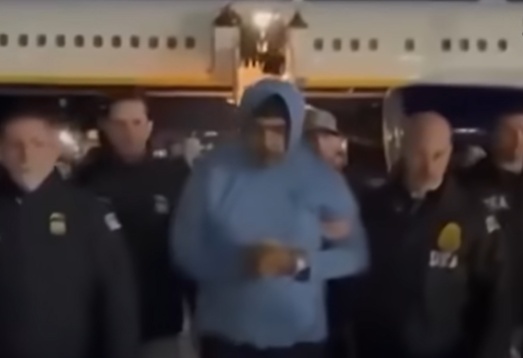
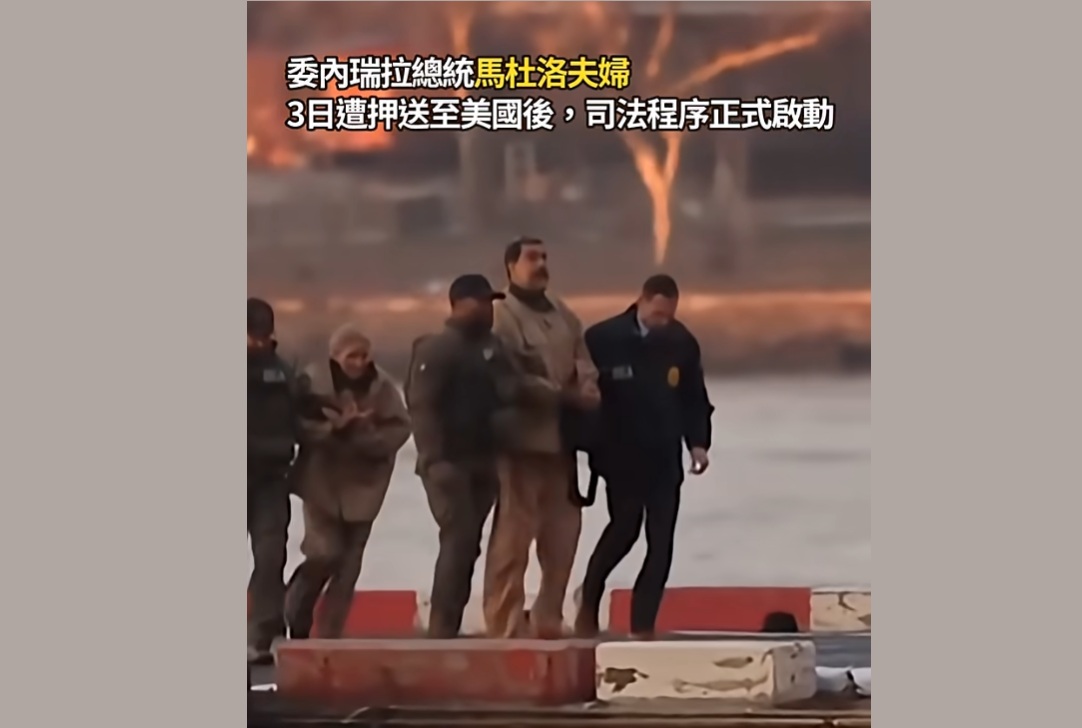
Venezuelan President Maduro has been captured by the U.S. military. (Video screenshot)
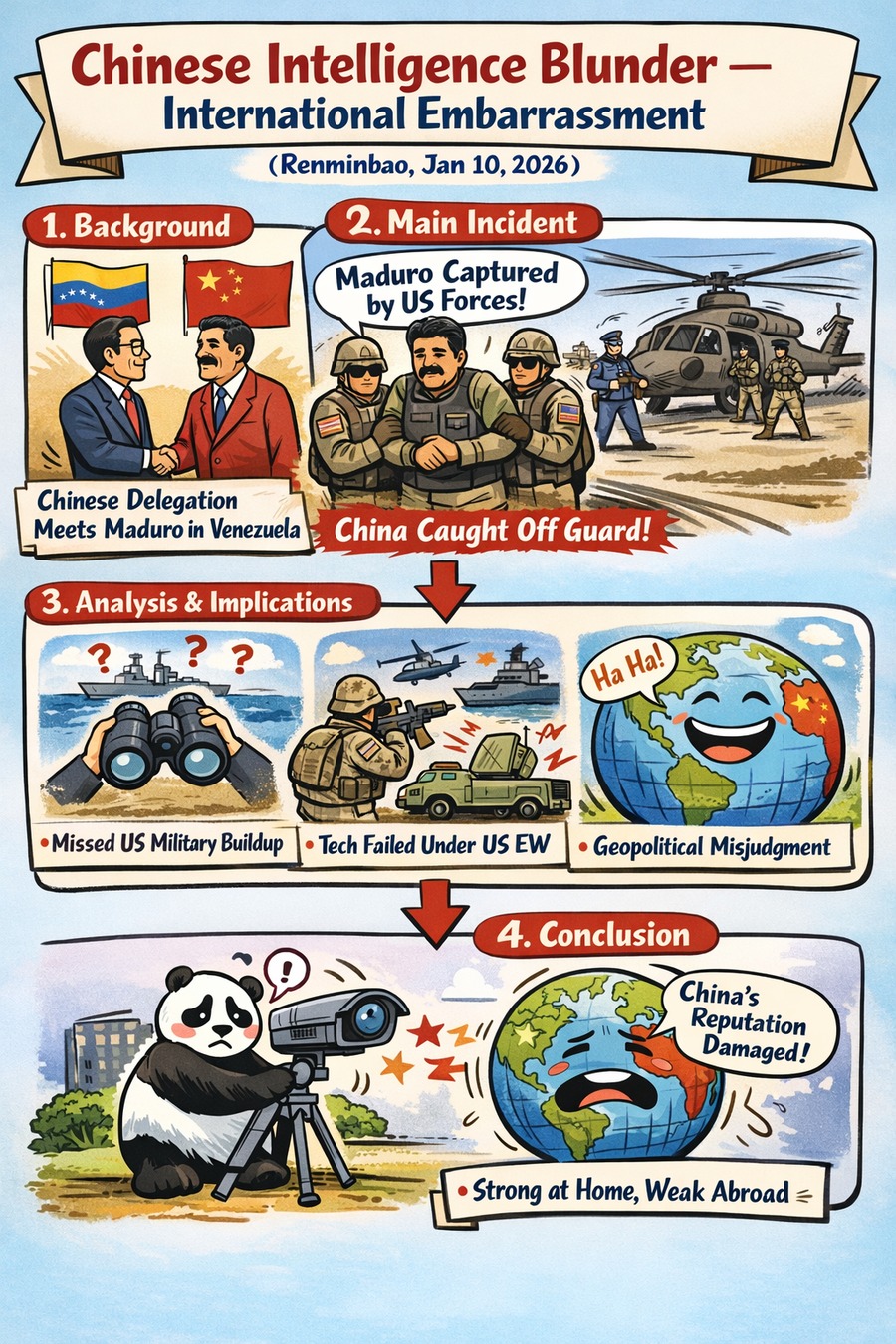
[People News] At the very beginning of 2026, the Chinese Communist Party (CCP) made yet another major strategic misjudgment in its confrontation with the United States over Venezuela, causing the CCP to lose face both internationally and domestically.
This major strategic blunder was as follows: just a few hours before the United States carried out its “catching a turtle in a jar” plan against Venezuelan President Nicolás Maduro, the CCP dispatched special envoy Qiu Xiaoqi to Venezuela to personally encourage and embolden Maduro, strongly backing him and urging him to continue serving as the CCP’s pawn in opposing the United States in South America.
The Last “Foreign Guest” Maduro Met
A few hours before the United States captured Maduro on January 2, the last foreign guest Maduro met, in his capacity as Venezuelan president, was CCP special envoy Qiu Xiaoqi.
In a press release on the 2nd, the Venezuelan presidential palace stated that “Maduro held a meeting lasting more than three hours with Chinese special envoy Qiu Xiaoqi in Office No. 1 of the Miraflores Palace”; and that “this meeting reviewed more than 600 agreements already signed by both sides, marking the launch of the 2026 high-level diplomatic agenda.”
Maduro said: “I thank President Xi Jinping for his consistent brotherly friendship, like that of an elder brother.”
Qiu Xiaoqi reiterated that “China and Venezuela are time-tested strategic partners”; and that “China not only regards Venezuela as a trade and energy partner, but also as an important political ally in the region.”
Also attending the meeting were the CCP’s ambassador to Venezuela Lan Hu, officials from the CCP Ministry of Foreign Affairs Liu Bo and Wang Hao (Liu Bo and Wang Hao are transliterations), among others. Qiu Xiaoqi presented Maduro with a ceramic horse, and Maduro reciprocated with a painting.
Maduro’s Arrest Completely Caught the CCP by Surprise
The Washington Post reported that when the United States launched a military surprise attack on January 3, CCP officials in Caracas were extremely shocked and immediately sent a series of urgent telegrams back to Beijing. One official said: “This was completely unexpected.”
None of the CCP’s major Party media outlets—including China Central Television, Xinhua News Agency, and People’s Daily—reported the news of CCP special envoy Qiu Xiaoqi meeting Maduro. There was only one reason: the U.S. military’s capture of Maduro slapped the CCP’s erroneous decision in the face far too quickly.
On January 5, at a routine press conference of the CCP Ministry of Foreign Affairs, a reporter from NBC asked: “China has demanded that the United States immediately release the detained Venezuelan President Maduro and his wife. If China’s demand is ignored, can you comment on whether the United States will face consequences? In addition, a CCP delegation had previously been meeting with Maduro—can you confirm whether they are still in Caracas?”
Regarding these two questions, CCP Foreign Ministry spokesperson Lin Jian did not answer for a long time. Instead, he lowered his head to flip through materials. The entire room fell silent. After a full 49 seconds of silence, Lin Jian finally raised his head and answered irrelevantly.
A reporter from Tokyo TV in Japan asked: “Venezuela has imported a large amount of military equipment from China, but this equipment seems to have played little real role in the recent U.S. attacks. What is the spokesperson’s comment on this?”
After hearing the question, Lin Jian’s face darkened. He remained silent for a few seconds and then again answered irrelevantly.
This extremely awkward scene, watched by both Chinese and foreign audiences, showed that the CCP had neither mental preparation nor a response plan for Maduro’s sudden arrest.
One Chinese netizen wrote: “The Chinese (CCP) special envoy Qiu Xiaoqi had just left, and the United States took action the very next day. This is completely不给我们面子 (showing us no respect)!” Another netizen immediately replied: “This is showing too much respect, okay? They waited until you left before arresting him. Otherwise, if they arrested him right in front of you, what would you dare to say?”
Why Did the CCP Make Such a Major Strategic Blunder?
In my personal view, the main reasons may lie in the following five aspects:
First, the Intentions of CCP Leaders
Rush Doshi, a China expert at Georgetown University in the United States, commented: “If Venezuela can distract U.S. attention, that would be more beneficial for Beijing.”
This statement reveals an important reason why CCP decision-makers decided to dispatch special envoy Qiu Xiaoqi to Venezuela.
The CCP wanted Maduro to become a “nail household” in South America to “distract U.S. attention.” Maduro’s hardline anti-U.S. stance would inevitably tie down large amounts of U.S. manpower, material resources, financial resources, and military power. In this way, the United States would not be able to focus all its attention on dealing with the CCP, giving the CCP some breathing room amid internal and external crises and allowing its precarious rule to be prolonged as much as possible.
Regarding this CCP decision-making motive, CCP Foreign Minister Wang Yi’s remarks last year on the Russia–Ukraine war provide the best footnote.
On July 2, 2025, in Brussels, the capital of Belgium, during a four-hour meeting with EU foreign policy chief Kallas, CCP Foreign Minister Wang Yi suddenly blurted out: “China (the CCP) does not want to see Russia fail in Ukraine,” “because [we] do not want the United States to shift all its attention to China (the CCP).”
This seemingly casual remark revealed a major secret of the CCP: the CCP’s attitude toward the Russia–Ukraine war is not based on international law, not based on morality, but based on considerations of the CCP’s own security. As long as Russia can tie down what the CCP regards as its greatest enemy—the United States—and prevent the United States from focusing all its attention on the CCP, that is sufficient.
The CCP treated Venezuelan President Maduro as the “Putin of South America.” But what the CCP never expected was that Venezuela is not Russia, and Maduro is not Putin.
Second, the CCP’s Anti-U.S. Ideology
The CCP is a party guided by Marxism-Leninism. Marx was filled with deep-seated hatred toward capitalism and called on communists to “kill” capitalism; Lenin called imperialism “the highest stage of capitalism,” describing it as decaying, declining, and moribund.
For the 76 years since the CCP seized power, “capitalist America” or “U.S. imperialism” has always been the CCP’s greatest enemy. Among the “foreign hostile forces” often mentioned by the CCP, the United States ranks first. In Mao Zedong’s later years and during Deng Xiaoping’s rule, periods of “uniting with the U.S. against the Soviet Union” or “expanding opening to the U.S.” were merely expedient measures, exploiting America’s “appeasement policy” to achieve the CCP’s own goals.
After Xi Jinping came to power, the CCP believed it had grown strong, and thus began to confront the United States globally. Venezuela, which promotes socialism and opposes the United States, naturally became the CCP’s most important ally in South America. The CCP’s strong support for Maduro was intended to turn Venezuela into a forward base for opposing the United States in South America.
Anti-U.S. ideology is not a judgment based on objective facts, but an inference based on Marxist-Leninist fundamentalism. The CCP’s strong support for Maduro’s anti-U.S. stance is built on this inference.
The problem is that Marx’s and Lenin’s views on capitalism and imperialism have been completely proven wrong by facts.
More than 170 years ago, in 1848, Marx sentenced capitalism to death in The Communist Manifesto; 110 years ago, in 1916, Lenin sentenced imperialism to death in Imperialism, the Highest Stage of Capitalism. Yet to this day, objective facts prove that “capitalist America” or “U.S. imperialism” remains the most powerful country in the world.
How could the CCP’s decision to strongly support Maduro, based on anti-U.S. ideology, not be disastrously wrong?
Third, a Major Failure in the CCP’s Intelligence System
At the very moment when Qiu Xiaoqi was shaking hands and chatting happily with Maduro in the Venezuelan presidential palace, the U.S. military had already completed large-scale battle deployment in the Caribbean. More than 150 fighter jets, bombers, electronic warfare aircraft, as well as special operations and support forces, had already entered attack positions. This meant that when CCP special envoy Qiu Xiaoqi led his delegation into Caracas, the entire country of Venezuela was already under the gun of the U.S. military.
Qiu Xiaoqi’s appearance at the Venezuelan presidential palace at such a critical moment shows that the CCP’s intelligence system had a serious problem.
As early as August 2025, the United States began assembling unprecedented military forces in the Caribbean and waters near Venezuela, dispatching multiple supersonic heavy bombers to fly along Venezuela’s coastline. In September, U.S. Southern Command began launching military strikes against vessels in the Caribbean. In October, Trump halted negotiations with Venezuela. In November, the U.S. military deployed the aircraft carrier Ford in the Caribbean. In December, the U.S. military began intercepting and seizing oil tankers, imposing a maritime blockade on Venezuela. On December 17, the well-known U.S. magazine Vanity Fair published content from 11 interviews with Trump’s most trusted chief of staff (White House Chief of Staff) Wiles. In those interviews, Wiles said: “He (Trump) wants to keep bombing until Maduro gives in.”
All of this information was visible to CCP intelligence personnel who study U.S. military movements. However, the intelligence they provided to CCP decision-makers was that Trump would not arrest Maduro.
Why did the CCP intelligence system make such a huge mistake?
The reason is simple: their guiding ideology for intelligence gathering is “the will of CCP leaders” and the CCP’s “anti-U.S. ideology.” They only report what leaders want to hear, and only report information consistent with anti-U.S. ideology.
When the CCP intelligence system starts from the subjective wishes of CCP leaders and from the CCP’s anti-U.S. ideology, rather than from reality, how could the so-called “intelligence” it gathers not be gravely wrong?
Fourth, the CCP’s Blind Confidence in the Military Equipment It Sold to Venezuela
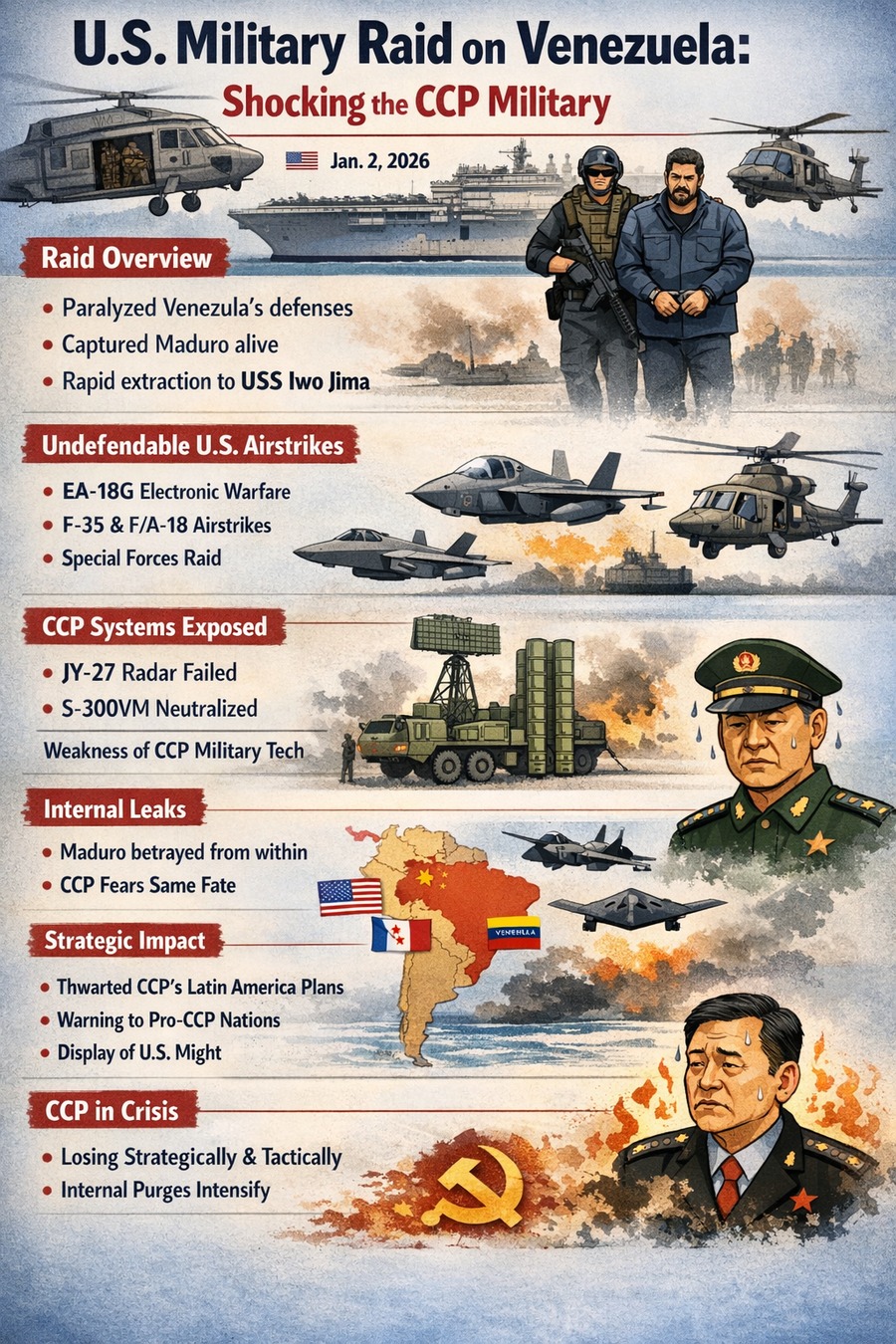
The core of Venezuela’s air defense network is the JYL-1 long-range surveillance radar and the JY-27A VHF radar provided by the CCP’s mega military-industrial enterprise—the China Electronics Technology Group Corporation (CETC).
The CCP boasts that the JYL-1 long-range surveillance radar features digitalization and software-defined characteristics, achieving high reliability, high intelligence, and high automation. It can stably and continuously provide real-time early warning information and integrates air defense and air traffic control functions. Its main advantages lie in advanced digital processing and phased-array technology, enabling it to effectively address modern airspace challenges.
The CCP also boasts that the JY-27A VHF radar is renowned for its strong anti-stealth capability, capable of effectively detecting stealth aircraft, with a maximum detection range exceeding 350 kilometers, and some improved versions reaching 450–550 kilometers. It uses advanced active phased-array, sparse array, and digital beamforming technologies, enabling four-dimensional detection of targets (range, speed, horizontal and vertical angles), with features such as omnidirectional coverage and highly mobile deployment.
However, at the very moment U.S. military operations began, these myth-like CCP military-industrial systems immediately fell into paralysis. The intense, wide-spectrum electronic interference implemented by U.S. EA-18G “Growler” electronic warfare aircraft directly cut off the signals of these radars, covering their screens with clutter and rendering them completely incapable of effective aerial surveillance.
In other words, under the powerful electronic interference of the U.S. military, all the military equipment that Venezuela had spent huge sums to buy from the CCP became blind eyes and deaf ears—mere decorations.
Fifth, CCP Experts Offering Advice Based on “the Intentions of CCP Leaders”
One month earlier, Li Li, a senior colonel, professor, and Ph.D. in military strategy at the CCP’s National Defense University, stated emphatically: “The reason the United States does not dare to take action against Maduro is very simple. Venezuela is not like Syria, nor is it equivalent to Gaddafi or Saddam. Even if Trump wants to do something, he must seriously consider the consequences… The reason the United States has not dared to use force against Venezuela is mainly because it has concerns, especially worrying that there is a big brother backing it. Now the S-400 air defense system is already in place—let’s see whether Trump dares to jump into this pit.”
Another CCTV special military commentator and well-known CCP military expert, Du Wenlong, also claimed that “the United States will not send ground forces forward, fearing it would become bogged down in the vast sea of Venezuela’s people’s war.”
Shen Yi, professor in the Department of International Politics at Fudan University in Shanghai, also repeatedly analyzed that “the United States does not dare to use force against Venezuela,” and that Trump’s “closure of Venezuelan airspace” was mere bluffing.
Conclusion
On December 31, 2025, CCP General Secretary Xi Jinping delivered a New Year’s address to the world via China Media Group and the internet, solemnly declaring: “China (the CCP) always stands on the right side of history.”
However, many facts in recent years have shown that the CCP always stands on the wrong side of history.
At critical historical junctures amid today’s turbulent international situation, it often turns out that whoever the CCP supports ends up finished: the CCP supported Syrian President Assad, and Assad fled to Moscow for refuge; the CCP supported Nepalese Prime Minister Oli, and Oli was driven from office and is now of unknown whereabouts; the CCP supported Bangladeshi Prime Minister Hasina, and Hasina fled to India for refuge and was sentenced to death in absentia by Bangladesh’s International Crimes Tribunal; the CCP supported Hamas leaders, and in the Israel–Hamas war, all 54 Hamas leaders on Israel’s “death playing cards” were beheaded.
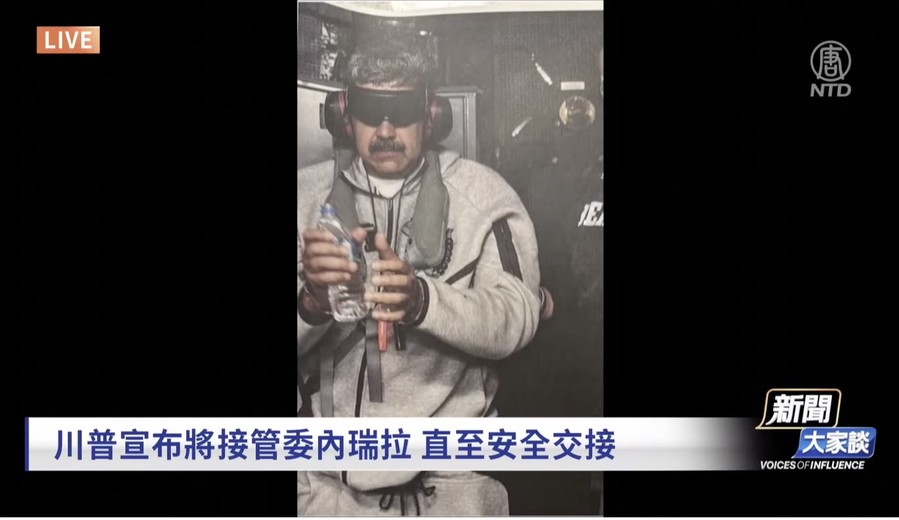
Now, the CCP has strongly supported Venezuelan President Maduro—and Maduro has become a prisoner.
Why does today’s CCP always stand on the wrong side of history?
The fundamental reason is that the CCP’s fundamental guiding ideology—Marxism-Leninism—has as its essence “falsehood, evil, and struggle,” which is completely opposed to universal values.
(The Dajiyuan)
△




News magazine bootstrap themes!
I like this themes, fast loading and look profesional
Thank you Carlos!
You're welcome!
Please support me with give positive rating!
Yes Sure!