
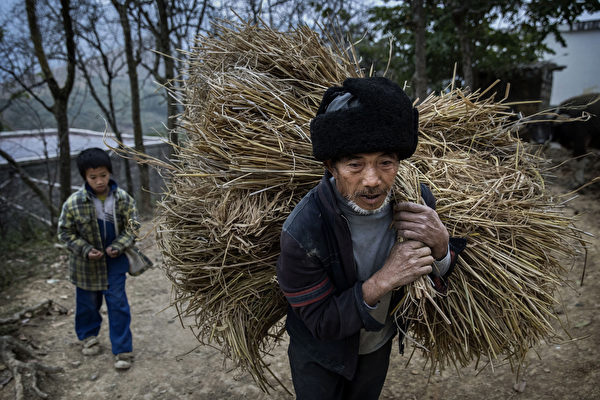
Illustration: The difficult lives of elderly people in rural China (Getty Images)
[People News] Two Taiwanese economists have made a significant impact in mainland China: Lin Yifu and Lang Xianping. Lin Yifu, who crossed the strait to enter the mainland, has been a key figure in the Chinese Communist Party (CCP) for many years, even serving as the Chief Economist of the World Bank on behalf of the CCP, thus being part of the establishment. On the other hand, Lang Xianping operates more independently, engaging actively on various media platforms in mainland China. As he is not part of the establishment, he tends to express his views more freely on pressing issues.
Recently, I came across a video featuring Lang Xianping, where he compared the total wage share of GDP across different countries to evaluate the average income levels of their citizens. The statistics he presented are quite intriguing and worth sharing.
In the United States, the total wage share of GDP is 58%; in the United Kingdom, it is 56%, Japan 53%, France 53%, Canada 51%, and Australia 47%. Advanced Western countries generally fall between 50% and 60%, which constitutes the first tier. Additionally, South Korea stands at 44%, Argentina at 36%, Mexico at 33%, and Venezuela at 31%, with most Latin American countries hovering around 33%, placing them in the second tier. Among Asian nations, Thailand and the Philippines are at 28%, while Iran and Turkey are at 25%, which is categorized as the fourth tier. African countries lack specific data, but Lang Xianping estimates that their figures are all below 20%, also placing them in the fourth tier.
During a recent program, Lang Xianping asked the audience to estimate certain figures regarding China. Over 90% of the viewers believed that the proportion of national income to GDP in China should be similar to that of African countries. However, Lang Xianping ultimately 'revealed the truth'; it turns out that the total income of Chinese citizens accounts for only 8% of the GDP, placing it at the bottom globally, in the fifth tier.
As an economist, Lang Xianping does not dare to speak falsely in the context of public opinion in mainland China, which makes these figures credible and able to withstand scrutiny.
It is crucial to understand that this figure does not compare the absolute numbers of average national income, but rather the proportion of total national income to GDP. The total income of Chinese citizens constitutes only 8% of China's total GDP, while African countries allocate 20% of their GDP to their citizens, which is more than double that of China.
This disparity is partly due to the relatively low GDP figures of African countries; with a smaller denominator, the ratio of the numerator to the denominator appears larger. While the GDP figures of African nations may be low, they still manage to distribute 20% of their national GDP to their citizens. In contrast, despite China's GDP ranking second in the world, the Chinese government only allocates 8% of this wealth to its people.
China describes itself as a socialist country. But what does it mean to be a socialist country? Firstly, it entails public ownership of the means of production; secondly, rights belong to the people; thirdly, distribution is based on labor according to each person's ability; and fourthly, it operates under a planned economy. For now, let's set aside other considerations and pose a crucial question: who determines the distribution of wealth in contemporary China? Is it the Chinese people? Clearly not; is it the working class and impoverished peasants? Even less so; is it the National People's Congress? In reality, it is not, as the National People's Congress merely votes on decisions made by the Central Committee of the Communist Party of China (CPC).
Thus, the sole entity that dictates the distribution of wealth in China is the CPC. The CPC government allocates only 8% of GDP to the citizens; where does the remaining 92% of GDP go? Firstly, it is directed towards national-level investments; secondly, it is used for international strategic expansion; thirdly, it is allocated for national defense; fourthly, it is necessary for maintaining local government operations; fifthly, it supports the government's high productivity; sixthly, it caters to the corrupt appetites of officials at all levels; and only after all this is there anything left to distribute to the general populace.
The term socialism, by its very definition, implies that 'society' is the highest principle. So, what constitutes society? Society is made up of all citizens, and the interests of all citizens are the foundation of this system, meaning that national wealth should primarily be used to enhance the living standards of all members of society. When making governmental decisions, while national interests are significant, the interests of the citizens should take precedence over those of the state. If the interests of the citizens are sacrificed for national interests, then the state loses its meaning for the citizens; this is not socialism, but rather nationalism.
In other words, the government should prioritize improving the living standards of its citizens before addressing other national development needs. It should not operate in reverse, where the state oppresses its citizens and neglects their basic needs. Currently, a significant number of people in China are experiencing a return to poverty, and the Communist Party of China remains unresponsive to this issue. This situation offers a perspective on understanding the true nature of socialism.
Why are African countries so impoverished, yet the total income they distribute to their citizens exceeds that of China? This is because their governments place greater importance on the welfare of their citizens than on national development; while national development can afford to be gradual, citizens cannot be left in precarious situations. Why is the share of income for Chinese citizens so low relative to GDP? This is due to the Chinese government's need for more funds to sustain its rule, and these funds come directly from the pockets of the Chinese populace.
In straightforward terms, the socialism that the CCP advocates is not true socialism for the Chinese people; it is merely a guise for the CCP to exploit resources under the banner of socialism. Why does the CCP's reform and opening-up process retract after reaching a certain threshold? It will never pursue political reform, as such reforms would transition socialism towards capitalism. Once China adopts capitalism, it will inevitably move towards parliamentary democracy, universal voting rights, a robust rule of law and human rights, and the realization of complete individual freedoms. At that point, the CCP will find itself without a foundation, and the state will no longer belong to the CCP, leading to the red families witnessing their wealth dissipate.
In 2025, China's GDP is projected to reach 140 trillion yuan. If the income of Chinese citizens were to rise to 28% of GDP, similar to that of Thailand and the Philippines (both Asian countries, and there is no reason for China to lag behind), this would equate to 39.2 trillion yuan. When this wealth is distributed among China's 1.3 billion people, each individual would receive 30,000 yuan. An increase of 30,000 yuan in annual income translates to an average monthly income boost of over 2,000 yuan per person.
This figure, based on common sense, highlights the current low percentage of national income in GDP in China, which is only 8%. It remains uncertain when this will rise to 28%. Nevertheless, even if China were to catch up to Thailand and the Philippines, it would still provide a significant benefit to the Chinese populace. After a few more years of effort, could China potentially catch up with South Korea? Logically, it should be feasible, but unfortunately, the Chinese Communist Party (CCP) seems unwilling to pursue this path.
Lang Xianping's statistics do not account for Taiwan. I consulted AI, and it indicated that employee compensation (including labor wages and benefits) constitutes 43.1% of GDP, which is nearly equivalent to South Korea's 44%. This suggests that the income of Taiwanese people as a percentage of GDP is already among the highest in the world. As fellow Chinese, they experience such a stark contrast, yet the CCP still has the audacity to seek unification with them!
Upon reviewing these figures, it becomes clear that the so-called 'superiority of socialism' is merely a ruse employed by the CCP to deceive the Chinese populace, and it holds no real value. The troubling aspect is that many Chinese individuals still become emotional when referring to the 'motherland,' and those who oppose the Communist Party are labeled as traitors—are these individuals incredibly naive, or are they simply destined to remain subservient forever?
Originally shared from (Facebook) △







News magazine bootstrap themes!
I like this themes, fast loading and look profesional
Thank you Carlos!
You're welcome!
Please support me with give positive rating!
Yes Sure!