
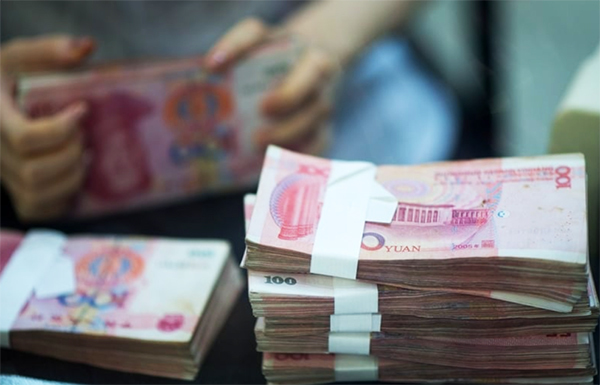
Photo Caption: As the CCP's local government finances grow increasingly strained, governments across China are finding new ways to extract money from the public. (Getty Images)
[People News] According to data from the National Taxation Bureau, by 2025, China's individual income tax revenue is projected to reach 1.62 trillion yuan, reflecting a year-on-year increase of 11.5%. This growth trend is expected to continue into the first quarter of 2026, with individual income tax revenue hitting 501.8 billion yuan, a year-on-year rise of 10.5%.
In the context of overall macroeconomic pressures and a downward trend, the persistent increase in individual income tax revenue stands out as both striking and unusual.
In 2025, the national general public budget revenue is expected to decline by 1.7%, with tax revenue showing only a slight increase of 0.8%, while non-tax revenue is projected to drop by 11.3%. GDP is anticipated to grow by 5.0%, and the nominal per capita disposable income of residents nationwide is also expected to rise by 5.0%. The actual growth rate closely aligns with the nominal figure, yet the per capita disposable income of urban residents is projected to increase by only 4.3%.
Among other major tax categories, domestic value-added tax is expected to grow by 3.4%, corporate income tax by 1%, and consumption tax by 2%. The growth rate of individual income tax significantly outpaces that of tax revenue, non-tax revenue, resident income, GDP, and other tax categories, which contradicts the expected relationship between tax growth and economic cycles.
Officials attribute this phenomenon to the "application of big data in taxation" and the "enhanced compliance of high-net-worth individuals," as well as tax revenue from the reduction of listed shares, which suggests the effective implementation of big data in tax governance. However, the underlying logic is not as sophisticated as the official narrative implies. This represents a signal from the CCP, amid soaring local debts and the collapse of land finance, to employ the strategy of "data-driven taxation" for the systematic extraction of private wealth. The era of the wealthy falling back into poverty and the poor becoming even poorer, leading to a complete erosion of wealth, has indeed arrived.
The 'tax miracle' amid economic downturn has garnered significant attention.
China's economy is currently facing the most severe deflationary pressure in over 40 years. The sluggish real estate market has negatively impacted land transfer fees, leading to widespread financial strain at the local government level. Both central and local government debts have surpassed the total GDP. By 2025, the projected per capita disposable income for residents nationwide is 43,377 yuan, reflecting a nominal growth of 5%, while the median growth is only 4.4%. This disparity highlights issues of income inequality and sluggish economic growth. Despite substantial financial support from the national government, domestic consumption remains weak, and private enterprises show a very low willingness to invest.
In contrast, personal income tax data has revealed a surprising surge. The primary sources of individual income tax include wages, labour remuneration, property transfers, dividends, and overseas income. This high growth suggests that the incomes of middle and high-income groups are being more thoroughly taxed. Recent statistics from the State Administration of Taxation indicate that among individual income tax filers in China, those earning over 1 million yuan annually make up about 1% of the total filers, yet they contribute more than 50% of the total individual income tax. Furthermore, individuals in the top 10% of reported income account for over 90% of the individual income tax paid.
In summary, despite only a 5% increase in resident income and a weakening economic momentum, the individual income tax has effectively and aggressively targeted the wealthy, resulting in double-digit growth. The improvement in the performance of listed companies has led to increased dividends and shareholder returns, the standardisation of platform economies, and the large-scale collection of overseas income, which is the official explanation for this phenomenon.
However, the reality is that as the economy declines, nationwide salary cuts have become a common trend, affecting everyone from financial executives to government officials, police, and state-owned enterprises. The so-called historic growth in personal income tax is essentially just an extreme intensification of tax collection efforts, rather than a genuine increase in wealth creation. This is akin to quenching thirst with poison and killing the goose that lays the golden eggs.
Superficially, this appears to be a legitimate effort to plug tax leaks, but in truth, it reflects a desperate grab for wealth amid fiscal shortages. The scale of local government debt is staggering, hidden debt risks are accumulating, and land finance is plummeting. The so-called revitalisation of state-owned assets is merely a drop in the ocean. The Chinese Communist Party must find new tax sources, targeting the vast fields of 'leeks' and specifically striking at some robust seedlings, which has naturally become the preferred strategy.
The Golden Tax Phase IV and CRS represent a systematic weapon for wealth extraction.
The anticipated surge in personal income tax in 2025 can be largely credited to the full implementation of the Golden Tax Phase IV system. This system leverages big data and artificial intelligence to facilitate data sharing across various departments, including taxation, banking, industry and commerce, and social security, creating a comprehensive 'one-person' profile of individuals. Previously hidden income, equity incentives, and non-wage compensation that evaded regulation are now easily exposed at the touch of a button by the Chinese Communist Party, revealing the full extent of an individual's wealth.
The deep integration of the Common Reporting Standard (CRS) with the Golden Tax Phase IV poses a significant threat. The global income of Chinese tax residents is now under the scrutiny of tax authorities. Information regarding overseas bank accounts, automatic exchanges, offshore trust income, capital gains from foreign investments, dividends, and other previously grey areas has become a primary target for inspection. The Chinese Communist Party (CCP) has designated 2025 as the inaugural year for the active management of overseas income, prompting tax authorities in various regions to initiate risk assessments that can look back several years. Cases of tax supplements and late payment penalties are increasingly common, creating a veritable blue ocean for wealth harvesting.
High-net-worth individuals are particularly affected. According to the '2025 Research Report on the Consumption Mindset and Behaviour of High-Net-Worth Individuals' released by the Hurun Research Institute, the number of affluent families in China (with net assets exceeding 6 million yuan) has declined for two consecutive years, slightly falling to 5.128 million households in 2024, a year-on-year decrease of 0.3%. Furthermore, the number of 'high-net-worth families' (with net assets over 10 million yuan) decreased by 0.8% year-on-year; 'ultra-high-net-worth families' (with net assets over 100 million yuan) saw a year-on-year decline of 1.7%, resulting in approximately 20,000 families with 'one small goal' disappearing; 'international ultra-high-net-worth families' (with net assets over 200 million yuan) experienced an even sharper decline, down 2.3% year-on-year.
This decline is partly due to asset shrinkage, with tax enforcement being a significant factor. Tax interviews and notices for supplementary payments have become the new normal for high-net-worth individuals. What was once legitimate tax planning through family trusts and offshore companies is now facing stringent adjustments under CRS regulations. The tax reach of the CCP has extended globally.
A sweeping change is underway: from the wealthy to the middle class and the lower class.
The wealth extraction by the Chinese Communist Party (CCP) is a systematic endeavour, with numerous typical cases:
The targeted governance of the high-income and high-net-worth "double high" demographic has been significant. In the first 11 months leading up to 2025, the CCP's tax authorities investigated 1,818 individuals, including celebrities and internet influencers, categorised as "double high" individuals, recovering a total of 1.523 billion yuan in taxes. Notably, Chongqing's prominent internet influencer Peng Xuan (who has over 30 million followers) was fined 4.15 million yuan due to discrepancies between his traffic data and reported income. Gansu influencer Yang Suiwa was required to pay an additional 1.81 million yuan. A cultural media company in Guangdong was ordered to pay back taxes of 16.59 million yuan and fines of 8.29 million yuan, totalling nearly 24.88 million yuan.
Overseas income has emerged as a significant area of concern. Shandong resident Zhang was identified through big data for failing to report income from overseas stock investments and account interest, resulting in a tax payment and late fees totalling 1.2638 million yuan. In Shanghai, Chen had unreported dividends from a Hong Kong account, leading to a tax payment of 184,800 yuan. A resident in Zhejiang failed to report profits from cryptocurrency trading, resulting in a repayment of 127,200 yuan. A case in Hubei involved a repayment of as much as 1.413 million yuan, while Xiamen's Fu paid back 6.987 million yuan. These cases illustrate that the targets of tax investigations have expanded from ultra-wealthy individuals to the middle class, with authorities tracing back several years of income, and even single profits requiring tax payments, while losses cannot be fully deducted.
In 2025, Chinese YouTube influencers Lao Gao and Xiao Mo were found to have ceased updating their content, and it was later reported to have been threatened by police from their registered residence in Dalian to pay substantial taxes. Additionally, there were reports on platform X of a shocking tax assignment task for Chinese YouTube bloggers amounting to 6 billion yuan from local public security in the CCP, indicating that as long as these influencers maintain Chinese nationality, they will be subject to the CCP's long arm of jurisdiction, even while overseas.
The grassroots platform economy in China, along with practitioners of new business models such as live streaming, short videos, and paid knowledge, find themselves with no escape. Previously, grey income was exposed through big data, and the tax enforcement of the Communist Party of China (CPC) is ever-present.
By 2025, the CPC will mandate that all industries contribute to social insurance, while ride-hailing platforms are increasingly taking larger cuts. Conflicts between street vendors and urban management are intensifying, leaving ordinary people at the grassroots level with no options.
These tactics, driven by fiscal pressure, have fostered a culture of unscrupulous practices and over-exploitation. We are witnessing capital outflow, a collapse of confidence, wealthy individuals fleeing, the middle class reverting to poverty, and grassroots loyalty. The market mechanism is entirely distorted, economic vitality is severely stifled, and social crises are widespread.
The unusually high growth of individual income tax under the CPC is a classic example of China's economic shift from rapid growth to a decline in stock. Over the past four decades, reform and opening up have unleashed the creative potential of private wealth, resulting in a substantial middle class and wealthy elite. However, under institutional strangulation, they are now facing decline.
The wealthy are falling back into poverty, the middle class is anxious, and the grassroots are struggling. Overall liquidity in society is nearly depleted, and various sectors are heading towards a doomsday recession due to internal competition. When social wealth becomes concentrated and flows passively towards the power system, it indicates that those in power are essentially vampires, and the power mechanism is the ultimate cause of economic haemorrhage.
(First published by the People News) △






News magazine bootstrap themes!
I like this themes, fast loading and look profesional
Thank you Carlos!
You're welcome!
Please support me with give positive rating!
Yes Sure!