

Dark clouds hang over Tiananmen Square in Beijing. (Lintao Zhang/Getty Images)
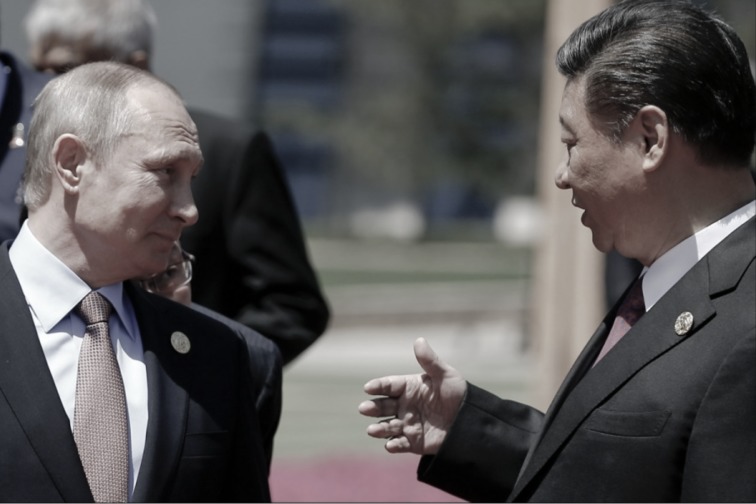
[People News] When U.S. President Trump visited Beijing in 2017, all members of the Chinese Communist Party (CCP) Politburo Standing Committee attended the welcoming banquet. However, nine years later, during Trump's return visit, four members of the Politburo Standing Committee were notably absent. This represents a significant change in the CCP's approach to hosting Trump this time around. Another key difference is that while Trump was invited into Zhongnanhai, the four Politburo Standing Committee members still did not appear. This raises questions: Is Trump unwilling to meet them, or are they reluctant to show up, or perhaps they are unable to attend? Trump's visit seems to reveal another layer of the internal power struggles within the CCP.
Trump Should Welcome a More Lively Scene
Following Trump's anticipated election in 2024, reports have surfaced indicating that his team wishes to bypass the CCP's diplomatic channels and engage directly with Zhongnanhai, even specifically mentioning a desire for direct communication with the Director of the General Office, Cai Qi. During the recent Xi-Trump meeting, Wang Yi appeared timid in the face of Cai Qi's fierce gaze, which further supports Trump's team's initial assessment.
The CCP Politburo or its expanded meetings convene once a month, while the Politburo Standing Committee meets irregularly; these gatherings are where the real decision-making takes place among the CCP's leadership. Trump's team has likely been aware of this for some time. If Trump were to visit Beijing and have the opportunity to meet all members of the Politburo Standing Committee again, it would not be seen as a negative outcome. Trump's team would probably welcome the chance to engage with these high-ranking officials at the welcoming banquet, rather than interacting with a larger number of lower-ranking officials.
Trump is adept at and enjoys various social engagements, welcoming the attendance of all senior officials from the Chinese Communist Party (CCP) at banquets, which represents the highest level of reception by the CCP. He would likely appreciate an even more extravagant arrangement. Therefore, it is anticipated that the United States will not oppose the participation of other members of the CCP Politburo Standing Committee in the banquet, nor in the arrangements for meetings.
During the Xi-Trump meeting, Trump notably invited the executives of major American companies accompanying him into the venue, reflecting his preference for lively gatherings. If the United States had not rejected the appearance of the CCP Politburo Standing Committee members, it would indicate that the CCP itself had altered the previous arrangement of having all members of the Politburo Standing Committee present for the reception.
Has the CCP downgraded its reception of Trump?
Nine years ago, when Trump visited, the CCP sent Yang Jiechi, who was then a member of the Politburo and director of the Foreign Affairs Office, to the airport to welcome him. Nine years later, the CCP sent the Vice President of China to greet him, raising the rank of the welcoming official from vice-ministerial to ministerial level.
Han Zheng is a retired member of the CCP Politburo Standing Committee. Nine years ago, at the 19th National Congress of the CCP in October 2017, Han Zheng was promoted to the Politburo Standing Committee and made his first appearance in that role on October 25. Two weeks later, when Trump visited, Han Zheng, along with other newly appointed and recently retired members of the Politburo Standing Committee, attended the banquet welcoming Trump.
During the 19th National Congress of the Communist Party of China, Xi Jinping and Li Keqiang were re-elected as members of the Politburo Standing Committee. The new members include Li Zhanshu, Wang Yang, Wang Huning, Zhao Leji, and Han Zheng, while the outgoing members are Zhang Dejiang, Yu Zhengsheng, Liu Yunshan, Zhang Gaoli, and Wang Qishan. Although the 19th National Congress has completed the transition of the Politburo and its Standing Committee, the reshuffle of the Two Sessions has not yet been fully realised. Li Zhanshu has not yet taken over from Zhang Dejiang as Chairman of the National People's Congress; Wang Yang has not yet succeeded Yu Zhengsheng as Chairman of the Chinese People's Political Consultative Conference; and Han Zheng has not yet replaced Zhang Gaoli as First Vice Premier of the State Council. Consequently, all of these officials were present at the banquet welcoming Trump.
At that time, Li Keqiang also held a private meeting with Trump, accompanied by Foreign Minister Wang Yi. The current Premier, Li Qiang, appears to be at a disadvantage, as he was unable to have a private meeting with Trump and could only meet with the American entrepreneurs who accompanied Trump on his visit, while Xi Jinping took Trump to the Temple of Heaven. Li Qiang also attended the banquet welcoming Trump, but he lacked presence; the other four members of the Politburo Standing Committee were absent.
Nine years ago, Xi Jinping and Trump participated in a business meeting that included a larger gathering of Chinese and American entrepreneurs, with Wang Yang, who had not yet stepped down as Vice Premier, also in attendance. Now, nine years later, while Li Qiang met with American entrepreneurs, there was no arrangement for a larger gathering of Chinese and American business leaders; only a few entrepreneurs from mainland China attended the banquet welcoming Trump.
When comparing the standards of the Chinese Communist Party's (CCP) reception of Trump nine years ago, the absence of the Politburo Standing Committee members at the welcome dinner can be seen as a downgrade. However, Han Zheng's presence at the airport to greet Trump can be viewed as an upgrade, and the fact that Trump and his team were invited into Zhongnanhai for the first time also counts as an upgrade. The standards of the CCP's welcoming ceremony and the discussions between both parties are generally consistent. Last time, Xi Jinping accompanied Trump on a tour of the Forbidden City, while this time it was a tour of the Temple of Heaven, which is also quite similar. Overall, the reception standards of the CCP have not diminished and may even have improved.
Thus, the absence of the other four members of the CCP Politburo Standing Committee should not be interpreted as a deliberate attempt by the CCP to lower the reception standards. So, why did they not appear?
Is the CCP leader returning to the status of 'one supreme leader'?
The absence of the other four members of the CCP Politburo Standing Committee raises the question of whether Xi Jinping did not permit them to appear, or if they themselves were unwilling to show up.
If Xi Jinping indeed did not allow the other Politburo members to meet Trump, it would suggest that he is returning to the status of 'one supreme leader.' However, if Xi Jinping truly wishes to regain significant power, he should ideally require all other Politburo members to be present, but only allow them to listen to his commands without speaking out, to publicly demonstrate that his status remains unchanged.
Xi Jinping likely also wants to take this opportunity to show Trump that he still firmly controls the highest power within the CCP, that no one can challenge him, and that he is still surrounded by numerous high-ranking CCP officials, with everything under his control, to demonstrate that he possesses the strength to stand on equal footing with Trump. If it is indeed Xi Jinping who did not allow the other Standing Committee members to be present, it may also indicate his concern about not being able to fully control the situation, thus raising doubts about the stability of his power.
During Trump's one-and-a-half-day visit, Xi Jinping intentionally wore height-increasing shoes and sat on a height-increasing cushion to minimise the height difference between himself and Trump, striving to maintain eye contact with him, which revealed his underlying insecurity.
Messages shared by Trump on social media, along with responses from his cabinet members during media interviews, suggest that Trump and his team are pleased with the Beijing trip. They likely secured more verbal commitments from Xi Jinping, including promises to purchase more American goods and assurances against chaotic restrictions on rare earth exports.
While the Chinese Communist Party (CCP) statement emphasised Xi Jinping's tough stance on Taiwan, it is largely viewed as an attempt by the CCP leader to mask the reality of conceding to the U.S. on this issue. Xi Jinping's so-called tough rhetoric regarding Taiwan can also be interpreted as the CCP's fear of a military 'conflict' with the U.S., especially given the current disarray and weakness of the CCP's military.
In other words, the CCP leader's seemingly threatening remarks about Taiwan may actually stem from his own fear of retaliation. Xi Jinping stressed the importance of 'stability' in Sino-U.S. relations. Following this, CCP state media and the Ministry of Foreign Affairs have repeatedly asserted that Sino-U.S. relations are 'stable.'
Despite the CCP's efforts to portray the CCP leader and the U.S. president as being 'on equal footing,' senior officials within the CCP understand that during Trump's visit, the CCP was compelled to make concessions once again due to internal and external pressures, and this occurred right at their own doorstep.
On May 14, the day of the Xi-Trump meeting, Xinhua News Agency reported that the Ministry of Commerce stated, 'China is willing to work with the U.S. to continuously expand the cooperation list.' This announcement followed recent economic and trade consultations held in Seoul, indicating that China is eager to 'continuously expand the cooperation list' with the U.S. This tone clearly reflects a willingness to engage rather than a fear of confrontation.
The earlier miscalculations in U.S.-China relations can be attributed to the Chinese Communist Party (CCP) leader, with Wang Yi emphasising that Xi Jinping has been 'personally involved' in these matters. Now, the CCP leader must deal with the fallout himself, as other members of the Politburo Standing Committee are likely reluctant to take the blame.
Is there a reluctance to take the blame for going too far?
Typically, when foreign heads of state visit, the CCP leader, the Premier of the State Council, and the Chairman of the Standing Committee of the National People's Congress would each hold separate meetings with them. However, Trump is a different case; the less influential Li Qiang cannot meet Trump alone as Li Keqiang did, and Trump may not be interested in meeting the relatively powerless Li Qiang either.
Zhao Leji also did not manage to meet Trump alone. However, he made a rather conspicuous move. On May 15, as Trump concluded his visit and departed Beijing, Xinhua reported that Zhao Leji was conducting research in Guizhou from May 13 to 15. This indicates that while Trump was visiting, Zhao Leji had left Beijing, which appears to be a deliberate attempt to avoid the meeting.
Knowing that an important guest was arriving, Zhao Leji chose to be absent, which is clearly impolite. Zhao Leji and Trump are not unfamiliar with each other; nine years ago, when Zhao Leji was newly promoted to the Politburo Standing Committee, he attended a welcome dinner for Trump. Now, nine years later, as Trump visits again, Zhao Leji seems to have intentionally left Beijing to avoid any association with him.
This situation is likely not orchestrated by Xi Jinping but rather reflects Zhao Leji's own intentions. The most plausible explanation is that the Chinese Communist Party (CCP) is making significant concessions to Trump right at their doorstep, a burden too heavy for Zhao Leji to sidestep.
While Li Qiang attended the welcome dinner for Trump on May 14, he convened a State Council executive meeting at the same time Trump was invited into Zhongnanhai on May 15. Xi Jinping was in the southern courtyard of Zhongnanhai, while Li Qiang was in the northern courtyard. Despite knowing that Trump was at Zhongnanhai, Li Qiang chose not to appear. This was also seen as a breach of etiquette; Li Qiang could only use the State Council executive meeting as a makeshift excuse. His underlying message was that he had official duties, and even with Trump present at Zhongnanhai, he could not step away to meet or bid farewell.
Wang Huning, Ding Xuexiang, and Li Xi may have all used the excuse of being busy to arrange their own matters, and it remains unclear whether they were actually in Zhongnanhai. Regardless, they acted as if Trump had not arrived, and none of them made an appearance. Wang Huning and Ding Xuexiang had met Trump nine years ago; at that time, Ding Xuexiang had just been promoted from director of Xi's office to director of the General Office and should have been responsible for the arrangements to receive Trump. They were aware of Trump's visit to Zhongnanhai but still chose to ignore it.
During the welcome dinner on May 14, both Xi Jinping and Trump referred to the visit as 'historic'; however, other members of the CCP's Politburo Standing Committee did not attend to show their support. Cai Qi (Cai Qi), as the director of the General Office, had to remain by Xi Jinping's side; Li Qiang did so reluctantly, while the others appeared to have intentionally avoided the event.
The Communist Party of China (CPC) is likely strategising about the upcoming leadership transition. Trump's visit and the public appearances of the Politburo Standing Committee members should generally be viewed positively; however, given Trump's challenging demeanour, the CPC finds itself in a position where it can only 'sell out the country for glory' right at its doorstep. It would be wise to distance themselves from this situation, allowing the CPC leader and his close allies to bear the consequences themselves.
Public Sentiment
The CPC leader is increasingly isolated due to his ongoing struggles and must now deal with the fallout from failed diplomatic efforts with the United States alone. In an attempt to salvage some dignity, he is promoting the 'head of state diplomacy' with Trump once again. By accompanying Trump to the Temple of Heaven, he may hope to draw some imperial prestige from this historic site, but this is unlikely to yield any real benefits.
During Trump's visit to Beijing, large crowds gathered wherever he stayed and wherever his motorcade travelled. It is clear that these individuals were not pre-arranged actors by the CPC, but rather came out of their own volition. Their expressions ranged from curiosity to outright joy. The presence of U.S. President Trump seems to have introduced a sense of relief into the otherwise oppressive and dull political atmosphere in Beijing.
While many may struggle to articulate their curiosity and admiration for the United States and the Western world, and find it even more difficult to express their desires for democracy and freedom, the crowds gathering indicate a strong yearning for change. Such scenes should undoubtedly cause alarm and concern for the CPC.
Senior officials of the Chinese Communist Party (CCP) recently conducted field research, necessitating the arrangement of crowd actors to show support and take photographs. While the CCP's propaganda has long portrayed the United States in a negative light, the spontaneous turnout of the public to witness the visit of the U.S. President inadvertently created a scene of enthusiastic welcome. This situation starkly reveals the CCP regime's complete loss of public support.
The CCP leader has caused numerous deep rifts within the party. The metaphorical 'red boat' has already been breached, and Trump's visit has once again exposed the true nature of the CCP regime. The Red Dynasty appears to be on the brink of collapse, seemingly just a spark away from igniting.
--Dajiyuan
△



News magazine bootstrap themes!
I like this themes, fast loading and look profesional
Thank you Carlos!
You're welcome!
Please support me with give positive rating!
Yes Sure!