

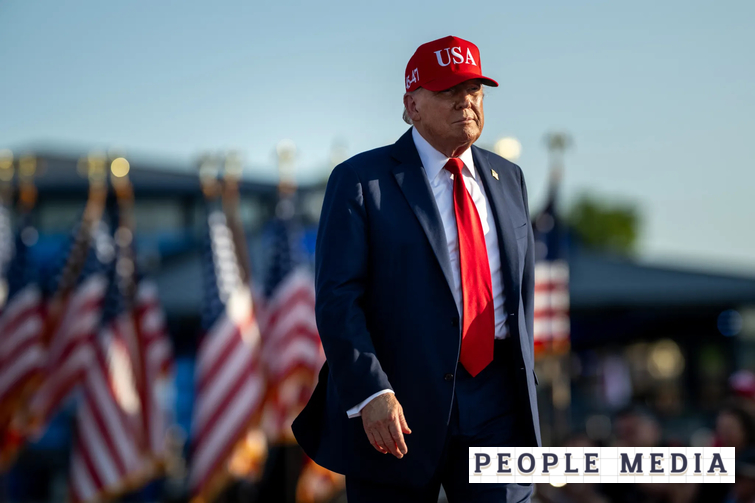
U.S. President Donald Trump. (Photo by Chip Somodevilla/Getty Images)
[People News] U.S. President Donald Trump arrived at Beijing Capital International Airport on the evening of May 13, marking the start of his state visit. The welcome ceremony organised for Trump in Beijing is widely perceived as being of a high calibre, reflecting the characteristics of a 'state visit' and a 'major power summit'.
Trump's Bold Move, Xi Jinping's Soft Approach
According to available footage and media reports, the Chinese Communist Party arranged several high-profile welcome events for Trump’s arrival at Beijing Capital Airport, which included: a red carpet laid out at the airport; a personal greeting from Chinese Vice President Han Zheng; a military honor guard and military band in attendance; and approximately 300 Chinese students waving the flags of both China and the United States while chanting 'Welcome, welcome, warmly welcome'...
On the morning of May 14, Xi Jinping conducted a formal welcome ceremony at the square outside the East Gate of the Great Hall of the People in Beijing, where both sides reviewed the honour guard.
The Chinese side also organised a state banquet and high-level discussions, with several prominent Chinese and American officials and business leaders present.
Beijing's lavish reception of Trump sharply contrasts with the long-standing narrative promoted by the Chinese Communist Party regarding the 'rise of the East and decline of the West' and the 'theory of American decline'.
In reaction, some Chinese commentators wryly noted: 'They criticise the U.S. daily, yet their actions reveal a different truth.'
Writer Yan Zeya highlighted that Beijing's warm welcome for Trump sharply contrasts with the cold reception Obama received during his visit to China, where no red carpet was laid out as he disembarked from the plane. This 'warm' versus 'cold' attitude illustrates the idea that 'if you treat China (the CCP) politely, they will respond with indifference; but if you act tough (by initiating a trade war), China (the CCP) will roll out the red carpet for you.'
Additionally, some netizens and media outlets have criticised the reception's style as reminiscent of North Korea, particularly the cheerleader-like welcome, which has been described as having a 'North Korean visual feel,' and comments like 'not being local will lead to death,' and 'what era are we in to still be doing this?' have surfaced.
In the face of multiple crises, Beijing is clinging tightly to the American tree.
The reason for Beijing's enthusiastic reception of Trump is closely tied to the various crises it is currently confronting, including a severe and ongoing economic downturn, long-term stagnation in the real estate market, deteriorating local finances, a continuous outflow of foreign capital, persistently high youth unemployment rates, slowing export growth, and a lack of confidence among private enterprises. Despite official propaganda repeatedly promoting 'self-reliance and controllability,' the CCP understands that the United States remains the central force in the global financial, technological, and consumer markets. The declining Chinese economy still heavily depends on the American market, the dollar system, and Western technology. Therefore, Beijing has no choice but to embrace the United States, improve Sino-American relations, and at least avoid a complete decoupling, in order to stabilise its sluggish economy and bolster foreign investment confidence.
When it comes to making money versus saving lives, which is more important?
Beijing organised a grand and lively ceremony to welcome Trump, seizing the opportunity to convey to the outside world that 'China still welcomes American and international capital.' This move likely reflects various considerations, including a desire to alleviate the tense atmosphere created by national security agencies' ongoing focus on 'catching spies' in recent years.
According to a report by Radio Free Asia, the 'China Business Environment Survey Report' released by the American Chamber of Commerce in China on February 1, 2024, indicates that among American companies investing in China, while 77% do not plan to relocate their production and procurement lines out of the country, more than 40% reported having no current plans to increase their investments in China. Furthermore, 57% of these companies expressed a lack of confidence in the Chinese government's commitment to market openness. The primary concern for these companies is the 'growing tension in U.S.-China relations,' followed by uncertainties in Chinese law and rising labour costs. Additionally, some technology and R&D firms view China's 'Cybersecurity Law' as a significant challenge for investment. Other factors, such as geopolitical issues, the reluctance of talent to relocate to China, and the slowdown of the Chinese economy, are also impacting American companies' ability to recruit foreign talent.
The revised "Anti-Espionage Law" of the Chinese Communist Party (CCP), which came into effect on July 1, 2023, broadens the definition of "espionage activities." This indicates that despite the CCP's financial struggles, there is a fundamental lack of trust in foreign businesses, exposing a pronounced "hostile" attitude. Consequently, activities that would typically be regarded as normal business investigations, macroeconomic analyses, or market research could be interpreted by CCP authorities as illegal attempts to acquire state secrets or security intelligence. In recent years, the CCP government has conducted a series of searches and arrests targeting foreign companies, and the heightened tension promoted by the CCP media's extensive focus on "anti-espionage" has further contributed to a sense of insecurity among foreign investors.
In July 2023, the U.S. National Counterintelligence and Security Centre (NCSC) released a statement highlighting that the ambiguities within the new "Anti-Espionage Law" imply that "any document, data, material, or item" could be deemed related to China's national security, thereby placing journalists, scholars, and researchers at risk.
While investing in China can be lucrative, when it comes to choosing between making money and ensuring personal safety, which is more critical? In this context, American businessmen appear to maintain a clear perspective.
(Originally published in People News) △






News magazine bootstrap themes!
I like this themes, fast loading and look profesional
Thank you Carlos!
You're welcome!
Please support me with give positive rating!
Yes Sure!