
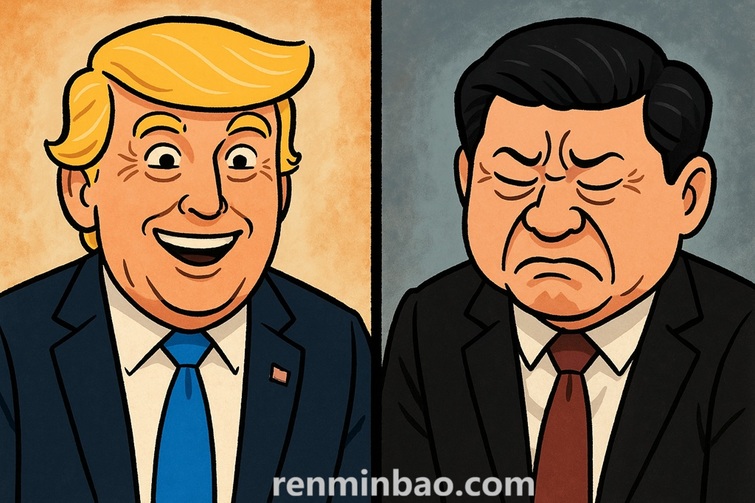
Thinking about taking action against Taiwan? Trump: You are free to think about it, but what are you actually going to do? (People News/AI-generated image)
[People News] Trump has returned to China after nine years, drawing significant global attention. Xi Jinping hopes to use this summit to highlight his authority, presenting the meeting as a personal display of power, and employing a strong sense of ceremony to obscure Beijing's various political anxieties. However, the reality diverged from expectations, as numerous details indicated that this carefully orchestrated grand event by Zhongnanhai was rife with power manoeuvres and dark humour.
Prime Minister's Absence in the Welcoming Party, Li Qiang Deliberately 'Low-Key'
At this China-U.S. summit, prominent figures from the Trump administration, tech giants, and business leaders were all present. Economic and trade issues were the primary focus of the discussions. According to diplomatic protocol, Chinese Premier Li Qiang should have taken a prominent role in the welcoming party at the Great Hall of the People, showcasing a 'full welcome' from the Chinese side. However, this time, the welcoming at the airport was handled by Vice President Han Zheng, while Xi Jinping dominated the scene in front of the Great Hall of the People. Trump shook hands with members of the Chinese delegation, including Cai Qi, Wang Yi, and He Lifeng, but Li Qiang was conspicuously absent; it appeared he was intentionally kept low-key.
During the key welcoming events on the morning of the 14th, which included bilateral talks, a visit to the Temple of Heaven, and a dinner, Li Qiang was not present. He only made an appearance on the afternoon of May 14, when he met with nearly 20 American business leaders who accompanied Trump on his visit to China at the Great Hall of the People.
This arrangement is clearly not a mere oversight, but rather a carefully calculated strategic absence of Li Qiang by Xi Jinping. Xi Jinping aims to dominate the spotlight of 'head of state diplomacy' and will not allow any potential competitors to overshadow him. As Premier, Li Qiang is relatively pragmatic in economic matters; if he were to make a high-profile appearance in front of Trump, it would detract from Xi's image as the core leader who has the final say. Additionally, there are concerns that this could create the impression that Beijing is pleading with Trump.
The Cold Stone Faces of Hegseth and Miller
In front of the Great Hall of the People, the hardline U.S. Secretary of Defence Hegseth and policy tough guy Stephen Miller displayed expressions during their handshake with Xi Jinping that quickly became iconic online. Both men wore expressionless faces and had cold gazes, likely filled with disdain for Xi Jinping. Meanwhile, Xi Jinping struggled to maintain a diplomatic smile that seemed friendly, but in front of these freedom fighters, he appeared like a dictator exposed in the open—timid yet trying to maintain a facade of confidence.
This situation resembles an internal struggle, more like a silent dismantling of the stage. The Chinese Communist Party intended to showcase its home-field advantage and the host's authority, but these handshake moments broadcasted globally ended up becoming a diplomatic embarrassment for Xi Jinping.
Diplomacy on Elevator Shoes and the Short Translator: The Ultimate Display of Image Anxiety
Xi Jinping's official height is approximately 178 cm, while Trump stands close to 190 cm, making the height difference quite apparent when they stand together. However, in the current video, Xi Jinping's image suddenly appears 'tall.' Height-increasing insoles, carefully crafted postures, and specific shooting angles, along with the long-standing leader shots and optimised perspectives from CCTV, cannot escape the discerning eyes of netizens.
Dictatorial leaders must maintain a visual dominance, suppressing any elements that could undermine their presence. Consequently, under high-definition cameras, these minor tactics have turned into the biggest punchlines on the internet. Trump's natural height advantage, coupled with his relaxed and casual body language, positions him as a towering dealmaker, while no matter how much Xi Jinping (Xi Jinping) attempts to 'boost his own growth,' he can only manage to 'look him in the eye' with difficulty. This situation highlights Xi Jinping's profound feelings of inferiority and anxiety.
Interestingly, the translators assigned to Xi Jinping by the Chinese Communist Party are notably short, likely needing to stand on tiptoes to whisper in the leaders' ears. This is likely a talent meticulously chosen by Cai Qi to ensure Xi Jinping's sense of security and superiority in height, making them almost invisible to the camera.
Why is Peng Liyuan absent from the spotlight?
The diplomatic role of First Lady Peng Liyuan is a significant aspect of Xi Jinping's personal display of power. However, during the state banquet and welcome event for the Trump-Xi meeting, she was largely invisible. There are no images of Peng Liyuan in news photos or on-site videos, which sharply contrasts with her prominent appearance during Trump's visit to China in 2017.
On the one hand, this absence is due to the fact that the First Lady of the United States did not attend. More importantly, it may reflect Xi Jinping's personal political calculations. Trump's entourage consists of cabinet members and business leaders, and the discussions between China and the U.S. focus on critical economic and geopolitical issues. If Xi Jinping were to emphasise his partnership with his wife at this moment, it would seem somewhat inappropriate, and the optics of clinging to power would be rather unseemly.
Trump reveals that Xi Jinping relies on 'American funding to attend college.'
During the banquet on the evening of the 14th, the highlight came when Trump remarked, "The United States helped establish Tsinghua University—Chairman Xi Jinping's alma mater." This statement seemed to reflect on the historical friendship between China and the U.S., while also subtly mocking the Chinese Communist Party (CCP). The underlying message was that Xi Jinping and his generation of CCP elites have significantly benefited from the historical investments and educational resources provided by the United States, yet they now stand against America.
Tsinghua University originated from Tsinghua School, which was established in 1911 using part of the Boxer Indemnity returned by the United States, with the goal of training Chinese students to study in America. This action by the U.S. was driven by both diplomatic considerations and a long-term strategy for influence. Trump's humorous reference to this historical context directly targeted a weak point in the CCP's narrative: Xi Jinping, you too were raised on American resources, yet you now choose to forget your origins and oppose the U.S.
Trump then cleverly invited Xi Jinping and his wife to visit the U.S. on September 14, showcasing his skills as a dealmaker. While it appeared to be a gesture of goodwill towards Xi Jinping, it actually allowed Trump to maintain control of the situation, strategically positioning the U.S. to secure another significant deal with the CCP, while also enhancing his prospects ahead of the midterm elections in November.
Absurd Collision: The CCP's Image Campaign and Trump's Pragmatic Deal-Making
These moments collectively create a vivid and absurd alternative portrayal of a summit between world leaders. The CCP went all out to host Trump's team, with 21-gun salutes, red carpets, honour guards, and extravagant banquets, showcasing their confidence in being on equal footing with the world. In contrast, Trump, accompanied by a group of hawks and businessmen, effortlessly applied tangible pressure.
The meeting between the heads of state highlights the structural conflicts and dilemmas between China and the United States. Both sides have a pressing need for short-term stability in their relationship, yet they remain irreconcilable on key issues such as Taiwan, technological decoupling, and competition for global influence. The Chinese Communist Party excels at transforming diplomacy into a political image campaign and a grand spectacle, but when confronted with an unconventional political opponent like Trump, the situation becomes absurd, alarming, and uncontrollable. It is unlikely that this high-profile summit will yield any groundbreaking agreements; at best, it may result in an extension of the trade truce, some procurement deals, and limited cooperation. Notably, Xi Jinping has crafted a so-called new positioning for Sino-U.S. relations specifically for Trump, suggesting, albeit vaguely, that over the next three years or even longer, a constructive and strategically stable relationship will be established between China and the U.S. Is this an implicit concession to Trump? What does 'over the next three years' imply? Isn't this merely a tribute designed for Trump 2.0?!
It appears that Xi Jinping is genuinely intimidated by Trump; during Trump's presidency, no matter how much courage he borrowed, he refrained from taking action on Taiwan.
(First published by People News) △





News magazine bootstrap themes!
I like this themes, fast loading and look profesional
Thank you Carlos!
You're welcome!
Please support me with give positive rating!
Yes Sure!